
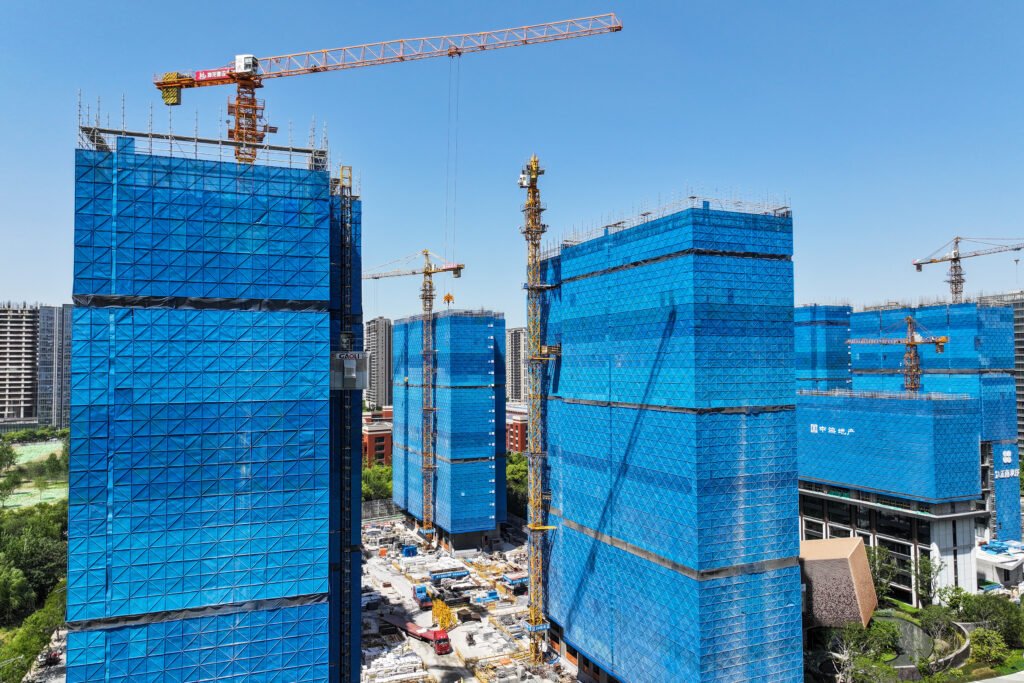
Whether looking back or looking forward, China faces two significant challenges that shaped its economy in 2025 and will continue to do so in 2026 — the US–China trade war and China’s ongoing property bust that began in 2021. China also faces a structural growth challenge as it tries to sustain high growth while being an upper-middle-income country. These challenges are likely to buffet China’s growth in 2026.
In its World Economic Outlook, the International Monetary Fund highlights challenges in China’s real estate sector as investment continues to contract. Together with infrastructure, real estate accounts for over 31 per cent of GDP. The woes of this sizeable sector have contributed to the slowing of the economy not only through investment, but also through consumption.
Property is the largest component of household wealth, accounting for 65 per cent of total assets. The slump in property prices has contributed to a negative wealth effect where Chinese households do not feel better off, dampening their confidence and consumption.
Due to weak domestic demand amid the property bust, China has relied more on trade, exporting more and importing less. Its 2025 trade surplus was a record, exceeding US$1 trillion. This occurred despite higher levels of tariffs imposed or threatened by the United States, which have added to costs and uncertainty.
The possible diversion of Chinese exports from the US market has led other countries, including those in Europe, to become concerned about a surge of cheap Chinese imports. Others have begun following the United States in imposing restrictions on Chinese trade, such as removing the tariff exemption for low-value or de minimis imports.
Looking ahead in 2026, there is unlikely to be much relief from US tariffs. China has, in turn, imposed its own tariffs and restricted exports of critical minerals, a potential chokepoint in global value chains for the production of electronic goods. This tit-for-tat trade uncertainty is likely to be a feature of world trade in 2026 and dampen global growth at a time when China also faces a slow recovery from its property bust.
Five years after the property bust began in 2021, China still has not wholly stabilised the property sector. The International Monetary Fund warns that a prolonged resolution of the crisis is likely to result in a weaker recovery for the economy, as seen in Japan after its real estate bubble burst in the early 1990s. Japan’s ‘lost decades’ of economic growth are a lesson for China — it needs to move faster to resolve the loss-making property companies and restructure the balance sheets of lenders exposed to the real estate sector.
A strong recovery does not appear likely for the real estate sector in 2026, which will continue to drag on Chinese growth at a geopolitically challenging time.
As China is an upper-middle income country, it faces the challenge of sustaining a high growth rate as economies typically slow as they approach higher-income levels. The World Bank argues that China’s strong growth has been based on investment and export-oriented manufacturing — an approach that has largely reached its limits. This has led to economic, social and environmental imbalances which will require a shift from manufacturing to high value services, from investment to consumption and from high to low carbon intensity.
The property bust impedes the move to more consumption and, alongside the US trade war, has led China to increase its focus on exports. Together, these challenges will make it more difficult for China to grow in 2026. Yet Beijing’s significant investment, including in research and development, artificial intelligence and renewables, will continue to support growth by increasing overall productivity. The success of these efforts will likely be determined by a range of factors, including government policies implemented in 2026, the first year of China’s 15th Five Year Plan.
China has grown steadily, but its structural slowdown is coming at a time when it is contending with the aftermath of a property bust and heightened trade tensions. These challenges are likely to be significant factors in China’s economic outlook for 2026.
Dr Linda Yueh is Fellow in Economics at St Edmund Hall, Oxford University, and Adjunct Professor of Economics at London Business School. Her books include The Great Economists: How Their Ideas Can Help Us Today (Penguin Random House, 2018) and The Great Crashes: Lessons from Global Meltdowns and How To Prevent Them (Penguin Random House, 2023).
This article is part of an EAF special feature series on 2025 in review and the year ahead.