
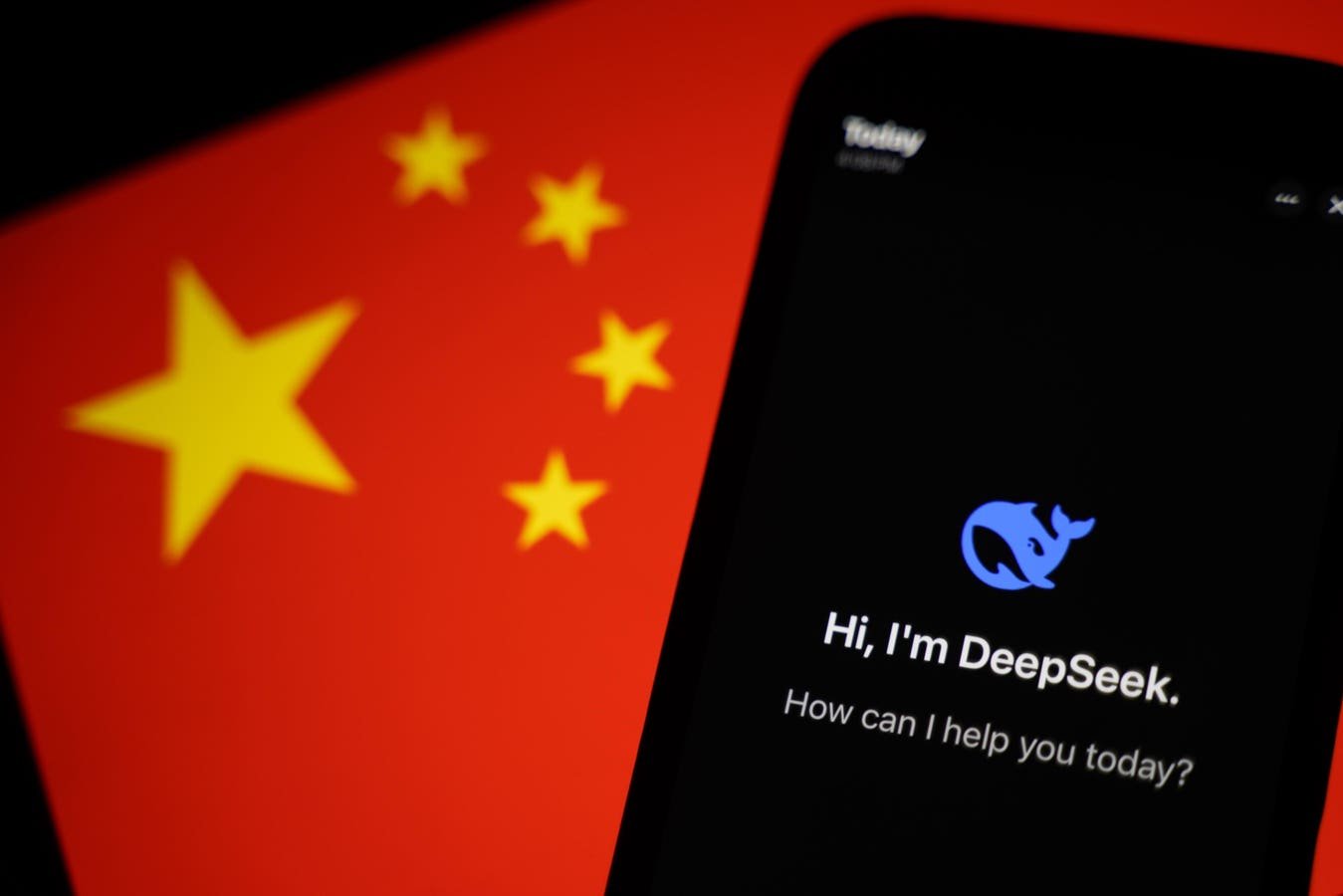
The DeepSeek app seen on a phone in front of a flag of China.
Anthony Kwan/Getty Images
The economic hardware/software debate about China just got more complicated.
Before DeepSeek flipped the script on the artificial intelligence game, many economists worried China had way too much of the former and not enough of the latter.
Years of building low-vacancy skyscrapers, six-lane highways, white-elephant stadiums and apartment complexes that developers can’t complete left China with dueling crises in property and local-government finances. Yet the economic software — innovation that generates major disruption — has too often lagged the nation’s infrastructure boom.
Enter startup DeepSeek to turn the conventional wisdom on its head. The success of its cost-effective AI model using less advanced chips rocked the tech world. The wild plunge in Nvidia’s shares alone — its market cap was down nearly $600 billion — demonstrated how intensely investors now question America’s plans for tech dominance.
That has minds in Silicon Valley racing to the next potential great leap forward: China Inc.’s chances of producing its own game-changing chips. Joe Biden spent much of his 2021-2025 presidency trying to halt China’s ambitions in semiconductors and AI. Here’s China letting the world know it’s emerged more unscathed than most thought possible.
DeepSeek may be a complete aberration. But the odds it’s a one-off seem rather low considering how much time, money and political capital Chinese leader Xi Jinping spent raising the nation’s tech game. Along with AI and chips, priorities include electric vehicles, renewable energy, robotics, biotechnology, aviation, high-speed rail and high-quality infrastructure.
China’s success in EVs has Japan Inc. icons Honda and Nissan racing to join forces in ways few saw coming. Last year, Elon Musk called on Washington to take action against Chinese EV companies. That was in response to Warren Buffett-back BYD, which makes cheaper EVs, topping Tesla in sales.
“Frankly,” Musk said in January 2024, “I think, if there are not trade barriers established, they will pretty much demolish most other companies in the world.”
Musk has since tried to walk back that plea. But the man, like Trump, has been known to change his mind from time to time, so who really knows?
Yet for all China’s infrastructure development success, there’s one part of its hardware that needs some serious work: the shaky economy on which it rests.
It’s grand that Xi’s “Made in China 2025” project is gaining some traction — and getting big headlines for it. But China enters 2025 with very serious pre-existing conditions, particularly a massive property reckoning that’s devastating confidence in Asia’s biggest economy.
China is suffering its longest deflationary streak since the 1997 Asian crisis. It’s exacerbating China’s weak consumption problem. It’s also colliding with the crushing debt loads facing local governments throughout the nation. Those trillions-of-dollars of IOUs, many of them the off-balance-sheet kind, are limiting municipalities’ ability to develop local industry and invest in human capital to cultivate the next wave of DeepSeek-like startups.
Chinese youth unemployment, meanwhile, is near record highs at a moment when the population is aging rapidly. Such scenarios are inherently deflationary. Folks in their 20s tend to spend a lot more actively than those in their 70s. When twenty-somethings can find steady employment, that is.
Falling prices are making their own global headlines. Even worse, perhaps, they have economists buzzing about China succumbing to a Japan-like lost decade. They also have Wall Street debating if China is “uninvestable.”
Many of these problems are self-inflicted. Xi’s response to China’s property reckoning allowed the crisis to fester and deepen. Tokyo’s multi-decade funk was the result of slow-walking policies to end the 1990s bad-loan crisis.
Now, this same mistake is limiting the People’s Bank of China’s latitude to battle deflation.
If the PBOC were to cut interest rates significantly, the yuan could drop sharply. That would make it harder for giant property developers to keep up with payments on offshore debt, increasing default risks. It also might undermine confidence in the currency.
More assertive PBOC easing could set back years of work to reduce financial leverage. And enrage Donald Trump, virtually ensuring that the U.S. president moves ahead with his giant trade war.
Might the DeepSeek shock increase Trump’s determination to contain China? For one thing, Trump can’t be happy that China just stole his White House’s AI thunder.
It sure seems like a lifetime ago when Trump toasted a big AI push by OpenAI’s Sam Altman, SoftBank’s Masayoshi Son and Oracle’s Larry Ellison at the White House. That was on January 21. DeepSeek already makes that $500 billion Stargate AI infrastructure project seem like old hat.
Trying to predict what Trump World might do is a fool’s game. It’s hardly a reach, though, to think China suddenly becoming the toast of the AI universe might have Trump hitting Xi’s economy even harder. Odds are, Trump won’t like hearing tech bros cozying up to his White House calling DeepSeek a “Sputnik moment.”
Nor is it a reach to wonder if Tesla’s big earnings miss in the fourth quarter might have Musk lobbying Trump to tariff Chinese EVs, and fast.
Thing is, China’s economy isn’t in the best place to withstand the 60% tariffs Trump threatens. Economists at UBS think levies of that magnitude will cut China’s annual growth by more than half — shaving 2.5 percentage points off gross domestic product.
Amid such risks, it’s high time Xi ended the property crisis, strengthened capital markets, reduced the dominance of state-owned enterprises and incentivized households to save less and spend more.
News that China is very much in the AI race suggests Xi is having success moving up market. But without bold moves to build a more dynamic and productive economic system, China won’t get very far.