
Stay informed with free updates
Simply sign up to the Property sector myFT Digest — delivered directly to your inbox.
A Singaporean asset manager has hit upon a novel way to handle its Chinese property portfolio as global investors look for ways out of a slumping market.
CapitaLand, a property company part-owned by Singapore’s state investor Temasek, is using China’s nascent real estate investment trust market to flip assets in a move that advisers said other international businesses were likely to follow.
The strategy highlights an attractive trade: shifting stagnant Chinese property assets from a disillusioned global investor base to yield-hungry onshore buyers.
“We have very good assets, but we are struggling to ascertain what their fair value is,” said Andrew Lim, group chief operating officer at CapitaLand. “It’s very frustrating.”
Once a sought-after asset class, Chinese property is enduring a five-year slump driven by oversupply, falling prices and a liquidity crisis among developers.
CapitaLand — whose China portfolio includes offices, business parks and shopping centres — has been forced into a series of devaluations, including a writedown of S$545mn ($425mn) in its last financial year.

Its solution is to set up listed funds in China to which it can transfer the properties.
China launched its Reit industry in 2021. The dividend-focused funds are designed to provide stable cash flows, and in China’s low-interest-rate environment, they have been a hit with investors.
In total, 79 Chinese Reits have been launched, with an overall market capitalisation of more than Rmb200bn ($29bn). That compares with the more mature US market’s $1.6tn and Singapore’s $100bn.
“What began as a pilot programme has quickly developed into a mature, institutionally driven market,” said Chris Yang, head of the China Reit business at property company Cushman & Wakefield.
Although Chinese Reits were designed to resemble their Singaporean equivalents, there are certain local characteristics. Chinese regulators provide a suggested valuation of the Reit’s assets, which the fund manager is expected to factor in when it carries out its own assessment.
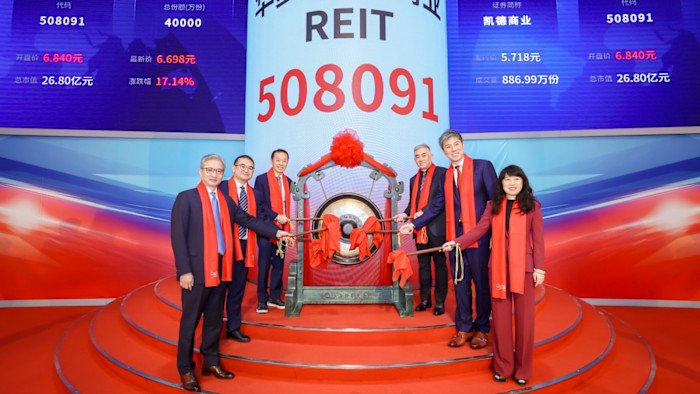
CapitaLand became the first international sponsor when it launched the CapitaLand Commercial C-Reit last September. Since the IPO, shares are up 15 per cent. It has filed for a second fund, which it plans to launch this year.
“We anticipate more global investors will follow CapitaLand’s lead,” said Yang. “The market is increasingly attractive to foreign sponsors.”
However, Sam Radwan, co-founder of Enhance International, a real estate consultancy with operations in greater China, said mainland Reits were “fraught with problems”.
“I don’t think they are being properly priced,” he said. “When I’m looking at the Reit market, there is nowhere near the data available to be able to price a Reit that I would have in a more mature market like the US or even Europe.”
In the US, said Radwan, investors had access to long-running property performance databases, debt market data and forecasts for capitalisation rates and rent growth, as well as public data from government agencies.
Lim said it was in Beijing’s interests to ensure its nascent Reit market continued to develop.
“Reits seek to produce a diversified, predictable, sleep-at-night stream of income for investors,” he said.
“I would say that is exactly what the Chinese investment market needs right now, as it weans itself off seeing real estate as a speculative investment.”