
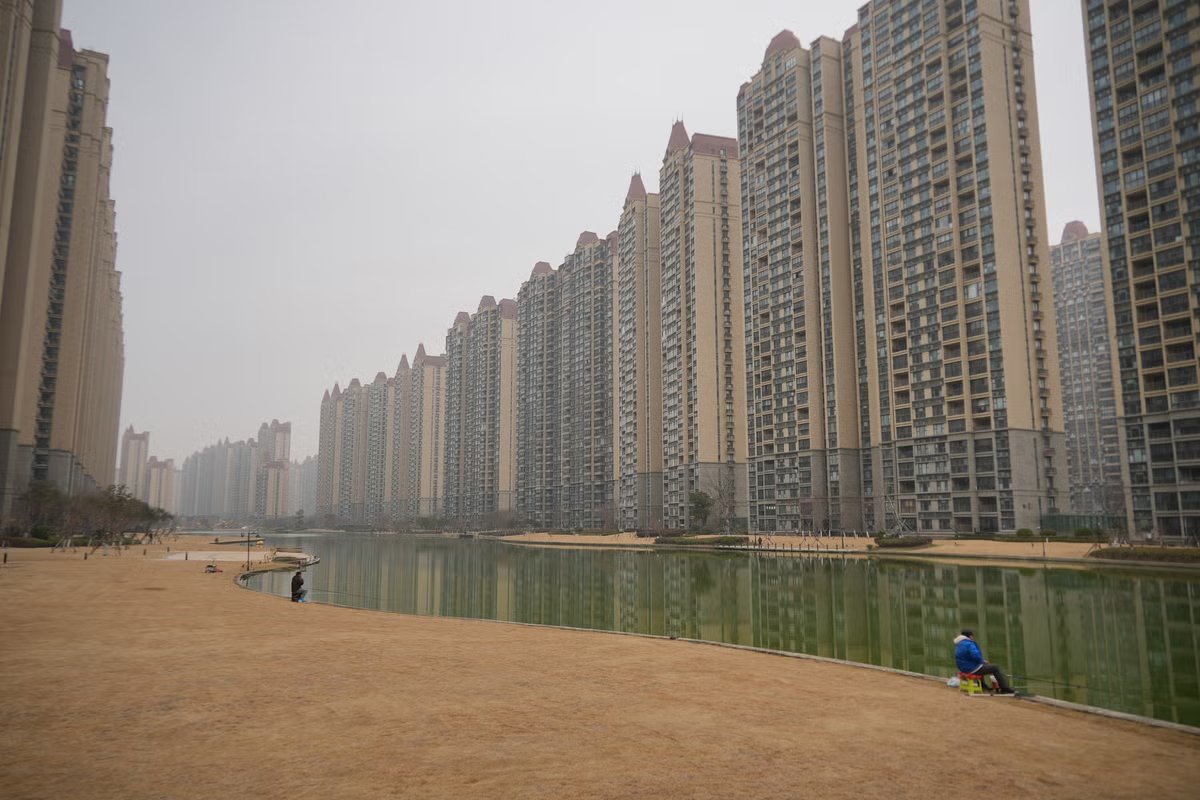
The “Life in Venice” housing development, a multibillion-dollar replica of the Italian city on the Chinese coast, stands silent. Many of the tens of thousands of homes are hollow husks of concrete and alabaster.
But in recent years the remote, partially abandoned complex has drawn unlikely new residents like Sasa Chen, a burned-out young Chinese woman who until recently worked a high-earning finance job in Shanghai, China’s bustling commerce hub.
The appeal?
Chen pays just 1200 RMB, or $168, a month for her apartment in faux Venice in the eastern Chinese province of Jiangsu. It’s so cheap that it’s allowed Chen to retire at the tender age of 28.
Experts say Chen is part of a broader trend that has seen a growing number of young people across China migrating to small towns and cities, taking advantage of cheap real estate prices that have been plummeting since the COVID pandemic.
It’s a stark reversal from previous generations that prized upward mobility. In decades past, China’s ascendent middle class flocked to booming megacities to chase jobs and dreams, once abundant as the country went from rags to riches. But as the once red-hot economy cooled, expectations have soared, opportunities have dwindled and competition has grown fierce.
Most large Chinese companies, especially high-paying tech firms, requires a work schedule of 9 a.m. to 9 p.m. from Monday to Saturday, a grueling lifestyle popularly known as the 996 culture. Under the intense pressure, some young professionals have called it quits altogether and joined a resistance movement called “ lying flat ” — shunning careers and capitalism for a “low-desire life.”
Some are redefining their dreams to focus on rest and relaxation, much like what some young adults in the West are doing under what they call FIRE: “Financial Independence, Retire Early.”
That’s much more achievable in China because the cost of living in some places can be so low compared to prices in the West.
Home prices at the massive “Life in Venice” development have more than halved since the downturn in China’s property market a few years ago, and a lunch of noodles or a rice dish costs under three dollars in the neighborhood’s restaurants.
The bargain prices have benefited young people like Chen willing to live in remote but affordable housing now available across the country. Chen describes it as the perfect life: a sea view, clean air, and cheap rent.
“I have all the time in the world, the freedom of doing whatever I want,” said Chen. “I am living the life that I want.”
The dream life
“Life in Venice” was envisioned in the early 2010s as a weekend resort for wealthy residents from nearby Shanghai, providing a luxurious yet peaceful life by the sea.
But demand for the vast complex’s 46,000 units cratered after China’s debt-fueled property market popped. The developer, real estate giant Evergrande, went bankrupt in 2024.
Today the site is a ghost town, with many villas just empty shells. Less than one in five apartments are occupied. Abandoned boats founder off its rundown pier and “For Sale” signs and empty storefronts line its streets. But a smattering of residents have moved in, some of them fishing in the development’s tranquil waters.
Chen used to work in a glossy high-rise in Shanghai, making up to 700,000 yuan ($98,480) a year at a large finance firm. But she had never liked the idea of working. After three years, she began plotting her escape from the drudgery of China’s white-collar workforce.
Her plan was to save up and find somewhere to live with rent so low she could live off returns on her investments.
Last year, her dream came true: Chen saved 2 million yuan ($290,000) and found a spacious apartment at “Life in Venice”. With such low rent, she calculates she can live there for the rest of her life without ever having to work again.
Though “Life in Venice” doesn’t have a branch of her favorite sour soup hotpot restaurant, door to door delivery, or proximity to major hospitals, her new residence has plenty of conveniences like a grocery store and eateries.
Chen used to dread the grind of her nine-to-six job, which she said “felt like marching to my own death.” Now, she wakes at 10 a.m. every day, filling her days with cooking, chilling, and long walks on the beach.
“I never believed that work is the meaning of life,” Chen said. “My ideal state of life is not to work and stay at places that I like.”
Quitting the rat race
Like Chen, scores of young Chinese people have left big cities.
While there’s no available data about how many have left the Chinese workforce in recent years, figures show that from 2019 to 2024, Beijing lost 1.6 million people in their twenties and early thirties — around the total population of Philadelphia — according to China’s capital statistic office.
“People are quitting this competition, this very clear, linear, upward career track,” said Xiang Biao, director of the Max Planck Institute for Social Anthropology in Germany. “It’s a broader trend.”
China’s economy has cooled in recent years, growing just 5% in 2025 — still higher than the U.S. and other rich countries, but a far cry from the double-digit growth the country saw in past decades.
As the economy slows, young Chinese are struggling to find jobs. As of December, 16.5% of 16-24 year-olds who aren’t in school were unemployed.
Some, like 29-year-old Ban Zhao, are rejecting the corporate rat race altogether.
Last summer, Ban moved from a bustling commercial city on China’s east coast to a small town in China’s southwestern Yunnan province. Tucked away in a lush valley, the town is famed for fresh, clean air and healing hot springs. There, for just 800 yuan a month ($110) Ban rents an apartment with three bedrooms, one of which she converted to a yoga studio.
She and her boyfriend work less than 20 hours a week, offering yoga classes online to make ends meet. The rest of the time, she walks around her scenic neighborhood surrounded by trees and blossoms, often enjoying the region’s famed sunshine.
“I can do whatever I want and not do whatever I don’t want,” Ban said. “I live in heaven.”
Apartments cheaper than cars
Some are flocking to places like Hegang, a cold and remote coal mining city in northeastern China famous for shockingly cheap housing prices. As resources dried up and mines closed, young people left, turning Hegang into a city with far more homes than people.
Apartments there are now cheaper than cars, making sales easy for realtor Yang Xuewei.
Yang has sold more than 100 bargain-priced apartments to clients across the country — and even to some foreigners who contacted Yang after watching his online virtual tours. A one-bedroom apartment can be bought for $3,000, and $13,000 can buy a roomy four-bedroom place.
“I don’t know about big cities, I never lived in one,” Yang said. “I can only say that living in Hegang is easy.”
Chen Zhiwu, a University of Hong Kong finance professor, said higher living costs and fewer job opportunities in bigger cities are driving people to move to cheaper places.
“It’s natural,” Chen said. “Young people are facing reality and thinking hard about their futures.”