

As summer winds down, many Americans experience a mix of emotions — saying goodbye to backyard barbecues, beach outings, camping trips, and rounds of golf, while welcoming cooler temperatures, the back-to-school season, and weekends filled with football. Similarly, the financial markets often shift gears in September, moving away from the quiet summer months marked by low trading volumes and limited volatility, and entering a period historically associated with seasonal weakness and increased market instability.
Of course, seasonal trends should always be viewed with caution — they reflect the broader market climate, not the current market conditions. To help frame the seasonal setup for September, here are five key takeaways on typical price action during the month:
September Is the Worst Month for Stocks: Over the last 75 years, the S&P 500 has posted an average return of -0.7% in September, making it the worst performing month for stocks. When September finished in the red, the average loss was -3.8%. This compares to the average gain of 3.2% when September was higher. Using the “you’re only as good as your last at bat” analogy, the S&P 500 has only finished higher on the month during one out of the last five years and generated an average decline of 1.4% over this period.
Fewer Than Half of September’s Returns Have Been Positive: Since 1950, the S&P 500 has only posted positive returns in September 44% of the time, marking the lowest positivity rate for any month across the calendar. February’s 54% positivity rate ranks as a distant second.
The Trend Is Your Friend When It Comes to September: As we alluded to earlier, seasonal data represents the typical climate for stocks but not the weather. And currently, the weather for the S&P 500 is filled with blue skies and record highs. When accounting for momentum and trend, which we believe is much-needed context, September doesn’t look so bad. For example, when the S&P 500 is above its 200-day moving average (dma) going into September, the average price return for the month jumps to 1.3%, with 60% of occurrences producing positive results. This compares to an average September price decline of 4.2% and positivity rate of only 15% when the index is below its 200-dma going into the month.
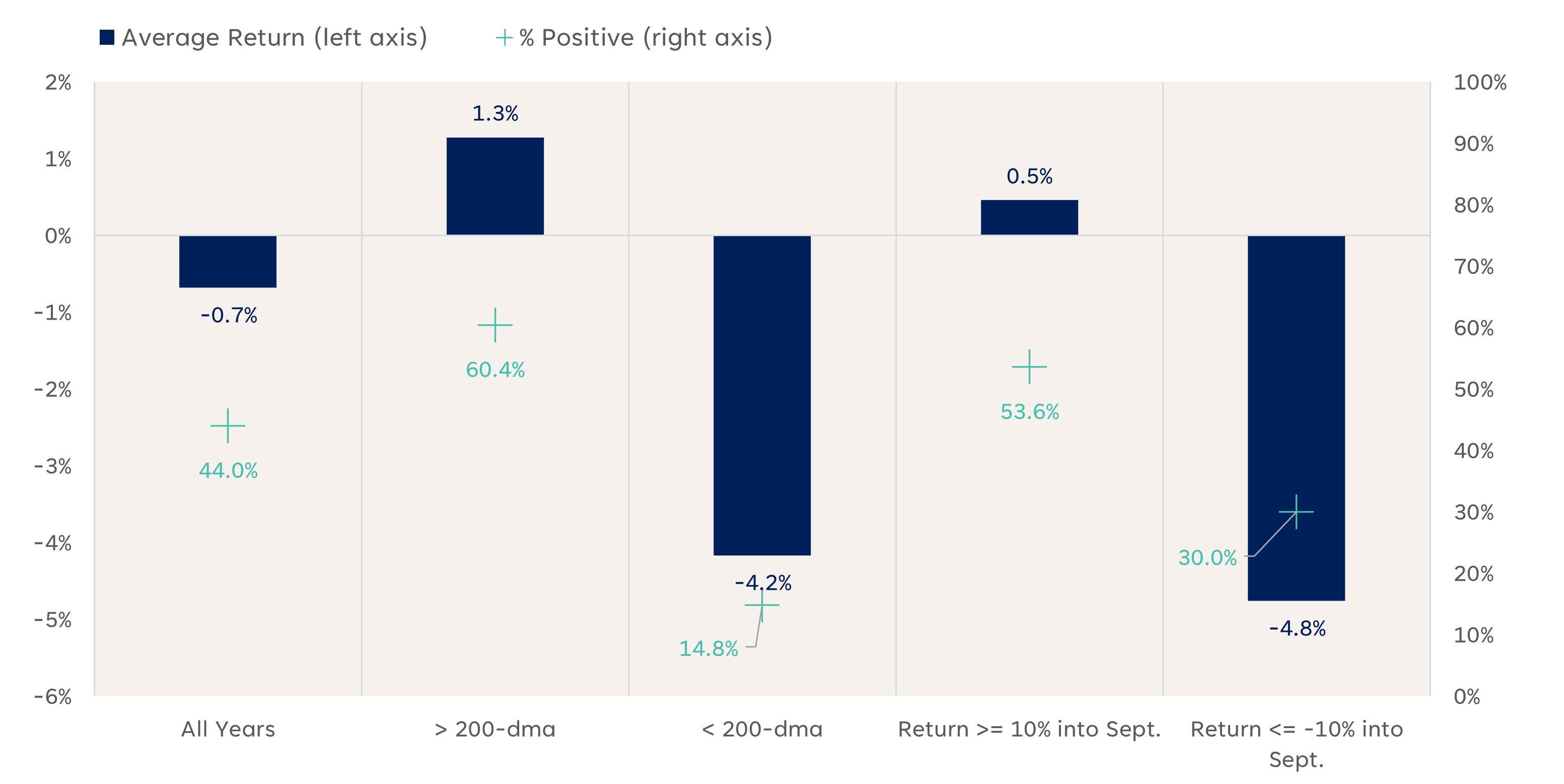
Source: LPL Research, Bloomberg 08/27/25
Implied Volatility Tends to Peak in September
Stocks finished at record highs yesterday, and the closed near year-to-date lows. Given the market-moving events of , this Friday’s Personal Consumption Expenditures () data, next week’s , and a highly anticipated Federal Open Market Committee () meeting in September, maybe this low-volatility backdrop represents the calm before the storm. As highlighted below, the VIX has historically advanced going into the fall, with a high-water mark for the year typically reached in late September or early October. Considering the relatively low starting point of the so-called fear gauge right now (spot VIX closed at 14.85 on August 27, for reference), we don’t think it is a bold call to suggest there is upside risk to the VIX, especially given the macro backdrop, looming event risk over the next month, and 98th percentile speculative short positions in futures.
Implied Volatility Tends to Ramp Up Into the Fall
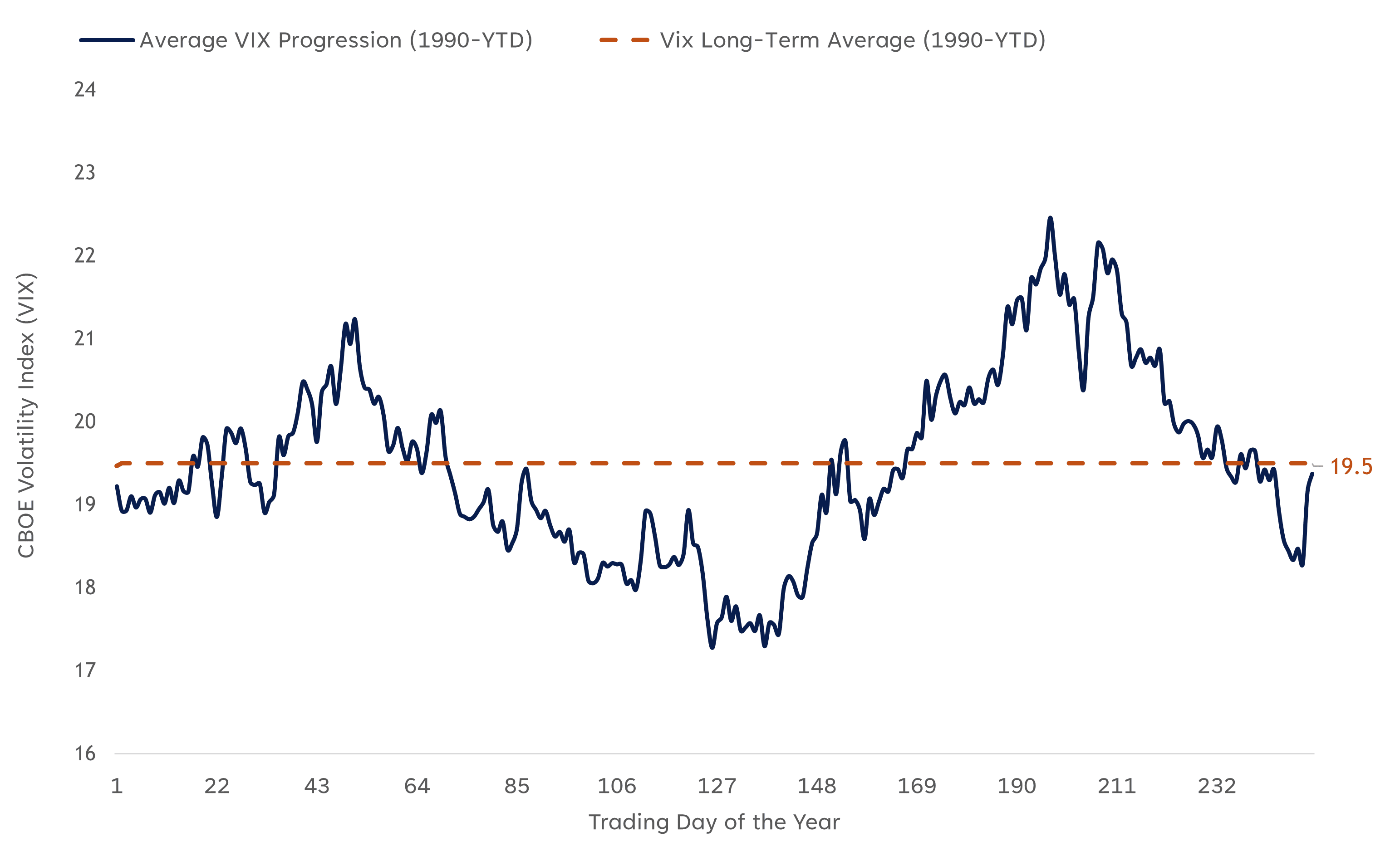
Source: LPL Research, Bloomberg 08/27/25
There Is a Silver Lining to September Weakness: As the saying goes, with volatility comes opportunity, and the October to December time frame has historically provided a steady stream of above-average returns in the equity market. Since 1950, the S&P 500 has generated an average annual gain of 4.2% and finished higher 80% of the time over this period. This impressive three-month return window comes in as a close second to the S&P 500’s average gain of 4.4% from November through January.
Summary
September could live up to its reputation of being turbulent for stocks. However, history has shown that when the broader market is trending higher into the month, seasonal weakness has not necessarily been a factor. Furthermore, if the market does suffer a drawdown, seasonal headwinds turn back into tailwinds in October. Finally, while seasonality may be an ancillary factor influencing market performance, other more powerful macroeconomic forces, such as the health of the overall economy and corporate America, ultimately drive future equity market performance.
***
Important Disclosures
This material is for general information only and is not intended to provide specific advice or recommendations for any individual. There is no assurance that the views or strategies discussed are suitable for all investors. To determine which investment(s) may be appropriate for you, please consult your financial professional prior to investing.
Investing involves risks including possible loss of principal. No investment strategy or risk management technique can guarantee return or eliminate risk.