

The market just drew a line in the sand: AI capex is no longer a free pass
When ’s stock plunged 12.3% on October 30th while surged 4.8% (despite both companies announcing aggressive capital expenditure increases), the market sent a clear message that should worry every investor with exposure to the AI infrastructure boom.
This was more than a tax charge. It was about the market finally demanding proof that massive AI spending will actually generate returns.
For two years, investors rewarded virtually any company promising to build AI infrastructure at scale. The formula was simple: announce bigger capex plans for AI data centers and chips, and watch your stock rise. That era appears to be ending. Meta’s collapse suggests we’ve entered what veteran investors recognize as the “discrimination phase” of a bubble cycle, where the market stops rewarding hype and starts punishing companies that can’t demonstrate clear paths to monetization.
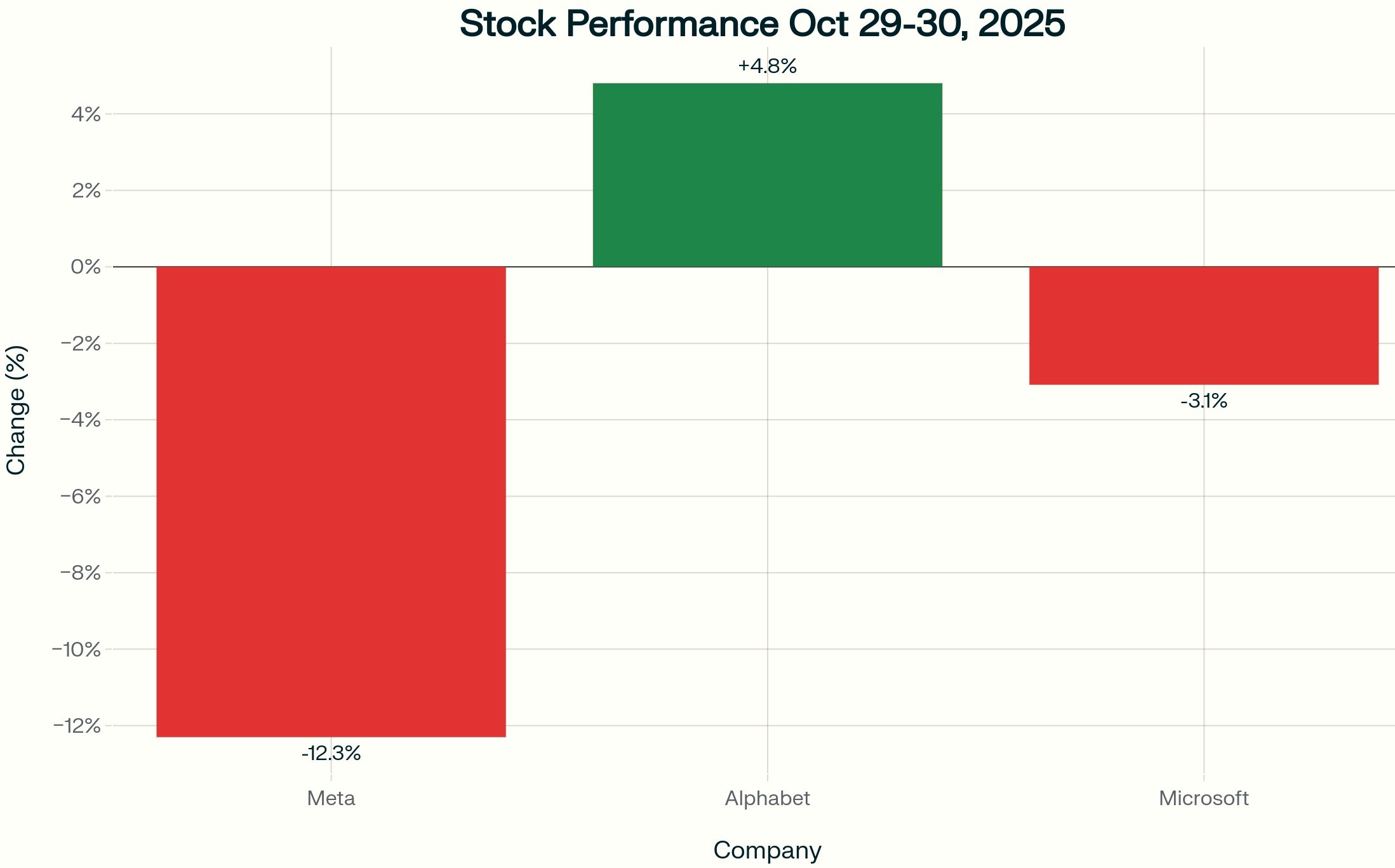
Stock Price Divergence on Earnings Day: Meta’s 12% Collapse vs. Alphabet’s 5% Rally
The Tale of Two Tech Giants
The contrast between Meta and Alphabet’s earnings reactions tells the entire story. Both companies reported strong quarterly results. Both announced capex increases that would have seemed astronomical just three years ago. Both are betting billions on AI infrastructure.
Yet Meta lost $140 billion in market value while Alphabet gained $130 billion.
The difference wasn’t in their spending plans. It was in their ability to prove those plans will pay off.
Alphabet crossed $100 billion in quarterly revenue for the first time, driven by 28% year-over-year growth in Google Cloud. CEO Sundar Pichai noted that “almost all Gen AI unicorns utilize Google Cloud,” and the company signed more billion-dollar cloud deals in the first nine months of 2025 than in the prior two years combined. Meanwhile, Google Search (supposedly under existential threat from AI chatbots) actually strengthened, with AI-driven features driving a 10% increase in search queries.
Alphabet demonstrated something important: external customers are willing to pay premium prices for AI infrastructure and services. The company isn’t just building AI capabilities for internal use. It’s selling them profitably to enterprises desperate to deploy generative AI without building their own infrastructure.
Meta cannot make the same claim.
The Monetization Proof Problem
Meta’s core business remains advertising. While the company claims AI has improved engagement (citing a 5% increase in time spent on Facebook, 10% on Threads, and 30% on Instagram video), this hasn’t translated into accelerating advertising revenue growth. Meta’s Q4 guidance suggests minimal acceleration from Q3 levels despite these engagement gains.
More troubling, CFO Susan Li’s comment that “advertising is no longer the priority” landed with investors like a confession rather than a strategic pivot. If AI improvements to your core business aren’t driving revenue acceleration, and your new priority (building AGI infrastructure) has no clear monetization path, what exactly are investors funding?
This is where Reality Labs enters the picture, and why it matters more than the headlines suggest. Meta’s VR/AR division posted a $4.43 billion loss on just $470 million in revenue in Q3 alone. The company has accumulated over $70 billion in Reality Labs losses since 2020, with no end in sight.
The market has seen this movie before. From 2020-2022, Meta justified massive spending on the metaverse as a necessary investment in the future. Investors grew skeptical, and the stock collapsed. Now Meta is asking for the same patience on an even larger scale, except this time for “AI superintelligence” infrastructure that currently generates zero external revenue.
Deutsche Bank analyst Michael Nathanson captured the sentiment shift when he downgraded Meta’s price target while raising Alphabet’s: “Meta’s costs have grown at a faster rate than revenues have, due to increasing depreciation and employment expenses.” Meanwhile, Alphabet showed “maintained margins on the heels of strong revenue growth.”
Translation: The market will reward AI spending that drives monetization. It will punish AI spending based on faith in future breakthroughs.
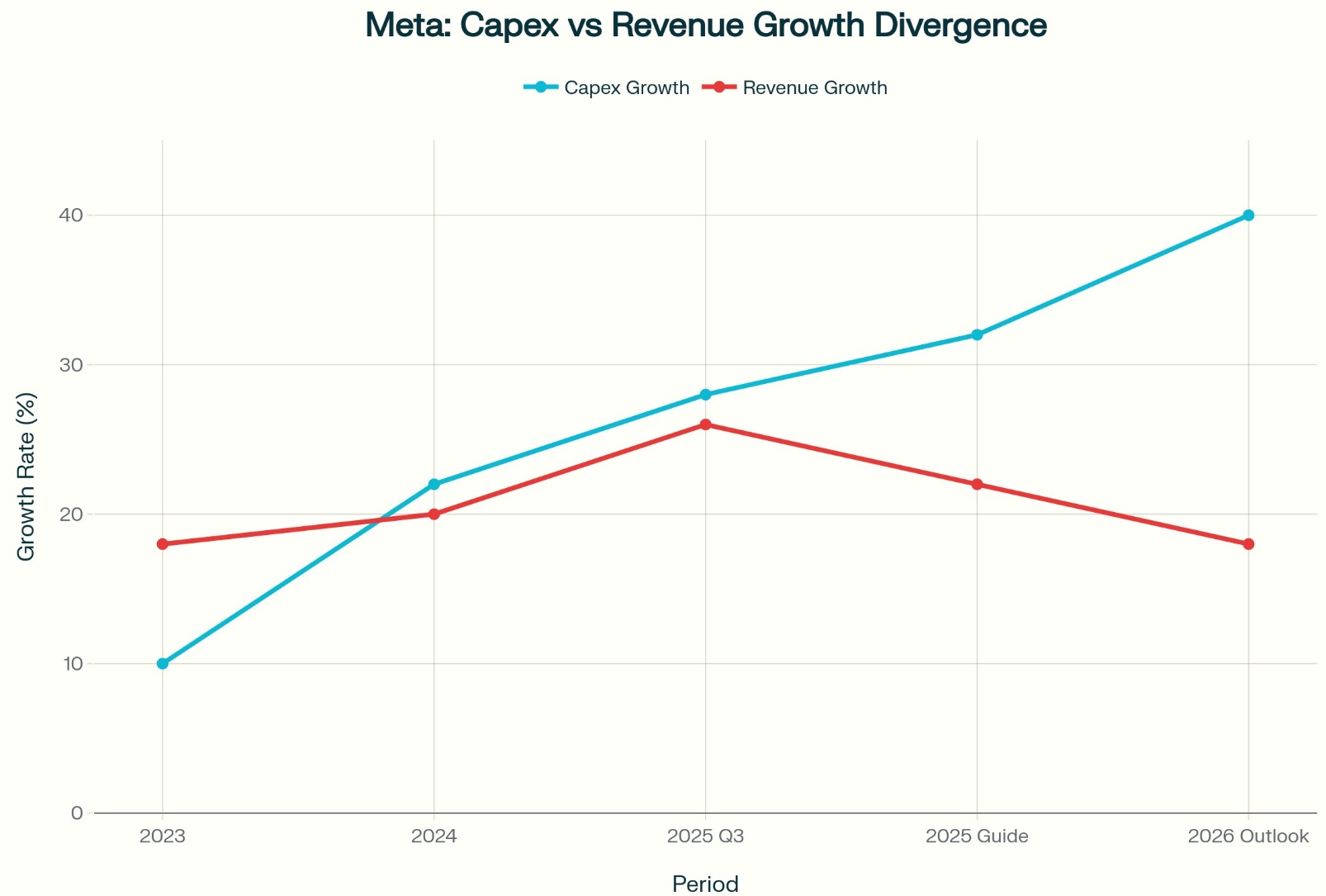
Meta’s key financial issue: capex growth accelerating while revenue growth slows, reversing prior margin expansion. Advertising is no longer the priority as AI infrastructure spending rises in 2026.
The Math That Doesn’t Work
Behind the philosophical shift lies a cold arithmetic problem that should concern anyone invested in the AI infrastructure boom.
Research firm Bain & Company estimates that assuming $400 billion in AI data center capital expenditure in 2025 (with typical depreciation schedules of 3-5 years for chips and 10 years for facilities), the accumulated annual depreciation burden reaches approximately $40 billion. Current AI revenue generation across all hyperscalers totals approximately $15-20 billion annually.
That’s a 2-to-1 deficit. Depreciation exceeds revenue by a factor of two.
For this math to work, AI infrastructure needs to generate roughly $160 billion in annual revenue at normalized 25% gross margins just to cover depreciation costs, before generating any returns on capital or servicing debt. At current growth trajectories, reaching $160 billion would require a near-10x scaling from today’s base.
That scaling must occur before 2028-2030, when hardware obsolescence forces replacement cycles. Miss that window, and you’re not just unprofitable. You’re writing down stranded assets.
Bain estimates that by 2030, achieving $2 trillion in annual AI revenue would be required to sustain projected infrastructure spending. Even if all corporate IT budgets shift to cloud and reinvest AI savings, the analysis suggests the world is “$800 billion short” of the revenue needed.
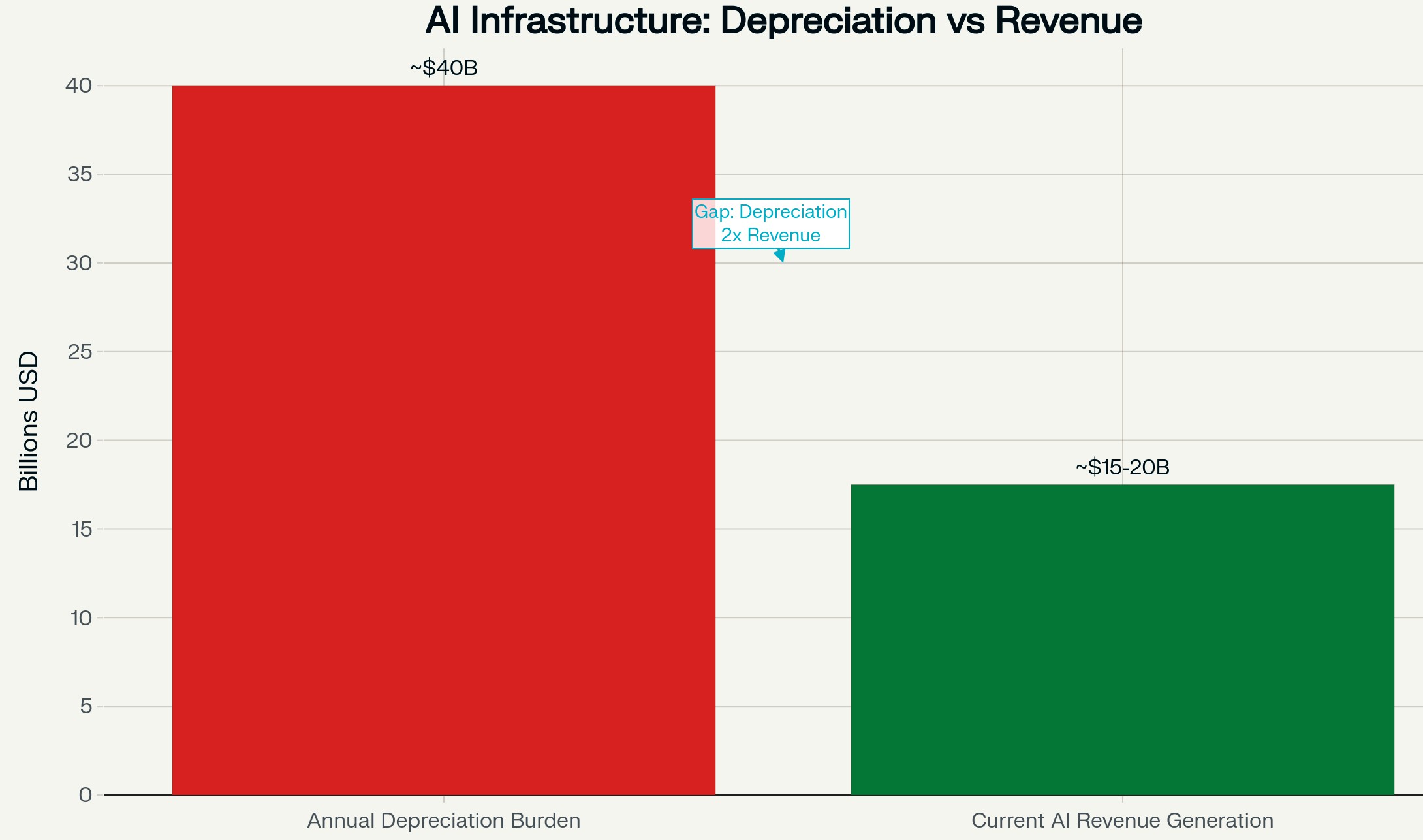
Economic imbalance where annual AI infrastructure depreciation ($40B) exceeds current AI revenue ($15-20B) by over twice, signaling sustainability challenges in the AI investment boom
When Bubbles Enter Discrimination Phase
Market historians recognize this pattern. In the late 1990s dot-com boom, investors initially rewarded any company with a “.com” in its name. By 1999-2000, the market began discriminating between businesses with actual revenue models (Amazon, eBay) and those burning cash on promises (Pets.com, Webvan).
That discrimination phase preceded the crash by roughly six to nine months.
The warning signs are multiplying:
- Deutsche Bank concluded in September 2025 that “the current AI boom is not sustainable” because “tech spending won’t remain parabolic”
- Bank of England explicitly warned in October that “the risk of a sharp market correction has increased” given stretched valuations in AI stocks
- International Monetary Fund noted that valuations “are approaching levels reminiscent of the internet boom 25 years ago”
- A record 54% of global fund managers surveyed by Bank of America in October 2025 identify “AI stocks in a bubble” as their top tail risk
Most tellingly, MIT research found that 95% of firms implementing generative AI are achieving zero return on their AI investments. If even the companies deploying these systems aren’t seeing productivity gains, the assumption that AI will generate the revenue needed to justify infrastructure spending becomes highly questionable.
The Structural Risks Investors Should Watch
Three concrete risks could trigger a broader repricing of AI-exposed stocks:
- First, electricity and infrastructure constraints. Meta’s Louisiana data center is reportedly straining local power grids. Multiple regions face hard limits on power availability that could force capex write-downs or delays that devalue infrastructure investments.
- Second, chip supply concentration. The entire buildout depends on ’s ability to supply cutting-edge GPUs. Any disruption (geopolitical, manufacturing, or technological like Chinese firm DeepSeek’s lower-cost alternative demonstrated in January 2025) could strand trillions in capex commitments.
- Third, slower-than-expected adoption. If AI productivity gains materialize more slowly than forecast, or if adoption plateaus below projections, the revenue base justifying capex spending evaporates, forcing impairments.
What This Means for Your Portfolio
Meta’s collapse isn’t primarily about a $16 billion tax charge, which is non-cash and actually tax-positive long-term. It’s about the market drawing a line: speculative AI capex without monetization proof will now be punished, not rewarded.
Investors should ask three questions about every AI-exposed holding:
- Can the company demonstrate external customers paying for AI capabilities? Cloud revenue, API usage, enterprise deals. These provide validation that AI infrastructure has market value beyond internal use cases.
- Is expense growth outpacing revenue growth? If capex and operating expenses are rising faster than top-line growth, margins will compress and free cash flow will deteriorate, exactly what spooked Meta investors.
- What’s the company’s ratio of AI spending to AI-attributable revenue? Companies spending tens of billions annually on AI infrastructure should be able to point to billions in revenue directly tied to those investments. Vague claims about “AI improving our core business” no longer suffice.
The discrimination phase of a bubble doesn’t mean every AI investment will collapse. It means the market stops treating all AI plays as equivalent. Companies with proven monetization (like Alphabet’s Cloud business or Microsoft’s Azure AI services) will continue to be rewarded. Companies asking investors to fund speculative moonshots based on future breakthroughs will face increasing skepticism.
Meta’s 12% collapse may be remembered as the moment the market’s patience is over with “build it and revenue will come” AI strategies. For investors, that’s not necessarily bad news. It’s clarifying. The question is no longer whether to invest in AI, but which AI investments can actually demonstrate returns.
The companies that can answer that question will thrive. Those that can’t may find themselves following Meta’s path downward as the discrimination phase broadens across the sector.