

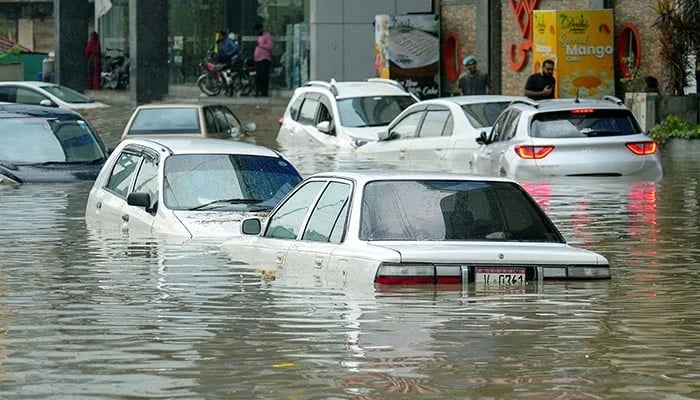
Pakistan is once again under water. This summer’s floods in Punjab, the worst in the province’s history, have displaced more than two million people, submerged crops and villages and left hundreds dead.
For many, the scale of devastation feels hauntingly familiar. Only three years ago, the 2022 floods claimed over 1,700 lives and caused $30 billion in economic losses. Today, despite warnings and lessons learned, Pakistan finds itself unprepared once again, facing the mounting costs of a climate crisis it did little to create.
This tragedy is a story of underinvestment in adaptation and resilience. According to the UK’s Foreign, Commonwealth & Development Office (FCDO) report, the country needs $348 billion between 2023 and 2030 to cope with climate impacts. Of this, at least $152 billion should be directed toward adaptation and resilience. Yet current spending on adaptation amounts to just 6.0 per cent of what is required, a gap 16 times larger than existing flows.
Even more worrying is the source of this funding. In 2021, Pakistan’s domestic private sector contributed only 5.0 per cent of total tracked climate finance. Of that, a negligible 0.7 per cent went toward adaptation. By contrast, over 80 per cent of climate finance went to mitigation projects like large-scale renewable energy. While decarbonisation is critical, it does little to shield communities from the immediate shocks of floods, droughts and glacial lake outbursts that now occur with terrifying regularity.
Projections indicate that by 2050, costs associated with flooding could reach $90 billion. The projected total cost of climate inaction in Pakistan is estimated to be $250 billion by 2030 and $1.2 trillion by 2050. The human toll will be even more staggering. By 2050, flooding and sea-level rise could cumulatively displace approximately 400 million people across Pakistan, including 320 million in Punjab.
Globally, adaptation finance lags far behind mitigation because the business case is less obvious. Solar and wind plants can generate predictable revenue streams; flood defences and resilient seeds cannot. The result is that adaptation is left almost entirely to public and donor funds. In Pakistan, this reliance is unsustainable. The World Bank estimates that without urgent adaptation, climate change could shave off 18-20 per cent of the country’s GDP by 2050. The costs of inaction will dwarf the costs of investment.
This is why the case for grant-based international climate finance remains critical. Mechanisms like the new Loss and Damage Fund are indispensable for vulnerable countries that cannot bear the burden of climate disasters on their own. Grants can support early warning systems, resilient infrastructure, and recovery for affected families, interventions that cannot and should not be monetised. But even with expanded donor support, public funds alone will not be enough.
The private sector, both domestic investors and international impact funds, must step up. Pakistan’s adaptation and resilience needs also present untapped opportunities for innovative finance. Blended finance, which combines concessional capital with private investment, can help de-risk projects and make them more attractive. But this requires a deliberate strategy to expand the pipeline of investable adaptation solutions.
Private investment can make a significant difference in several key areas. In climate-smart agriculture, financing drought-resilient seeds, efficient irrigation systems and regenerative farming practices is essential for protecting farmers’ livelihoods. With agriculture employing a large share of Pakistan’s workforce, such investments generate both economic and social payoffs.
As cities swell under rapid urbanisation, funding flood-proof housing, resilient infrastructure and sustainable waste management systems can safeguard millions while creating new markets for climate-resilient construction and services.
To unlock this potential, adaptation projects must become easier to invest in. Many promising ideas stall because they lack studies, technical support or clear plans. Helping communities and businesses prepare stronger projects will attract more finance. Success stories are equally important. Small pilot projects, jointly supported by government, donors and businesses, can prove that adaptation works – whether through flood-proof housing protecting families or insurance products safeguarding farmers. Finally, Pakistan needs better data to show the real benefits of resilience, from lives saved to jobs created. Strong evidence can turn adaptation from a perceived cost into a clear opportunity.
The stakes could not be higher. This year’s floods remind us that climate change is not a distant threat; it is here, claiming lives and livelihoods every season. Adaptation must be treated as an economic priority, not a secondary concern. That means scaling up climate finance flows, operationalising the Loss and Damage Fund and building stronger domestic institutions. But it also means mobilising private capital, not as a replacement but as a complement to public finance.
Pakistan is at a crossroads. Either it continues to stumble from disaster to disaster, or it seizes this moment to build a climate-resilient future. The floods of 2025 should be the final wake-up call: adaptation finance cannot wait.
The writer works for a non-profit in Islamabad. He can be reached at: jawadkhalid7@gmail.com