
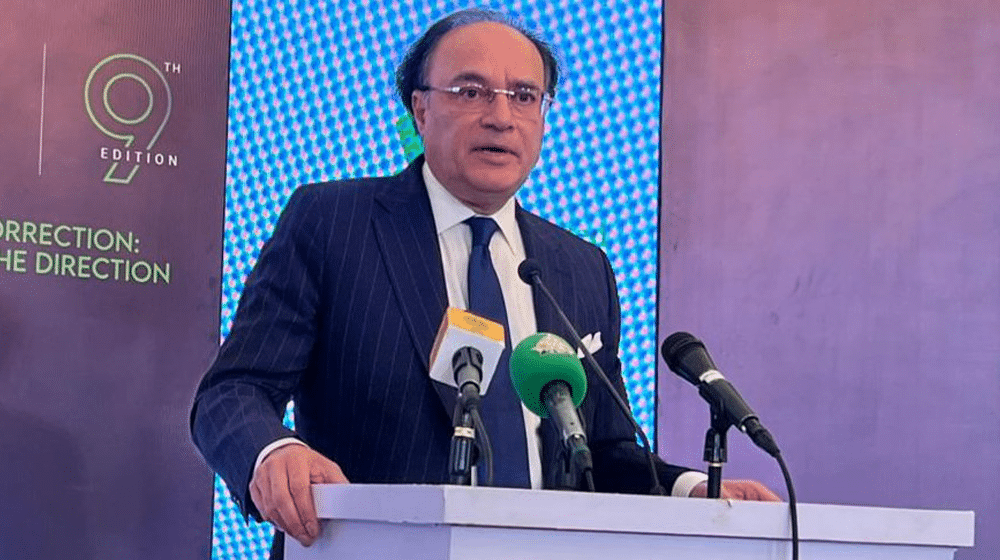
Federal Minister for Finance and Revenue, Senator Muhammad Aurangzeb, has said the government is pressing ahead with a broad and irreversible reform agenda aimed at strengthening economic stability, enhancing competitiveness, and restoring fiscal balance.
Speaking at the Pakistan Business Council’s Dialogue on the Pakistan Economy in the federal capital today, the Finance Minister outlined key measures underway in taxation, digital transformation, state-owned enterprise restructuring, and debt management as part of a coordinated effort to place Pakistan on a more sustainable economic footing.
The Minister noted that Pakistan has consolidated gains in macroeconomic stability, with early signs of economic recovery becoming visible. He highlighted positive trends in key sectors, including cement, fertilizer, automobiles, mobile phone manufacturing, and large-scale manufacturing.
He also referred to a recent OICCI survey, which reported a significant improvement in investor sentiment, with a notable rise in respondents recommending Pakistan as a viable destination for foreign direct investment. Senator Aurangzeb highlighted renewed interest from global companies across energy, mining, technology, logistics, and automotive sectors, describing these as meaningful indicators of growing confidence in Pakistan’s economic direction.
The Finance Minister stated that the government is now focused on moving from designing reforms to their operationalization. He underlined the broad transformation underway in Pakistan’s taxation system, driven by a comprehensive digitalization agenda involving people, processes, and technology.
He informed participants that tax policy has been shifted from the FBR to the Ministry of Finance, where a fully operational Tax Policy Office and an Advisory Council, comprising academicians and later private-sector representatives, are being established. The Minister emphasized that continuous, year-round engagement with chambers and sectoral bodies will replace the previous once-a-year budget consultations, enabling evidence-based and analytically aligned policy development.
Senator Aurangzeb shared detailed progress on state-owned enterprise and government restructuring, noting that half of all federal ministries and attached departments have already been reviewed under the right-sizing process. He reported the abolition of 54,000 vacant posts, resulting in annual savings of Rs. 56 billion, and outlined mergers or closures of several ministries and organizations. While acknowledging the complexities arising from HR, legal, and financial liabilities, he reaffirmed the government’s resolve to advance reforms despite institutional and political challenges.
He identified Digital Pakistan as a key priority, personally monitored by the Prime Minister on a weekly basis. The initiative integrates digital payments adoption, digital public infrastructure, and the digitization of government payments. The Minister stressed the importance of transitioning Pakistan from a heavily cash-based to a documented economy, with clear milestones set for merchant digitization, financial inclusion, and technology-enabled transparency in government processes.
Senator Aurangzeb described improvements in debt management as another area of significant progress. He stated that the Debt Management Office is being modernized to international standards and that reforms have already contributed to extending Pakistan’s average debt maturity to four years, reducing refinancing risks, and lowering overall debt servicing costs.
He also mentioned the launch of a new contributory pension scheme, operational since July 2024, which has already enrolled over 9,000 new government employees. This is accompanied by parametric reforms designed to slow the fiscal pressure from pension liabilities.
Outlining forthcoming priorities, the Minister announced that the inaugural session of the 11th NFC Award will be held on 4 December and expressed confidence that constructive engagement with provinces would continue the collaborative spirit established through the National Fiscal Pact.
He further noted that Pakistan is working towards its inaugural Panda Bond issuance, expected before the Chinese New Year. The Minister also confirmed progress on Pakistan’s regulatory framework for the emerging digital and crypto economy, with the operationalization of the Pakistan Virtual Asset Regulatory Authority underway to ensure that crypto-related activities are governed within a formal and well-regulated structure.
The Minister commended the Pakistan Business Council for presenting a comprehensive programme that spans immediate macroeconomic priorities as well as Pakistan’s longer-term structural and existential challenges, including demographic pressures and climate vulnerability. He acknowledged the research-based capacity of the PBC and emphasized the importance of fact-driven analysis in policy formulation.
During an interactive session, the Minister discussed Pakistan’s growth trajectory, stating that despite the impact of recent floods, the country is expected to achieve around 3.5 percent growth this year. He projected growth of around 4 percent over the next two to three years, with potential to reach 6 to 7 percent over the medium term, provided momentum in agriculture, manufacturing, and services is sustained.
He also provided updates on remittances and external inflows, noting stabilized monthly inflows through formal channels, strong performance of the Roshan Digital Account, and improved institutional flows under SCRA after introducing a lock-in period to curb short-term arbitrage.
Responding to concerns over high taxation, energy costs, and expensive financing, Senator Aurangzeb reiterated the government’s understanding of industry challenges. He noted that easing monetary conditions will help lower financing costs but encouraged corporates to diversify beyond bank borrowing and utilize capital markets for longer-tenor, more competitive financing.
He reaffirmed the government’s commitment to addressing structural issues in taxation and energy and outlined ongoing review mechanisms designed to closely monitor the impact of recent tariff adjustments.
Addressing questions related to the investment environment and security concerns raised by foreign investors, the Minister underscored that national security is non-negotiable. He noted that fundamental issues of security, macroeconomic stability, and profit repatriation form the basic prerequisites for attracting and retaining global investment. He assured participants that the government will continue to review policy measures transparently while remaining receptive to feedback from the business community.
Senator Muhammad Aurangzeb concluded by reaffirming the government’s commitment to evidence-based policymaking, private-sector partnership, and the continuation of irreversible reforms to place Pakistan on a sustainable path of economic revival and long-term growth.