
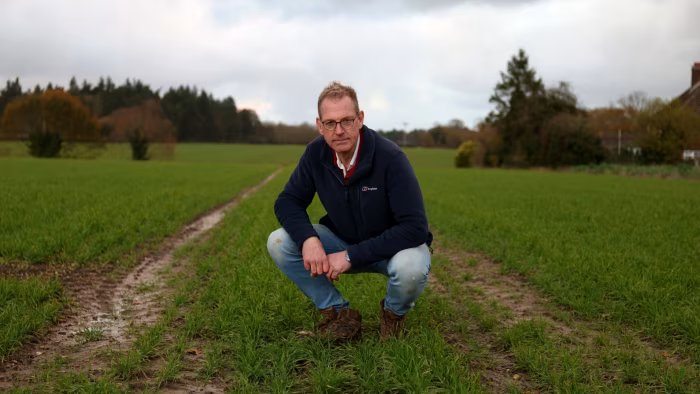
In eastern England’s breadbasket, autumn’s dry, golden weather has been ideal for sowing cereals. After last year’s low yields, it should provide some comfort for farmers such as Charles Bracey.
But this year it does not. “We’re drilling this week in the knowledge that we’re not going to make any money from it,” said the 60-year-old farmer, who grows wheat, sugar beet and vegetables across two farms totalling 1,000 acres between the villages of Postwick and Stalham in Norfolk. “Prices are grim and it doesn’t look like they are going to get any better.”
Agricultural commodities such as grains and sugar have plummeted on futures markets as global supplies have surged. European farmers are suffering in particular as they contend with high input costs and increasingly competitive global rivals.
Benchmark wheat futures in Paris have fallen more than 20 per cent this year to multiyear lows, dragged down by bumper harvests in Russia, Australia and parts of South America. Meanwhile, speculators are building bets on further price falls, with investment funds adding more than 280,000 new short lots in milling wheat futures in the week to November 21, extending their net short position, according to Euronext data.
For UK growers, the fall has been brutal. Wheat prices are now little more than half the levels reached in 2022 following Russia’s invasion of Ukraine. Yet fertiliser, fuel and machinery costs — inflated during the energy shock — have barely retreated.

For arable farmers in Europe, “it’s not a happy situation at all,” said Ole Hansen, head of commodity strategy at Saxo Bank. There is a big gap between “the cheap crop that leaves the farm gate” and the price of bread “when it hits the store”, he said.
While the upcoming harvest in Norfolk looks promising, the UK’s wheat yields at this year’s harvest fell after last winter’s torrential rain. But because international markets are well supplied, that does not translate into higher prices.
“It’s the perfect storm: low yields and low prices,” said Bracey’s business partner, Nick Hood, who is in the process of merging their operation with another to spread fixed costs. “On the arable side, you’re looking at negative margins almost across the board.”
“We have regional weather and global markets,” he added. “The barns are half full and it’s not worth much.”

The financial squeeze is prompting visible restructuring. Brown & Co, the UK’s largest dedicated agricultural auctioneer, said the number of agricultural machines being put up for sale has risen sharply. “It’s become hard to find a day of the week without an auction,” said partner Simon Wearmouth. “I’ve never known the calendar this crowded.”
Even as grain markets sink, UK shoppers have seen little relief in the cost of bread, beer or baked goods. That is because the raw commodity typically accounts for only a small fraction of the retail price. In a loaf of bread costing £1.50, wheat may only account for 16.5 pence to 22.5 pence, according to Financial Times calculations based on research by the Agriculture and Horticulture Development Board, while barley only accounts for a small proportion of a pint of beer. Energy, packaging, transport and processing costs and retail margins are the main components of the final price.
Annual food inflation in the UK was 4.9 per cent in October, up from 4.5 per cent in September. The rise has been driven by five products — beef, butter, milk, coffee and cocoa — where supply shortages globally have pushed up prices.
“Up horn, down corn,” said Wearmouth. “The beef price is buoyant . . . but if you’re solely arable and you haven’t got any irrigation water for any high-value crops to mix in amongst your rotation, then the pressure is really on at the moment.”
Across the Channel, growers say the situation is similarly dire. In France, where sugar beet is a flagship crop, producers describe a sector under existential pressure after global sugar prices plunged almost 50 per cent over the past year.

“This is a serious problem,” said Timothé Masson of the CGB, the French beet growers’ association. “Producers are cultivating below cost. You can do that for one year, not for several.”
Concessions for South Africa, Mercosur countries in South America and traditional cane exporters have added to supply on a market where European consumption is flat or declining. The result, according to Masson, has been factory closures, with six sites shutting in France since the end of EU sugar quotas in 2017, with more expected if 2026 prices fail to recover.
“It’s a real crisis,” said French farmer Guillaume Gandon, who grows about 70 hectares of beet. Growers are now “cultivating at a loss” after production costs surged post-2022 while yields fell, and “we have lost nine tonnes per hectare in 10 years”, he added, as EU pesticide bans tightened. Meanwhile, “cane sugar from Brazil or India arrives at very low prices — we cannot compete with that”. If prices do not recover soon, he warned, the sector will collapse.
A veteran sugar trader said: “The whole [sugar] industry is in panic mode . . . they [sugar companies] are all haemorrhaging money . . . so they’re pleading with the farmers to help them out and not plant beets going forward.” They added that not only have supplies of sugar surged but demand has fallen as Europeans are ditching sweet treats, which are increasingly maligned as unhealthy.

Producers on both sides of the Channel emphasise a structural problem: Europe’s high environmental and labour standards, while politically popular, make production significantly more expensive than in major exporting nations.
In Brazil and India, cane cultivation benefits from favourable climates, large vertically integrated estates and looser rules on pesticides and labour. “If you open the market fully to Brazil, you can close the European beet sector,” Masson said. “We will never match those costs.”
UK cereals farmers echo the point. Since leaving the EU, the basic payment that once stabilised incomes has been almost entirely phased out in England, in favour of payments for making environmental or animal welfare improvements, for instance. Meanwhile, farmers in Scotland, Wales and the EU still receive substantial area-based support.
“The level playing field is long gone,” Bracey said. “We lost our best ally — the French — in the Brexit negotiations. Now we’re on our own.”
Also weighing on the British farming sector is the government’s planned overhaul of inheritance tax reliefs for farms. From April 2026, only the first £1mn of agricultural or business assets will qualify for full relief, with the remainder in effect facing a charge of 20 per cent.
Advisers say the change is influencing succession plans in a sector dominated by family-owned operations. With incomes under pressure and many younger family members reluctant to take over, the prospect of a new tax liability is prompting some older owners to consolidate, restructure or sell land.
“When farmers leave, the knowledge doesn’t come back,” said Hood. “That’s what worries me.”