
Bitcoin holders now have more ways than ever to put their BTC to work and earn yield. From native staking protocols to liquid staking tokens and Bitcoin sidechains, the Bitcoin DeFi landscape has matured dramatically, making 2026 the best year yet to explore Bitcoin staking rewards.
This guide breaks down every major option for earning yield on your Bitcoin, helping you find the right approach based on your goals, risk tolerance, and desired level of involvement. Whether you’re a long-term holder looking for passive income or an active DeFi participant seeking the highest returns, there’s a Bitcoin staking solution waiting for you.
Understanding Bitcoin Staking: What It Really Means
Bitcoin staking doesn’t work like traditional proof-of-stake networks because Bitcoin uses proof-of-work consensus. However, several innovative approaches now let BTC holders earn yield without selling their holdings. These methods range from native Bitcoin staking protocols that keep your BTC on the Bitcoin blockchain to wrapped solutions that bring Bitcoin’s value into other ecosystems.
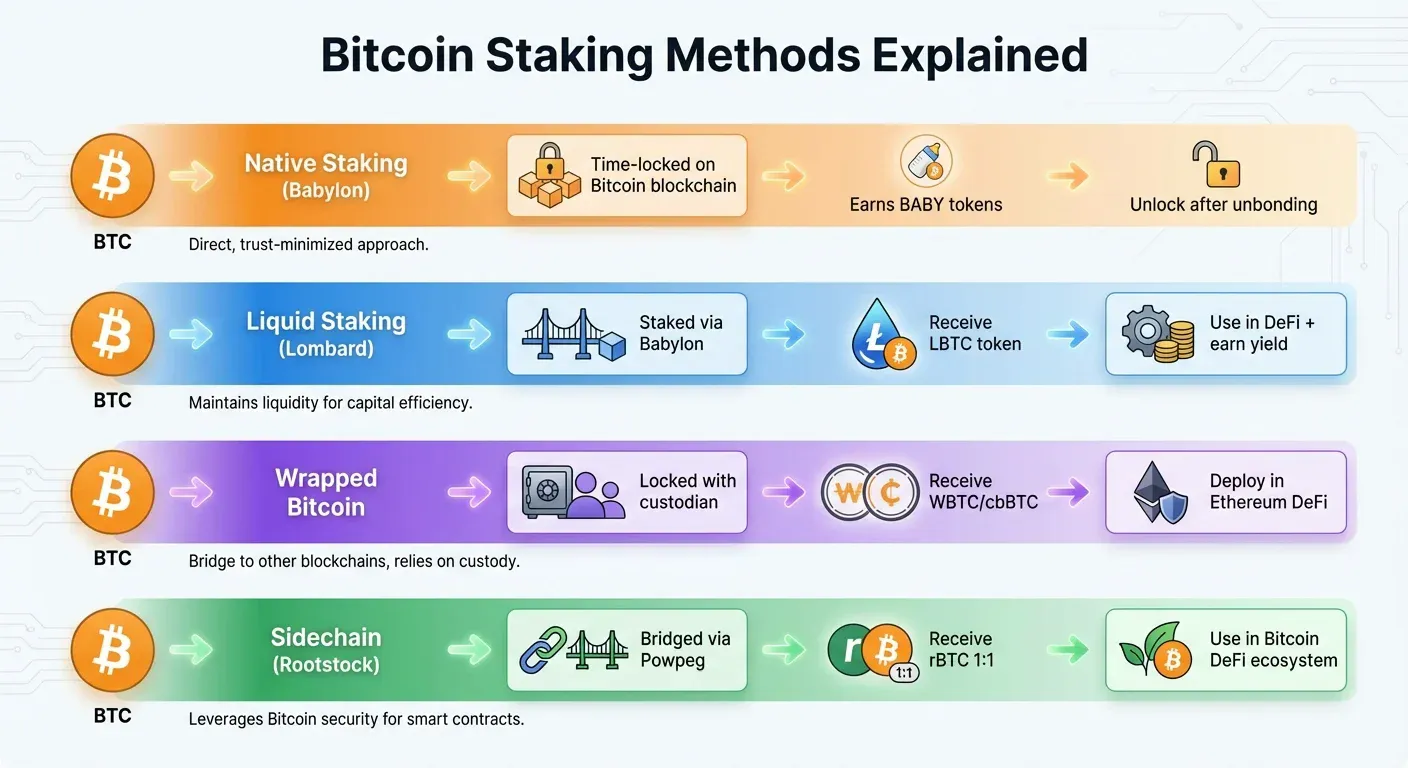
Alt text: Infographic comparing four Bitcoin staking methods: Native Staking via Babylon (time-locked on Bitcoin blockchain, earns BABY tokens), Liquid Staking via Lombard (receive LBTC token for DeFi), Wrapped Bitcoin (WBTC/cbBTC locked with custodian for Ethereum DeFi), and Sidechain via Rootstock (bridged via Powpeg to receive rBTC 1:1 for Bitcoin DeFi ecosystem).
The key distinction lies in how each method handles your Bitcoin:
- Native Bitcoin staking keeps your BTC on the Bitcoin network while generating yield
- Liquid staking tokens represent staked BTC and can be used across DeFi
- Wrapped Bitcoin brings BTC value to other chains like Ethereum
- Bitcoin sidechains offer smart contract functionality while maintaining Bitcoin’s security
- Centralized platforms provide the simplest onboarding but require trusting a third party
Let’s explore each category in detail so you can make an informed decision about where to stake your Bitcoin.
Native Bitcoin Staking: Babylon Protocol
Babylon has emerged as the leading native Bitcoin staking protocol, with over $5 billion in total value locked as of late 2025. The protocol allows BTC holders to stake directly on the Bitcoin network without wrapping, bridging, or giving up custody of their assets.
How Babylon Works
Babylon uses innovative cryptographic technology to enable Bitcoin staking through time-lock scripts on Bitcoin’s UTXO-based ledger. Your BTC never leaves the Bitcoin blockchain, instead, it’s locked for a period you choose, providing economic security to proof-of-stake networks in exchange for rewards paid in BABY tokens (Babylon’s native token).
Key features of Babylon staking include:
- Self-custodial: Your Bitcoin stays in your wallet on the Bitcoin network
- No wrapping required: Stake native BTC directly without converting to a wrapped version
- Flexible unbonding: Request unbonding at any time (subject to a 7-day unbonding period)
- Slashing protection: Extractable One-Time Signatures (EOTS) ensure accountability
Babylon Staking Access Points
Several major platforms now offer Babylon staking integration:
- Kraken: Launched BTC staking via Babylon in June 2025, allowing direct staking from the exchange
- Hex Trust: Institutional-grade access for professional investors
- Kiln: Enterprise staking infrastructure with non-custodial options
Babylon represents a significant breakthrough for Bitcoin holders who want yield without compromising on Bitcoin’s core principles of self-custody and decentralization.
Bitcoin Liquid Staking Tokens (LSTs)
Liquid staking tokens solve a key limitation of direct staking: illiquidity. When you stake directly through Babylon, your BTC is locked and can’t be used elsewhere. Liquid staking protocols like Lombard give you a tradeable token representing your staked Bitcoin, allowing you to earn staking rewards while still participating in DeFi.
Lombard (LBTC)
Lombard’s LBTC has become the dominant Bitcoin liquid staking token, with nearly $2 billion in circulation and over 40% market share of the Bitcoin LST sector. LBTC is backed 1:1 by BTC staked through Babylon, meaning you earn native staking yields while maintaining liquidity.
How LBTC works:
- Deposit BTC with Lombard
- Your BTC is staked on Babylon
- You receive LBTC tokens representing your staked position
- Use LBTC across DeFi protocols (lending, borrowing, liquidity provision)
- Earn Babylon staking rewards automatically reflected in LBTC’s value
LBTC is available on multiple chains including Ethereum, Base, BNB Chain, and Sui, making it highly versatile for DeFi participation. The token maintains liquidity through Lombard’s Security Consortium, which validates all staking, minting, and cross-chain transactions.
Considerations:
- 9-day unstaking period when redeeming for BTC
- Smart contract risk inherent to any DeFi protocol
- 0.1% slashing risk introduced in the Babylon protocol
Wrapped Bitcoin Options
Wrapped Bitcoin tokens bring BTC value to other blockchain ecosystems, particularly Ethereum’s vast DeFi landscape. While not “staking” in the traditional sense, wrapped BTC can be deployed in lending protocols, liquidity pools, and yield farming strategies to generate returns.
WBTC (Wrapped Bitcoin)
WBTC remains the largest wrapped Bitcoin token by market cap, with over 125,000 BTC wrapped as of early 2026. Each WBTC is backed 1:1 by Bitcoin held by custodians (primarily BitGo).
Yield opportunities with WBTC:
- Lending on Aave: Earn interest by supplying WBTC
- Liquidity provision on Curve and Uniswap: Earn trading fees
- Yield farming: Deploy WBTC in various DeFi strategies
- Collateral for borrowing: Use WBTC to borrow stablecoins or other assets
Typical APY ranges from 2-5% for conservative strategies, with higher returns available in more complex or riskier positions.
cbBTC (Coinbase Wrapped BTC)
Coinbase’s wrapped Bitcoin offering has grown rapidly, now holding approximately 73,000 BTC (around $6 billion). cbBTC offers similar functionality to WBTC but with Coinbase as the custodian, which some users prefer due to the exchange’s regulatory compliance and institutional reputation.
Key differences from WBTC:
- Coinbase serves as the sole custodian (centralized but regulated)
- Available on multiple chains via Chainlink CCIP integration
- May offer additional peace of mind for users already on Coinbase
Bitcoin Sidechains: Rootstock
Bitcoin sidechains offer a unique approach to earning yield on Bitcoin by enabling smart contract functionality while inheriting Bitcoin’s security. Rootstock stands out as the oldest and most established Bitcoin sidechain, operating with 100% uptime since 2018.
How Rootstock Works
Rootstock is an EVM-compatible sidechain secured by over 80% of Bitcoin’s mining hashpower through merged mining. Users bridge BTC to Rootstock via the Powpeg, receiving rBTC (Rootstock Bitcoin) at a 1:1 ratio. rBTC can then be used across Rootstock’s growing DeFi ecosystem. Rootstock’s smart contract capabilities enabled the creation of RootstockCollective, the first DAO dedicated to Bitcoin builders.
Rootstock advantages:
- Bitcoin-level security: Secured by Bitcoin miners through merged mining
- EVM compatibility: Use familiar Ethereum tools and deploy Solidity smart contracts
- Low fees: Average transaction costs around $0.005 with 30-second confirmation times
- Established ecosystem: 150+ partner applications including Uniswap V3, Beefy Finance, and Money On Chain
RootstockCollective: Stake, Vote, Earn Bitcoin
RootstockCollective represents a powerful opportunity for those seeking transparent Bitcoin staking rewards with real ecosystem impact. As the first DAO dedicated to Bitcoin builders, RootstockCollective lets you stake RIF tokens to earn rewards in rBTC (Bitcoin), RIF and USDRIF while directly funding innovation on Bitcoin.
What makes RootstockCollective unique:
Unlike passive staking where your funds simply sit idle, RootstockCollective creates a direct connection between your stake and the projects building Bitcoin’s future. When you stake RIF, you become a “Backer” with the power to vote on which builders receive funding, and you earn rewards based on your participation.

Current RootstockCollective metrics:
- 30% average Annual Backer Incentive (ABI) for active participants
- 28M+ RIF staked in the DAO
- 2.69+ BTC and 1.1M+ RIF already paid out in Collective Rewards
- Bi-weekly reward distribution for consistent, predictable returns
How to participate as a Backer:
- Acquire RIF tokens from supported exchanges (available on Binance, and other major platforms)
- Connect your wallet (MetaMask, SafePal, Bitget Wallet, Rabby, and others supported)
- Stake RIF through the RootstockCollective dApp to receive stRIF (staked RIF)
- Back builders by allocating your stRIF to projects you believe in
- Earn rewards in rBTC, RIF and USDRIF every two weeks
Key benefits of RootstockCollective:
- Non-custodial staking: Your tokens remain under your control
- Transparent on-chain governance: All proposals and votes visible on-chain via Tally
- Real impact: Your backing decisions directly fund Bitcoin builders
- RBTC airdrop for gas: Removes the main barrier for new users
- No lock-up required: Adjust your allocations anytime
Ecosystem projects you can back: OpenOcean, Boltz, WoodSwap, Money On Chain, Tropykus, WakeUp Labs, SimpleFi, Router Protocol, LayerBank, Symbiosis, and many more innovative Bitcoin builders.
RootstockCollective stands apart because you’re not just earning passive yield, you’re actively shaping Bitcoin’s DeFi future while being rewarded for your participation.
Centralized Exchange Options
For those prioritizing simplicity over decentralization, major exchanges offer Bitcoin earning products with minimal friction.
Binance Earn
Binance offers flexible and locked Bitcoin earning options through Binance Earn. Rates fluctuate based on market conditions, with flexible options typically offering lower yields than locked terms.
Nexo
Nexo provides Bitcoin earning with daily payouts and no lock-up periods, making it attractive for users who want flexibility. However, rates depend on your loyalty tier and overall platform activity.
Bybit Earn
Bybit’s Bitcoin earning program offers 2.4% APR for amounts under 0.005 BTC, with lower rates for larger deposits. The platform uses cold storage for most funds.
Important considerations for centralized options:
- Custodial risk: You don’t control your keys
- Platform solvency risk: Remember Celsius and BlockFi collapses
- Regulatory uncertainty: Rules vary by jurisdiction
- Lower transparency compared to on-chain alternatives
Comparing Bitcoin Staking Options
| Option | Typical APY | Custody | Complexity | Best For |
|---|---|---|---|---|
| Babylon (Direct) | Variable (BABY tokens) | Self-custody | Medium | Purists wanting native BTC staking |
| Lombard (LBTC) | Babylon yield + DeFi | Smart contract | Medium-High | DeFi-active users wanting liquidity |
| WBTC/cbBTC DeFi | 2-10%+ | Custodian | High | Experienced DeFi participants |
| RootstockCollective | ~30% ABI* | Non-custodial | Low-Medium | Those wanting impact + rewards |
| CEX Earning | 1-4% | Custodial | Low | Beginners prioritizing simplicity |
*ABI = Annual Backer Incentive for active RootstockCollective participants
How to Choose the Right Bitcoin Staking Option
Selecting the best approach depends on your priorities and circumstances. Consider these factors:
If you prioritize self-custody and Bitcoin purity: Babylon’s native staking keeps your BTC on the Bitcoin network without any wrapping or bridging. You maintain complete control while earning yield.
If you want liquidity while earning: Lombard’s LBTC or similar liquid staking tokens let you earn Babylon staking rewards while still using your position in DeFi protocols.
If you value transparency and ecosystem impact: RootstockCollective offers a unique combination of high rewards (30% ABI), transparent on-chain governance, and the ability to directly support Bitcoin builders. Your participation has meaning beyond just yield.
If you’re new to Bitcoin DeFi: RootstockCollective’s user-friendly interface, gas coverage through rBTC airdrops, and non-custodial staking make it an excellent entry point. You can start with just RIF tokens and a MetaMask wallet.
If you want maximum simplicity: Centralized exchanges offer the lowest friction, though at the cost of custody and typically lower yields.
Getting Started: Your First Steps
Ready to put your Bitcoin to work? Here’s how to begin:
For RootstockCollective (Recommended for balanced rewards and impact):
- Visit rootstockcollective.xyz
- Acquire RIF tokens from a supported exchange
- Connect your wallet (MetaMask or other supported options)
- Stake your RIF to receive stRIF
- Browse active builders and allocate your backing
- Claim rewards every two weeks
For Babylon Native Staking:
- Access Babylon through Kraken, Kiln, or the Babylon staking dashboard
- Choose your staking duration
- Stake your BTC using your wallet
- Receive BABY token rewards
For Wrapped Bitcoin DeFi:
- Convert BTC to WBTC or cbBTC via a supported exchange
- Transfer to a Web3 wallet like MetaMask
- Connect to DeFi protocols (Aave, Curve, Uniswap)
- Deploy your wrapped BTC in your chosen strategy
The Future of Bitcoin Staking
Bitcoin staking has evolved from a theoretical concept to a multi-billion dollar sector in just a few years. As we move through 2026, expect continued innovation including deeper DeFi integrations, institutional products, and enhanced user experiences across all platforms.
RootstockCollective exemplifies where Bitcoin staking is heading: beyond passive yield toward active ecosystem participation. The most rewarding opportunities increasingly combine financial returns with governance rights and community impact.
Whether you choose native staking through Babylon, liquid staking via Lombard, or the transparent rewards and builder-backing model of RootstockCollective, you’re participating in Bitcoin’s transformation from a passive store of value into a productive, yield-generating asset powering the next generation of decentralized finance.