

You Don’t Need to Predict the Bottom of the Stock Market — For Middle-Aged and Older Adults, Buying Government Bonds and Waiting Three Years Is Also an Option
So far, we have examined market peaks and bottoms while comparing Bitcoin, financial stocks, gold, U.S. Treasury yields, and commodity markets.
At this point, I believe it is still too early to conclude that the market has bottomed out.
In the first place, however, do we really need to pinpoint the bottom of the stock market?
This time, I would like to consider this from the perspective of middle-aged and older individual investors.
■ Market Bottoms Can Only Be Known in Hindsight
During a stock market downturn, major rebounds occur time and time again.
Each time, people appear claiming that the market has hit bottom, and others argue that it is a golden opportunity to buy on the dip.
Yet, even after the collapse of Japan’s economic bubble, there were many such rebounds.
Sometimes, whether it was a true bottom can only be known in hindsight, looking back years later.
There is no guarantee of a V-shaped recovery this time, either.
Will the market adjust through price magnitude, adjust over time, or enter a prolonged bear market?
There is likely no need to jump to conclusions at this stage.
■ Do Middle-Aged and Older Adults Need to Look for the Next 10x Stock?
I suspect that many of the people reading my note are middle-aged or older.
Therefore, I have no intention of giving the usual talk about long-term diversified investing.
A 20-year-old and a 60-year-old have different amounts of time available for investing.
Even if you search for the next 10x stock starting at age 60 and become exceedingly wealthy 20 years later, you will be 80 years old by then.
Some might think, “Doesn’t that mean I can’t become rich, then?”
You just have to give up on that (laughs).
Giving up on getting rich and giving up on a rich life are two entirely different things.
■ Do You Really Need to Double 20 Million Yen in Assets?
Suppose you have 20 million yen in financial assets.
If stock prices double over the next 10 years, it will become 40 million yen.
On the other hand, if stock prices fall by half, it will become 10 million yen.
If you invest in government bonds yielding 2% annually, you would earn 4 million yen in interest over 10 years based on simple interest calculations.
Of course, the profit is smaller compared to when stock investing succeeds.
However, the happiness gained when reaching 40 million yen and the peace of mind lost when dropping to 10 million yen are not necessarily equal.
Especially for middle-aged and older adults whose basic living expenses can be covered by pensions, I do not believe there is any need to take on excessive risks.
■ The Option of Government Bonds and High-Dividend ETFs
For example, consider an asset allocation like the following:
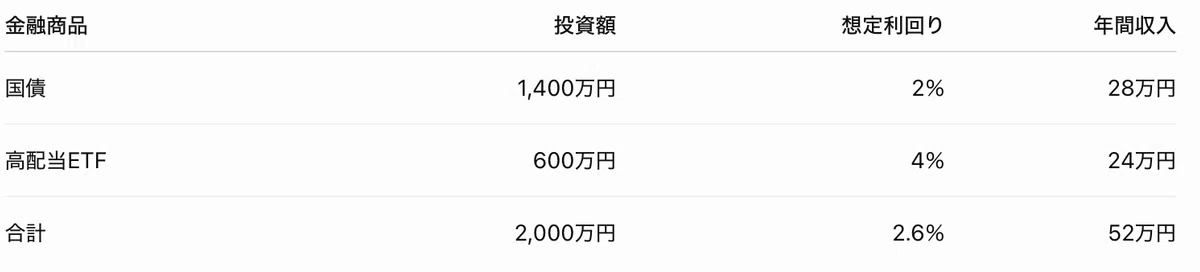
*Trial calculation based on pre-tax assumptions. May differ from actual interest rates and distribution yields.
Aren’t there many people for whom an investment income of around 500,000 yen per year would be quite sufficient?
You could go on hot spring trips multiple times every year.
Of course, high-dividend ETFs carry the risk of falling stock prices and dividend cuts. It cannot be categorically stated that they are safer than index funds investing in the entire market.
Whether to focus primarily on government bonds or to combine them with high-dividend ETFs is something you should decide according to your life plan and risk tolerance.
■ If It Were Me, I’d Buy Retail Government Bonds and Wait 3 Years
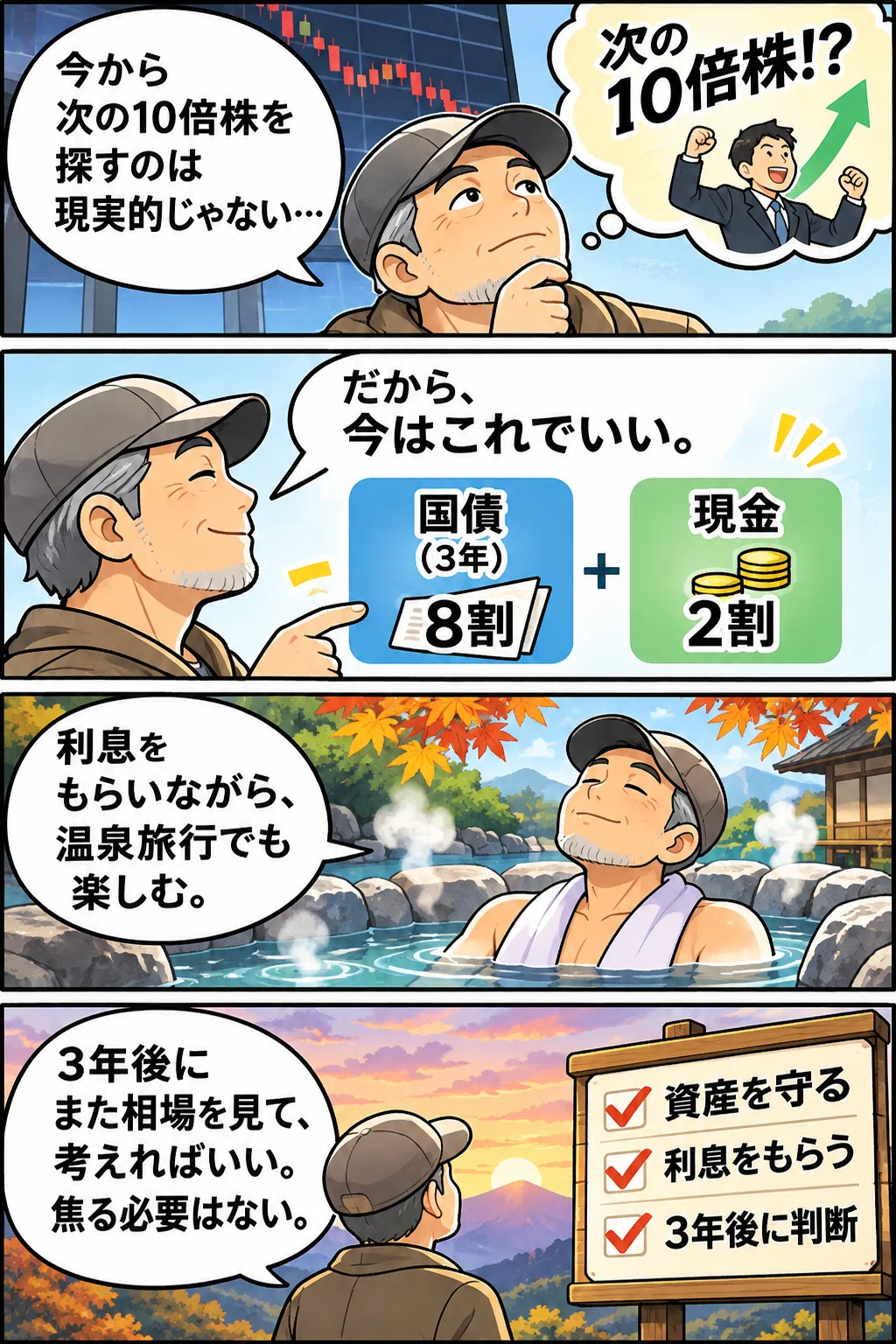
If it were me, while waiting for stock prices to bottom out, I would also consider allocating 80% of my assets to 3-year fixed-rate retail government bonds and holding the remaining 20% in cash.
With 20 million yen in assets,
This is how the portfolio is structured.
Assuming an annual interest rate of 2%, you would earn 320,000 yen per year, totaling 960,000 yen in interest over three years. Taking standard taxation into account, your net earnings over the three years would be about 760,000 yen.
As a general rule, retail government bonds can be cashed in early once one year has passed since issuance. However, an amount equivalent to the last two interest payments will be deducted.
Because it has a fixed interest rate, there is also the opportunity cost if interest rates rise, as well as a decline in purchasing power due to inflation.
Even so, as long as you have secured immediate living expenses and medical costs in cash, I believe it is not a bad option.
And then, you can simply reconsider in three years.
If the stock market has bottomed out, you can shift funds into stocks.
If you feel it has not yet bottomed out, you can just buy government bonds again.
■ Missing Out on a V-Shaped Recovery Is Totally Fine
Of course, there is a possibility that stock prices will stage a V-shaped recovery right after you buy government bonds.
In that case, you will miss out on the gains you could have achieved had you invested in stocks.
But really, what does that matter?
Individual investors are not fund managers.
You have no obligation to beat the S&P 500 year after year, nor do you need to explain your investment performance to clients.
There is simply no necessity to time the market bottom perfectly.
■ If Saizeriya Satisfies You, That Is Good Enough
Some people are perfectly content eating at Saizeriya and having coffee at McDonald’s.
For someone like that, is there really any need to go out of their way to take major investment risks just to be able to afford champagne dinners?
The amount of assets you need depends on the kind of life you desire.
Doubling your assets in ten years versus enjoying an annual hot spring trip for the next ten years.
Which holds more value is entirely up to each individual.
While financial assets can recover, lost time in life never comes back.
■ Markets Will Wait for a Bottom, but Life Won’t Wait
I intend to keep observing the flow of funds in the financial markets and examining when stock prices might bottom out.
However, that does not mean you must buy stocks at rock-bottom prices.
You can collect interest from government bonds, go on a hot spring trip, and glance at the weekly charts once you get back.
Then, after three years, you can reconsider your asset management strategy.
For middle-aged and older adults, isn’t that kind of investing life perfectly fine?
Asset management exists for your life; your life does not exist for asset management.
#AssetManagement #RetailGovernmentBonds #HighDividendETFs #StockMarketCrash #RetirementFunds #MiddleAgedAndOlderAdults #InvestmentStrategy #FinancialMarkets #PensionerLife