
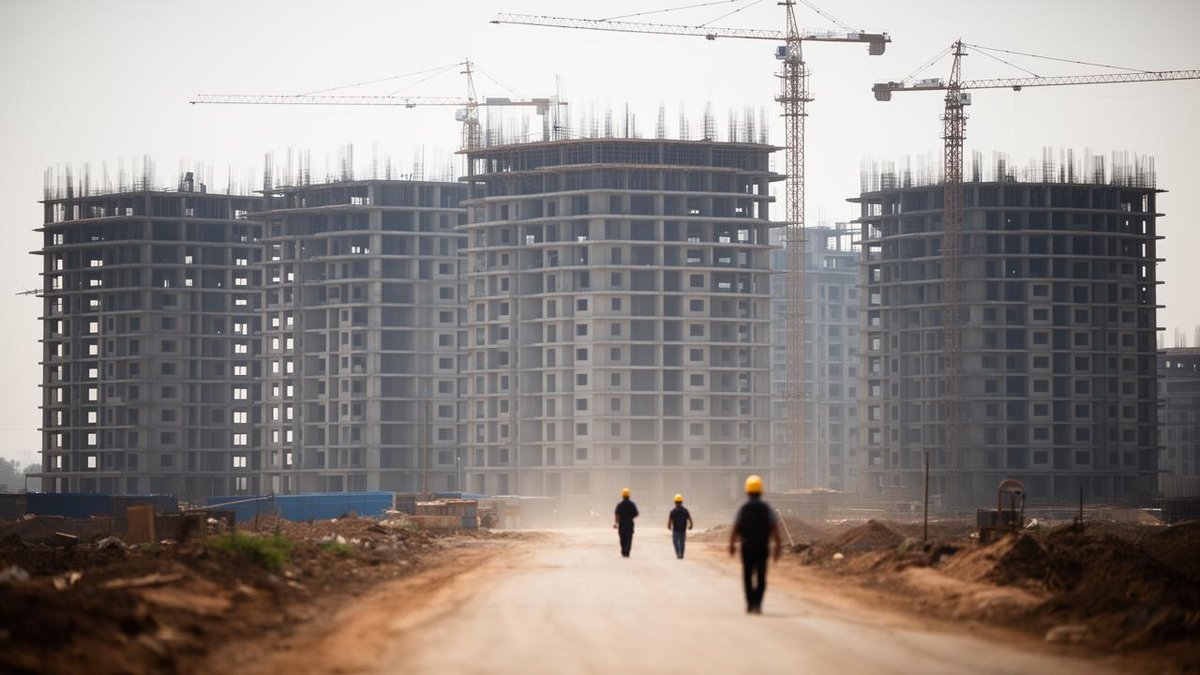
China’s October real estate development investment fell 34.24% year-over-year on a single-month basis. That figure means monthly investment data has returned to levels last seen fifteen years ago—while the cumulative year-over-year figure for the first ten months was still -21.6%, indicating that developers’ operating difficulties have not only failed to improve but are accelerating.
This was the most striking number presented by CLS Macro Projection in its breakdown of November data. In the same projection, another figure was no less devastating: in October, growth in all categories of basic household consumer goods turned comprehensively negative compared with September, and vegetable prices hit a record low for the month. The projection’s speaker distinguished between pork and vegetable prices—the decline in pork could still be explained by major producers expanding output and falling beef and mutton prices, but the new lows in vegetable and grain prices “can only mean household consumption has weakened to the point of cutting back on staple food consumption.”
Putting these two figures together, the underlying picture of China’s November economy becomes clear: prices “look decent on the surface, but the structure is extremely poor, with obvious K-shaped divergence.”
Prices Held Up Entirely by Oil, Negative Once Energy Is Excluded
The November CPI came in at 0.7% year-over-year and PPI at 5.7% year-over-year, both superficially in positive territory. But the projection’s speaker exposed the support behind them: after September, international oil prices surged again, and external inflation pushed up the overall readings. After excluding the impact of exogenous energy, domestic CPI has once again turned negative.
| Indicator | November Reading | Structural Breakdown | Speaker’s Forecast |
|---|---|---|---|
| CPI year-over-year | 0.7% | Energy (oil prices) as key support; negative after exclusion | May return to negative growth next year |
| PPI year-over-year | 5.7% | Relies on AI supply chain, energy, low base from last year | December data to begin pulling back |
| October basic household consumer goods | Comprehensively negative | Food prices back to late-2025 lows | — |
| Vegetable prices | Record low | Not explainable by supply factors | — |
The trigger for the pullback has already appeared. Crude oil, after surging twice in September and October, fell rapidly in November, so the November inflation data released in December will begin to pull back. The speaker further projected: absent new policies, with crude oil and gold prices falling sharply and AI product prices ceasing to rise, both household and industrial prices may return to negative growth territory next year.
This is not an isolated price judgment but the starting point of an aggregate projection.

The Three Growth Engines May Stall Simultaneously in the First Half of Next Year
The speaker used reverse deduction to connect the price clues into an aggregate judgment: if export growth declines or even falls to zero as the AI supply chain stops raising prices, real estate investment maintains a -20% decline, infrastructure investment maintains a -5% decline, corporate investment declines continue to widen and spread, and trade-in programs continue to be the main drag on household consumption—then the three growth engines driving the economy will stall simultaneously in the first half of 2027, and next year’s economic growth “may test the 4% threshold.”
This year’s situation: consumption and investment declines have widened, with the investment side particularly severe. There have been no new incremental fiscal or monetary policies all year, and combined with local government debt resolution and leadership transition pressures, the investment decline has approached pandemic-era levels. Although high export growth has been maintained, “the acceleration of the second derivative has already fallen to zero.” With three-quarters of the fourth quarter already past, the speaker judged that even if incremental policies were introduced now, their effect on the real economy would not arrive until next year, so the 2026 aggregate growth target will most likely only be met at the lower bound of 4.5%.
The policy path depends on exports. The speaker noted that senior leadership has maintained “strategic resolve” throughout the year—vigorously supporting new quality productive forces while dragging domestic demand along without lifting it—because high export growth can serve as a shield; but maintaining the current 30% year-over-year export growth next year will be significantly more difficult. Under a reasonable projection, next year will most likely see rate cuts, reserve requirement ratio cuts, expanded consumption measures, and real estate support policies.
The reverse scenario also holds: if AI applications explode and the AI supply chain is reignited to drive exports above expectations, broad incremental policies may again prove difficult to deliver.
“When export growth is high, domestic demand is dragged along without being lifted; when exports clearly fall back, domestic demand becomes the target for additional stimulus. So saying the global economy depends on AI is not just a joke.”
Real Estate: Only Shanghai Holding Steady; Investment Back to Levels of Fifteen Years Ago
In November, national home prices continued to fall and the pace of decline accelerated. Apart from Shanghai, which has recently maintained high transaction volumes while prices have stopped falling, other cities have returned to declining volumes and prices after the stimulus effects of the August and September policies faded.
The speaker reviewed the year’s trajectory: in the first half, first-tier cities stopped falling and rebounded, pulling second- and third-tier cities’ declines flat; mid-year, the first-tier rebound ended and turned sideways, while second- and third-tier cities re-accelerated their declines; in August and September, successive policies provided modest stimulus for a nationwide rebound; now only Shanghai remains stable.
The deterioration on the investment side is more severe than home prices. October real estate investment fell 34.24% year-over-year on a single-month basis, while the cumulative figure for the first ten months was -21.6%, with monthly investment data having returned to levels of fifteen years ago. The land market has cooled in tandem: the premium rate for land in 100 cities fell rapidly as developers’ rush to acquire land before new policies took effect came to an end.
Policy transmission on the demand side has also been uneven. More than two months after the launch of the 40-year mortgage policy, actual applications have fallen far short of expectations; bank data shows that 30-year mortgage applications are still twice the number of 40-year mortgages, which the speaker interpreted as “most people are still very resistant to adding leverage.”
Nevertheless, the speaker’s attitude toward real estate has turned less pessimistic. Benchmarking against Japan, he concluded: China’s five-year home price decline has already caught up with Japan’s fifteen years, yet Japan did not experience China’s dramatic collapse in new construction starts, accelerated price declines, and sharp supply contraction after prices peaked. He tends to believe China’s home price decline cycle has reached the latter half of Japan’s cycle, but stopping the decline and rebounding will still take time—Japan took twenty years to see society-wide inflation return, “and we most likely won’t take that long.” On the policy front, he believes that as auto and home appliance subsidies expire, the probability of a new round of stimulus falling on real estate has risen significantly, but this probability is likewise negatively correlated with export performance.
China-US Economic Mirror Resonance: AI Squeezing Real Estate in Both Countries
The speaker described the US three growth engines as a mirror image of China’s: investment and consumption performing excellently, exports persistently in deficit. The two countries resonate on the AI variable, and he identified two specific channels.
Investment side: China is seeing infrastructure and real estate contract while industrial plants remain stable; the US similarly has real estate under pressure, caused by the high interest rate environment created by AI-driven debt expansion. Consumption side: in China, the profit gap between AI and non-AI companies continues to widen, causing a 10-90 divergence in household wage growth; in the US, real wage growth for tech elites and blue-collar workers far outpaces other sectors.
US employment data supports the judgment of a manufacturing recovery. November nonfarm payrolls surged by 165,000, with the previous two months revised up by a combined 84,000. The speaker noted that the job market has shown a rebound and accelerating expansion after 2026, with the structure shifting from policy-affected healthcare and education sectors to manufacturing sectors such as factories, transportation, and warehousing, and growth momentum clearly shifting from private services and government to construction and manufacturing. His conclusion: although China’s internet has constantly mocked the US manufacturing reshoring strategy, the data shows that this AI cycle combined with strict US blockade policies has indeed given US manufacturing a possibility of renewed recovery.
The cost is inflation. Locking AI investment domestically means losing access to cheap labor supply, so inflation naturally cannot continue to fall: October US CPI rose 0.4% month-over-month, with core CPI up 0.3% month-over-month for the third consecutive month. The speaker believes oil price fluctuations are only temporary external influences; what truly keeps inflation sticky is AI-driven manufacturing reshoring, and this endogenous inflation will be difficult to eliminate in the short term, making a US return to a rate-cutting cycle increasingly difficult.
Falling Oil Prices Weaken Iran’s Leverage; US Inflation to Fall Markedly in December
The speaker judged that as long as the US-Iran conflict does not escalate, the downward trend in oil prices will be difficult to reverse—even if Iran frequently attacks tankers to gain favorable terms in negotiations. His reasoning is that the market has seen through Iran’s hand: “The boy who cried wolf loses credibility after too many cries; everyone has already seen Iran’s true colors.”
The supply-side evidence chain is clear: Iran attack reports appear almost daily, yet OPEC continues to increase production, crude oil flows through the Strait of Hormuz continue to rise, crude inventories in Europe, the US, and Japan continue to recover, and the International Energy Agency even forecasts that the global oil market is returning to oversupply, turning to surplus in the fourth quarter. Falling oil prices have put Iran in a dilemma: negotiations yield no major results, yet acting out is unsatisfying, and the longer it drags on, the weaker the leverage that falling crude prices give it against the US. The speaker’s judgment is that formal US-Iran peace talks will either emerge soon or remain in prolonged stalemate, “as if the conflict never happened.”
The direct market implication: combined with the November oil price decline, US inflation data released in December will show a relatively marked pullback.
Fed Decisions Disconnected from Real Economy; Waller’s Hawkish Turn Seen as Retaliation
The speaker’s baseline judgment on a December rate hike: from the perspective of short-term oil-driven imported inflation, there is little need for a 25 or 50 basis point hike; but from the long-term perspective that AI manufacturing may persistently raise the internal inflation center, a 25 basis point hike is defensible. The real problem is not in the data but inside the Federal Reserve—since Kevin Warsh took office, whether to hike has become disconnected from the real economy.
This month, hawkish remarks from various voting members continued to bombard the market, and the speaker believes many rate-hike arguments do not hold up, singling out Christopher Waller for “unprecedentedly” calling for a 50 basis point hike. He provided the background of personal恩怨—personnel grievances: Waller was one of two governors nominated by Donald Trump in his first term and had strongly advocated rate cuts before this year’s Fed chair transition; when another Trump-nominated governor, Michelle Bowman, successfully became vice chair, Waller was seen by outsiders as a hot favorite for the new chair, ultimately losing to Kevin Warsh, who has few achievements but closer ties to Bessent and the Trump family. The speaker said this 67-year-old governor, with three years left in his term, “has essentially reached the end of his career,” so Waller’s abrupt shift in stance against a backdrop of unchanged economic and inflation data carries too obvious a whiff of retaliation.
The remaining voting members were already at odds with Trump, and the Democratic Party, after its sweeping victories in both chambers, will be even less afraid of Trump’s threats—the result being that Warsh has become a commander without troops. The speaker’s inference: a smooth rate-cutting cycle will be hard to see during Trump’s term.
US Partisan Conflict Has Become an AI Bull-Bear Showdown; Bubble Burst Is the Biggest Gray Rhino
The speaker directly linked politics to market pricing: today’s US partisan conflict has become a contest between AI bulls and bears. He posed a projection with a question mark—whether the Democratic Party will, regardless of US economic fundamentals, insist on puncturing the AI bubble during what it calls Trump’s term, so as to win the election two years later and claim credit as the savior. He called this potentially the biggest gray rhino for capital markets over the next two years. Conversely, if AI can achieve rapid breakthroughs, the Republican Party’s election prospects two years from now may still be salvageable, so “US politics is now tied to AI’s belt,” and dramas like Jensen Huang’s departure and return may only multiply.
“Today’s US partisan conflict has become a contest between AI bulls and bears. If AI can achieve rapid breakthroughs, the Republican Party’s election prospects two years from now may still be salvageable.”
This political framework explains this month’s global asset selloff path. The main cause is panic selling after a concentration of negative news: earlier months’ preemptive declines in China and South Korea had already extinguished bullish sentiment, and this month’s release of negative news from the US side directly pushed US stocks into a bear market, dragging global assets into a negative spiral of cascading selloffs. Under panic, safe-haven plays became the only direction of capital inflow, with US Treasuries and dividend-paying consumer stocks rising against exaggerated rate-hike expectations, while almost all other assets were sold off.
Taiwan stock market movements provide a concrete sample of this cascading selloff. From October 30 to November 20, Taiwan stocks plunged from 45,211 points to 36,033 points, a swing decline of 20.3%; over the same period, the Philadelphia Semiconductor Index plunged 21.33%, the S&P 500 fell 8.83%, South Korean stocks slid 15.02%, and the Nikkei fell 10.83%. Taiwan’s Executive Yuan urgently convened industry and financial sector roundtables and rolled out six market-stabilization measures including National Stabilization Fund support, a full ban on short-selling below the previous close, and raising the margin requirement for short sales from 130% to 150%; on the day the policy package was announced, Taiwan stocks closed up 778 points.
The speaker emphasized the extreme disconnect between the real economy and capital markets: the global manufacturing PMI continues to expand, capital expenditure expectations have not been revised down but are being revised up, and AI companies’ earnings continue to beat expectations. “As frenzied as it was in June, so panicked is it now.” His judgment is that after the negative news and panic pass, the market will return to fundamentals-based pricing; Jensen Huang’s return is only the beginning, and the level of repricing depends on the pace of AI development—which he left for the Plus version to discuss in detail.
“The global manufacturing PMI continues to expand, capital expenditure expectations have not been revised down but are being revised up, and AI companies’ earnings continue to beat expectations—it’s fair to say the real economy and capital markets are extremely disconnected right now.”
This disconnect is most visible in Taiwan’s economic fundamentals. Taiwan’s Directorate-General of Budget, Accounting and Statistics on November 27 sharply revised this year’s economic growth rate up to 13.28%, the highest in 48 years, and also revised next year’s up to 6.51%; third-quarter economic growth was estimated at 14.36%, exports for the first ten months reached $758.287 billion, up 47.68% year-over-year, and October capital equipment imports surged 105.99% year-over-year. Over the same period, Taiwan stocks fell by a fifth in a single month. Darson Chiu, CEO of the Asia-Pacific Chambers of Commerce and Industry, warned that next year’s economy faces three major variables: a high base this year, whether AI demand can continue, and whether violent stock market swings will further affect private consumption—in the past, some people who did not work in the AI supply chain could still enjoy economic growth dividends through stock market trading, but that channel is now being cut off by valuation corrections.

The Internal Tension Between Two Judgments
What is most worth tracking in this entire piece is not any single data point but how the two main threads couple together. When China’s domestic demand policy will be stepped up depends on when exports fall back, and exports depend on whether the AI supply chain continues to raise prices; the US interest rate path depends on the endogenous inflation pushed up by AI manufacturing reshoring, and on a partisan conflict that may deliberately puncture the bubble. In other words, the same AI variable simultaneously determines the timing of China’s fiscal and monetary easing and the scope for US rate cuts.
The speaker himself flagged the fragility of this projection chain: if AI applications explode and drive exports above expectations, China’s incremental policies will again prove difficult to deliver; if the Democratic Party chooses to actively squeeze the bubble, the return to fundamentals-based pricing will be interrupted by the political cycle. His relative optimism on real estate (a five-year decline benchmarked against Japan’s fifteen years) and his pessimism on the aggregate (next year testing 4%) are not contradictory, but both rest on the premise that “policies will eventually be introduced”—and that premise itself is a function of exports.
For investors, this means that asset pricing in 2027 cannot look only at China’s policy calendar, nor only at the Federal Reserve’s dot plot—behind both is the same switch. The longer the boom in exports and AI capital expenditure lasts, the lower the urgency of China’s incremental policies; and the more stubborn the inflation pushed up by AI manufacturing reshoring, the narrower the Federal Reserve’s room for rate cuts. There is only one signal truly worth watching: when the AI supply chain’s price-raising cycle stops. Once it stops, China’s rate cuts, reserve requirement ratio cuts, and real estate support policies will quickly fill the gap, while US inflation stickiness will simultaneously loosen—that is the moment global assets switch from panic pricing back to fundamentals-based pricing.