

[Japanese Stock Market Crash] 10 Mistakes Individual Investors Make! Investment Rules to Check Before Fearing a Double Bottom
November 21, 2026 | Japanese Stock Market & Investor Sentiment Analysis
■ Introduction: Investor Judgment Tested by the Japanese Stock Market Crash
◇ The Japanese stock market has fallen significantly from last week to this week.
・The Nikkei Stock Average on November 20 was 56,436.65 yen.
・A decline of 4,705.70 yen from the previous weekend, with a weekly drop of approximately 7.70%.
・Selling has spread, centered on AI and semiconductor-related stocks, and investor sentiment has worsened.
◇ I believe the following anxieties are spreading among individual investors.
・Is this decline a double bottom?
・Won’t stock prices fall even further?
・Should I sell my holdings now?
・Or is this the perfect buying opportunity?
◇ However, the most important thing to be careful of during a market crash is not the decline in stock prices themselves.
It is breaking your own investment rules due to fear or impatience.
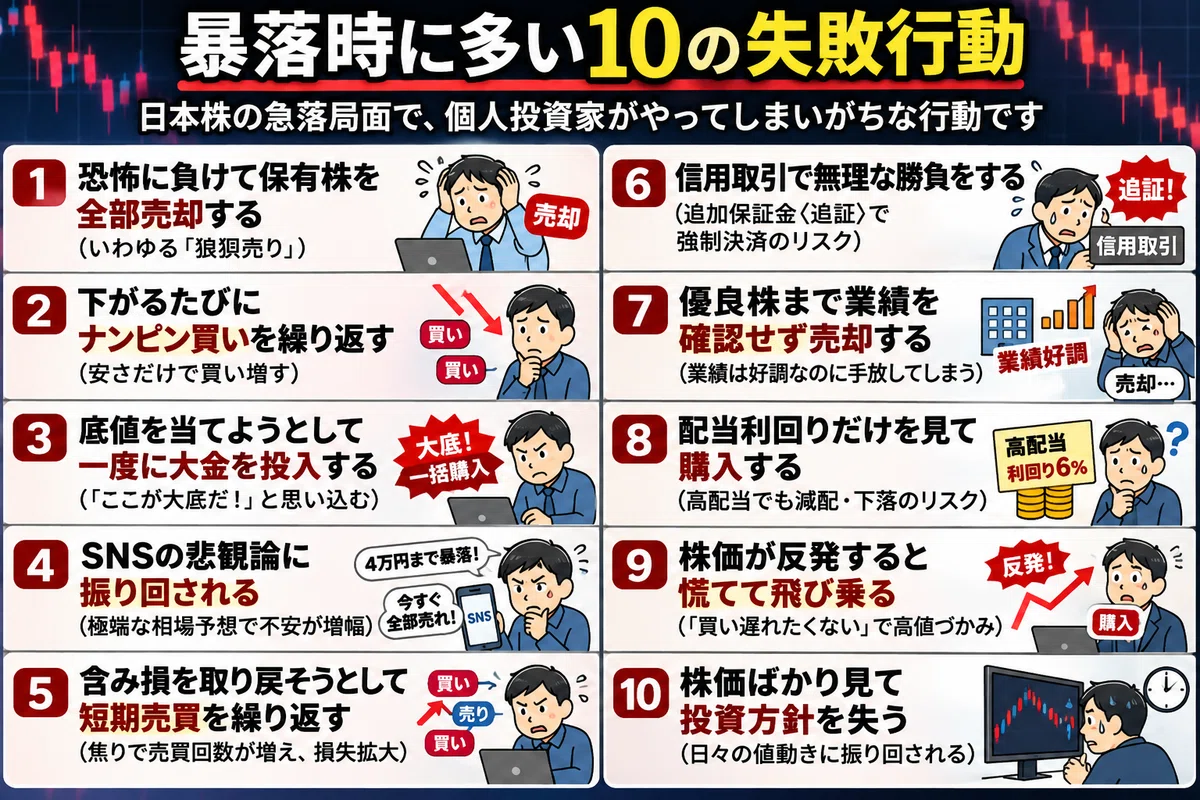
■ ① Giving in to fear and selling all your holdings
◇ This is what is known as a “panic sell.”
・Becoming unable to endure consecutive days of stock price declines.
・Selling holdings without checking corporate performance.
・Being unable to buy back in even if stock prices rebound sharply after selling.
◇ Countermeasures
・Distinguish between a decline in stock price and a deterioration in corporate value.
・Clarify the reason for selling.
■ ② Repeatedly averaging down every time the price drops
◇ This is the mistake of buying more just because the price has become cheaper.
・Buying after a 5% drop, and adding more after another 5% drop.
・The decline does not stop, and you end up using up all your investment capital.
・Mistaking a stock price decline due to poor performance for being undervalued.
◇ Countermeasures
・Check corporate performance before buying more.
・Decide on the number of purchases and the maximum investment amount in advance.
■ ③ Investing a large sum of money at once while trying to time the bottom
◇ The act of convincing yourself that “this is the absolute bottom!”
・Judging it to be the bottom because it has fallen 20% from the recent high.
・Not considering the possibility of further declines.
・Running out of additional funds and becoming unable to take action.
◇ Countermeasures
・Do not try to hit the bottom at a single point.
・Make split purchases the standard and keep cash reserves.
■ ④ Being swayed by pessimism on social media
◇ During a market crash, extreme market predictions attract attention.
・”The Nikkei Stock Average will crash to 40,000 yen!”
・”The AI bubble will completely collapse!”
・”You should sell everything right now!”
◇ Repeatedly viewing information like this amplifies anxiety.
◇ Countermeasures
・Do not take social media predictions at face value.
・Check corporate earnings, economic indicators, and supply-demand trends.
■ ⑤ Repeatedly engaging in short-term trading to recover unrealized losses
◇ This is the psychology of wanting to recover losses quickly.
・Buying another stock immediately after cutting losses.
・Jumping into surging stocks and buying at the peak.
・Increasing the frequency of trades, further expanding losses.
◇ Countermeasures
・Do not trade to recover losses.
・Only select stocks with clear reasons for purchase.
■ 6. Taking unreasonable risks with margin trading
◇ This is an especially dangerous action during a market crash.
・Increasing margin buying just because the stock price has become cheap.
・Additional margin calls (oisho) occur.
・Losses expand due to forced liquidation.
◇ Countermeasures
・Avoid excessive leverage.
・Thoroughly manage funds so you can withstand further market declines.
■ ⑦ Selling even high-quality stocks without checking their performance
◇ This is a mistake of confusing a stock price decline with a deterioration in corporate performance.
・Selling off even companies that continue to see revenue and profit growth.
・Letting go of high-dividend stocks that continue to increase their dividends.
・Losing out on future dividend income and opportunities for stock price recovery.
◇ Countermeasures
・Check the financial results before selling.
・Focus on profit growth, financial health, and dividend policy.
■ 8. Buying based solely on dividend yield
◇ A mistake that high-dividend investors should be wary of.
・Dividend yields reach 5% or 6% due to a sharp drop in stock price.
・Buying simply because it is a high-dividend stock.
・Subsequently, dividends are cut due to deteriorating performance, and the stock price falls even further.
◇ Countermeasures
・Check the dividend payout ratio.
・Check operating cash flow and profit growth.
・Consider the risk of dividend cuts.
■ 9. Jumping in a panic when stock prices rebound
◇ This is the psychology of “not wanting to miss out on buying.”
・The Nikkei Stock Average rises by 2,000 yen in a single day.
・You think it has bottomed out and buy in a hurry.
・The price falls again the next day, and you end up catching a rebound high.
◇ Countermeasures
・Distinguish between a sharp rebound and a full-scale upward trend.
・Check moving averages, trading volume, and corporate performance.
■ 10. Losing sight of your investment strategy by focusing only on stock prices
◇ The mental burden becomes significant during a market crash.
・Checking stock prices every few minutes.
・Focusing too much on unrealized losses.
・Changing from medium-to-long-term investment to short-term trading.
◇ Countermeasures
・Clarify your investment period.
・Follow your trading rules.
・Do not check stock prices more than necessary.
—
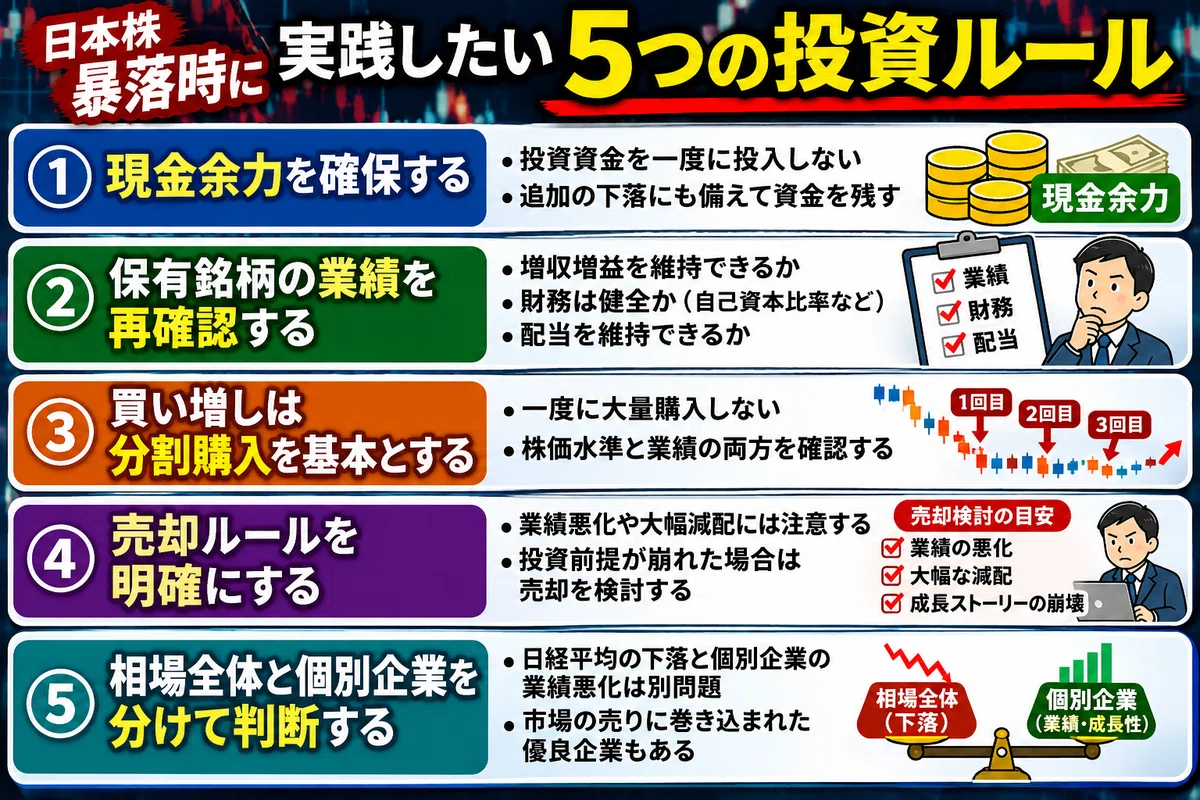
■ 5 Investment Rules to Practice During a Market Crash
◇ ① Secure cash reserves
・Do not invest all your funds at once.
・Keep funds in reserve for further declines.
◇ ② Reconfirm the performance of your holdings
・Can they maintain revenue and profit growth?
・Is the financial position sound?
・Can they maintain dividends?
◇ ③ Make additional purchases in installments as a rule
・Do not buy a large amount at once.
・Check both the stock price level and the company’s performance.
◇ ④ Define clear selling rules
・Be cautious of deteriorating performance and significant dividend cuts.
・Consider selling if the premise of your investment collapses.
◇ ⑤ Judge the overall market and individual companies separately
・A crash in the Nikkei Stock Average and the poor performance of an individual company are separate issues.
・There are also excellent companies that get caught up in a general market decline.
—
■ Is this crash a double bottom?
◇ At this point, it is impossible to determine whether this will be a double bottom or if it will fall further.
・Deterioration in supply and demand for AI and semiconductor-related stocks.
・Profit-taking and position reduction by institutional investors.
・Trends in the U.S. stock market.
・Corporate earnings and future profit growth.
◇ It is necessary to comprehensively confirm these factors.
◇ What is particularly important is not to predict how far stock prices will fall.
It is to prepare an investment environment that can handle further declines.
■ Finally: An investor’s true ability is tested during a market crash
◇ I believe that in the stock market, the difference in investor ability is more apparent during a crash than in a bull market.
・Getting greedy when prices rise.
・Selling out of fear when prices fall.
・Jumping in when prices rebound for fear of missing out.
◇ Repeating such emotional trading will make it difficult to build stable assets in the long term.
◇ On the other hand, investors who can calmly check corporate performance during a crash and adhere to fund management and investment rules can prepare for the next investment opportunity.
◇ However, it does not mean you should buy just any stock that has crashed.
・Companies with deteriorating performance.
・Companies with issues in their financial standing.
・Companies with the potential for significant dividend cuts.
◇ Sufficient caution is required for such stocks.
What is important in stock investment is not to perfectly predict a crash, but to ensure you do not exit the market even if a crash occurs.
And I believe it is about keeping the funds and judgment necessary to participate in the next bull market.
※ This article is an explanation of general investment behavior and risk management, and does not recommend the buying or selling of any specific stocks.