
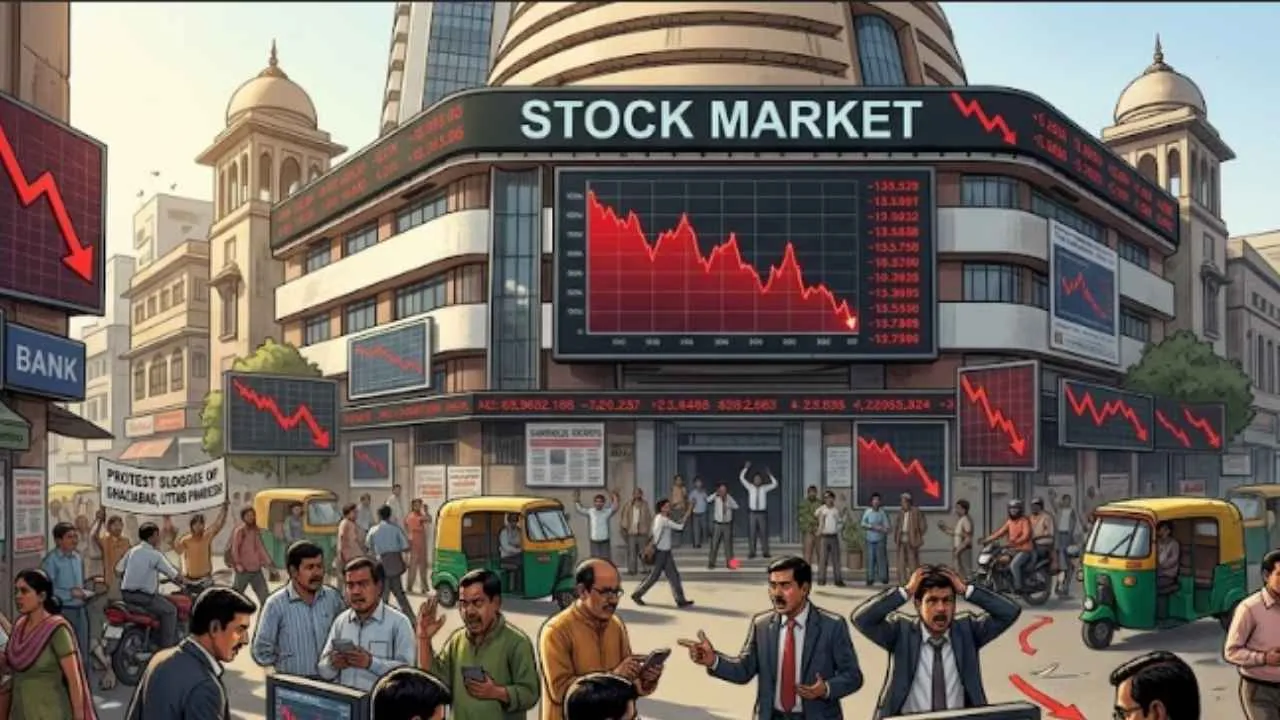
Stock Market Today: The Indian stock market has been under pressure for long now, and the market is in its most difficult 30 days with more losing streaks than winning.
It has recently faced massive selling pressure, costing more than expected. It amounts to over Rs 20 lakh crore in market capitalisation wiped out during the truncated week ending October 2, 2026.
On October 1, 2026, the Indian stock market witnessed a sharp sell-off, with around Rs 8.7 lakh crore to Rs 9.5 lakh crore wiped out in a single trading session. The Sensex plunged over 1,000 points intraday, highlighting the intensity of selling pressure and growing investor concerns.
In the broader picture, investor wealth erosion has crossed Rs 26 lakh crore. For the whole time, the Sensex and Nifty have remained under pressure amid heavy foreign investor selling.
The markets have also been taking pressure from rising global bond yields, elevated crude oil prices and rupee depreciation.
But when the stock market catches a cold, does everyone lose money? Not exactly. A market crash can reduce the value of investments. On the other hand, understanding what happens behind the numbers is crucial before making investment decisions.
Key Highlights Of The Stock Market Sell-Off
-
Market Capitalisation: The total market capitalisation of BSE-listed companies fell from Rs 4,71,86,292 crore at the opening to Rs 4,62,71,545 crore by 1:45 pm.
-
Rs 9 Lakh Crore Wiped Out: The sharp decline erased around Rs 9 lakh crore in market capitalisation within just a few hours.
-
Heavy FII Selling: Foreign Institutional Investors (FIIs) continued their selling spree, putting additional pressure on Indian equities.
-
Rs 10,000 Crore Sold: On September 30, FIIs sold Indian equities worth more than Rs 10,000 crore.
-
Rs 20,000 Crore In Two Sessions: FII selling crossed Rs 20,000 crore over the two sessions preceding the October 1 market sell-off.
What Is A Stock Market Crash?
To make the stock market crash simple, let’s decode. A stock market crash is a rapid and sharp fall on Dalal Street. There is a fall in the stock prices across a broad section of the market, sometimes all the sectors are in red. The market movement purely relies on the sentiments of the investors. And the sentiments of the investors are directly affected by the economic concerns, weak corporate earnings, rising interest rates, geopolitical tensions or investor panic.
When investors sell stocks heavily, share prices decline, reducing the overall market capitalisation. This does not mean the same amount of physical cash has disappeared. The figure mainly reflects a decline in the market value of listed companies.
Why Is The Indian Stock Market Falling?
The stock market is facing pressure due to several factors, including heavy FII selling, rising US bond yields, higher crude oil prices and rupee depreciation. Together, these factors can weaken investor sentiment and increase volatility across the Sensex and Nifty.
|
Factor |
How It Impacts The Indian Stock Market |
|
Foreign Investor Selling |
Heavy selling by FIIs increases supply in the market and can push stock prices lower. |
|
Rising US Bond Yields |
Higher US Treasury yields can attract global funds away from emerging markets such as India. |
|
Higher Crude Oil Prices |
Rising oil prices can increase India’s import costs, fuel inflation and affect corporate profit margins. |
|
Rupee Depreciation |
A weaker rupee can increase import costs, particularly crude oil, and influence returns for foreign investors. |
What Does Rs 20 Lakh Crore Wiped Out From Stock Market Mean?
The stock market capitalisation is calculated by multiple company shares and the number of outstanding shares. To make it simple, here is an example.
For Example: How Does Market Capitalisation Fall?
Step 1: Number of shares
A company has 10 crore outstanding shares.
Step 2: Initial share price
Suppose each share is trading at Rs 100.
Step 3: Calculate market capitalisation
10 crore shares × Rs 100 = Rs 1,000 crore
Step 4: Share price falls
Now, the share price falls from Rs 100 to Rs 80.
Step 5: New market capitalisation
10 crore shares × Rs 80 = Rs 800 crore
Step 6: Market value wiped out
Rs 1,000 crore − Rs 800 crore = Rs 200 crore decline
Now, imagine similar declines happening across hundreds or thousands of listed companies. The combined fall in their market values can quickly run into several lakh crore rupees.
So, when we say Rs 20 lakh crore has been wiped out, it primarily means that the market value of listed shares has declined, not that Rs 20 lakh crore in cash has vanished.
How Does A Market Crash Affect The Stock Market Ecosystem
How Does A Market Crash Affect Investors?
A stock market crash can harm the portfolio of the investors immensely. The crash will reduce the short-term value of an investor’s portfolio. Shares, mutual funds and equity-linked investments may decline in value. An unrealised loss is different from a realised loss.
So, investors generally realise a loss only when they sell an investment below its purchase price.
How Does A Market Crash Affect The Economy?
A stretched stock market decline can affect investor confidence, corporate fundraising and overall investment sentiment.
All these will directly affect, and falling share prices may make companies more cautious about raising capital and can influence consumption. This will affect the monetary flow in the economy and somehow disrupt the flow.
However, a falling Sensex or Nifty does not automatically mean that the entire Indian economy is in recession.
BSE Sensex & NSE Nifty 50: Opening vs. Closing (Last 15 Days)
|
Date |
BSE Sensex Open |
BSE Sensex Close |
NSE Nifty 50 Open |
NSE Nifty 50 Close |
|
Sep 18, 2026 |
74,505.90 |
74,294.96 |
23,334.70 |
23,346.40 |
|
Sep 21, 2026 |
74,380.15 |
74,858.99 |
23,330.20 |
23,414.30 |
|
Sep 22, 2026 |
74,910.40 |
74,529.08 |
23,454.05 |
23,329.00 |
|
Sep 23, 2026 |
74,620.10 |
74,828.25 |
23,352.15 |
23,446.80 |
|
Sep 24, 2026 |
74,750.80 |
73,580.54 |
23,221.80 |
23,063.10 |
|
Sep 25, 2026 |
73,610.25 |
73,895.74 |
23,035.00 |
23,140.50 |
|
Sep 28, 2026 |
73,734.83 |
72,771.72 |
23,064.90 |
22,780.25 |
|
Sep 29, 2026 |
72,260.09 |
72,529.07 |
22,732.45 |
22,716.20 |
|
Sep 30, 2026 |
72,441.15 |
72,480.29 |
22,665.00 |
22,620.45 |
|
Oct 1, 2026 |
72,192.89 |
71,909.70 |
22,543.70 |
22,421.95 |
|
Oct 2, 2026 |
Market Closed |
Gandhi Jayanti |
Market Closed |
Gandhi Jayanti |
|
Oct 5, 2026 (Live) |
72,340.95 |
~72,594.24 |
22,510.80 |
~22,608.70 |
-
Peak Trading Day: The Sensex recorded its highest closing level in this period on September 21, 2026, at 74,858.99, while the Nifty 50 closed at 23,446.80 on September 23.
-
Biggest Single-Day Drop: On September 28, 2026, the Sensex fell from an opening level of 73,734.83 to close at 72,771.72.
-
October 2: Indian equity markets remained closed on account of Gandhi Jayanti.
-
October 5: The figures marked as Live are indicative and may change during the trading session.
First Published: Oct 5, 2026, 08:49 IST