

This has been yet another great year for the stock market. The S&P 500 index (^GSPC -0.28%) recently reached an all-time high in August, and is up about 12% year to date. But some investors are worried. They’re wondering if the artificial intelligence (AI) trade is overhyped and overpriced. They’re concerned that U.S. growth stocks are too highly valued, and that the big gains can’t keep going for long.
I’ve been working, saving, and investing in the stock market for more than 20 years. I’ve seen some things. And probably the biggest lesson I’ve learned in my career is this: The stock market always bounces back. Even the worst bear markets and stock market crashes lead to buying opportunities. Long-term investors tend to keep making money — but you must be able to live with some short-term fear, doubt, and drawdowns.
Let’s look at what I learned about investing by living through three historic stock market crashes.

Even the biggest stock market crashes can be opportunities to plant seeds of future growth. Image source: Getty Images.
1. Dot-com crash: Tech stocks don’t always keep growing
I graduated from college in 2001, amid the bursting of the dot-com bubble. Many famous internet start-ups like Webvan, Kozmo.com, and Pets.com went bankrupt, and their shareholders were wiped out. A college classmate got her first job out of college at an innovative, world-changing, stock-market-darling company called Enron. We were all happy for her, until Enron collapsed in an accounting scandal. The stock market was plummeting. I was new to the working world, but it already seemed like that world was ending.
Here’s what happened to the S&P 500 and the tech-heavy Nasdaq-100 index during the bursting of the dotcom bubble, from March 2000 to October 2002:
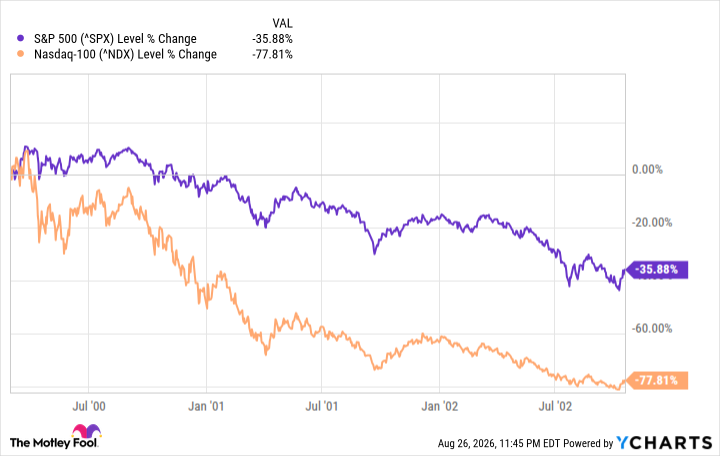
Here’s the lesson I learned: tech stocks don’t always outperform the rest of the market. They can be risky. If you want to make a concentrated investment in a tech-heavy Nasdaq-100 ETF like the Invesco QQQ Trust (QQQ -0.65%), keep in mind that booming growth stocks can go through big declines and volatility. Not every new technology that investors are excited about ultimately turns into a profitable business.
2. Global financial crisis: Housing isn’t always safe
In 2008, my wife and I had recently bought our first house, and had a new baby. I was still in the early stages of my career, working in the financial industry, trying to become better established both professionally and as an investor. Then the global financial crisis happened; massive banks failed, and millions of people lost their jobs and homes. It seemed that capitalism almost collapsed.
Here’s what happened to the stock market between July 2007 and March 2009:
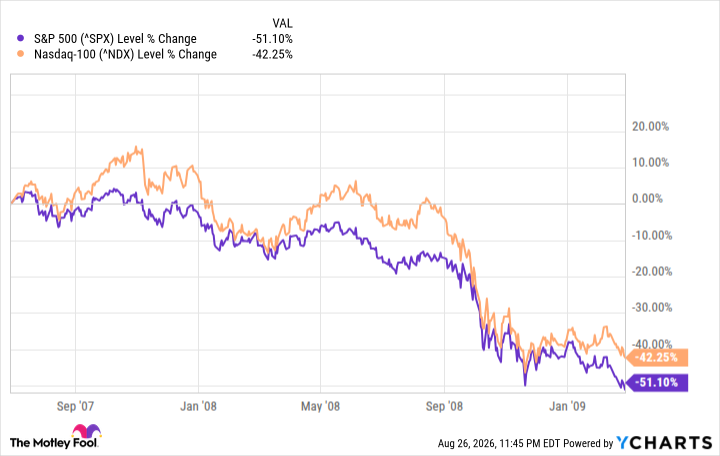
Here’s the lesson I learned: Buying a bigger house isn’t always the safest move for your money. And sometimes, there’s no place to hide during an economic crisis. You just have to hold on, keep working, and (if you’re lucky) keep saving and investing.
I was lucky. I never lost my job, and we were never in danger of losing our home. I kept putting money into stocks during the bear market’s lowest moments. But those tumultuous years stuck in my memory as a cautionary example of just how bad and how scary the economy and the stock market can get.
3. COVID pandemic: Stocks can crash fast, and recover faster
In January 2020, I was self-employed as a freelance writer and had recently lost a big client. I was hustling hard to find new gigs when the news started to fill with ominous chatter about a mysterious viral illness called COVID-19.
Soon, everyday life was turned upside down. Hospitals were filling up, public spaces were empty, almost everyone with an office job was working from home, and our children were doing online school. It seemed like society had changed overnight.
Here’s what happened to the stock market in less than two months during the pandemic stock market crash from February to March of 2020:
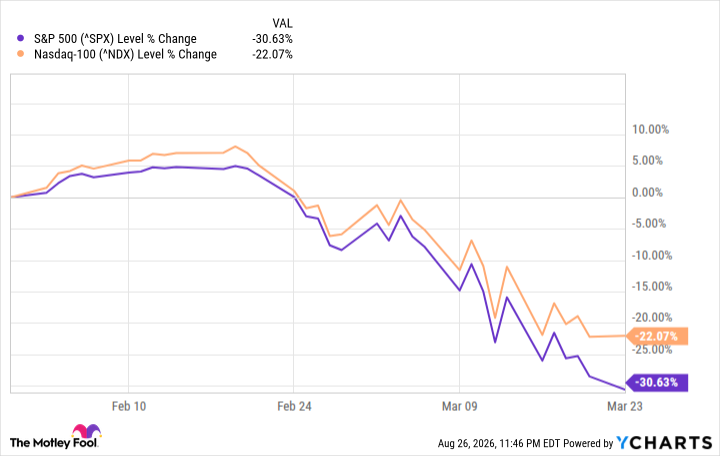
Here’s the lesson I learned: Stocks can fall fast, but they can also bounce back fast. By the end of 2020, the S&P 500 was up about 50% from its initial pandemic lows.
How to keep investing during stock market crashes and bear markets
What did I learn from all these stock market crashes? The world doesn’t end; it keeps going. Crises happen, but they also end. People keep working; companies keep innovating and earning. The economy heals. New jobs get created. New opportunities emerge. And “this too shall pass.”
With the steady, consistent process of saving and investing, and buying a broadly diversified portfolio of stocks and bonds, it really is possible to build wealth and achieve significant financial security as a long-term investor. The math works.
Even if you buy an S&P 500 ETF right before a big stock market crash, in the long run, you’re likely to make money. Don’t worry about trying to time the market by waiting for exactly the right moment to “buy the dip.” Just keep dollar-cost averaging with the same amount of money on a regular basis, every month, every payday.
SPDR Portfolio S&P 500 ETF: Annualized returns of 11.26% since November 2005
I believe that one of the best ways for most people to invest in stocks is to buy well-diversified low-cost index funds. Buying an S&P 500 ETF like the SPDR Portfolio S&P 500 ETF (SPYM -0.21%) gives you exposure to all 500 of the largest publicly traded companies in America, which make up about 80% of the U.S. stock market.
This fund charges a remarkably low expense ratio of 0.02%. And just by tracking the performance of the S&P 500, it has delivered an average annual return of 11.26% over the past 20 years (and counting) since its inception in November 2005.

State Street SPDR Portfolio S&P 500 ETF
Today’s Change
(-0.21%) $-0.19
Current Price
$90.56
Key Data Points
AUM
$171B
Dividend Yield
1.00%
Expense Ratio
0.02%
Top Holdings
NVDA
8.30%
AAPL
6.95%
MSFT
5.64%
That strong annualized return includes all the bear markets, corrections, crises, and stock market crashes since November 2005. This fund isn’t the only way to invest in a diversified portfolio or buy the “entire” U.S. stock market, but it’s a great start. If you buy the S&P 500 and hold that investment for the long term, you’re likely to earn solid returns and build wealth — no matter what bad news happens along the way.