
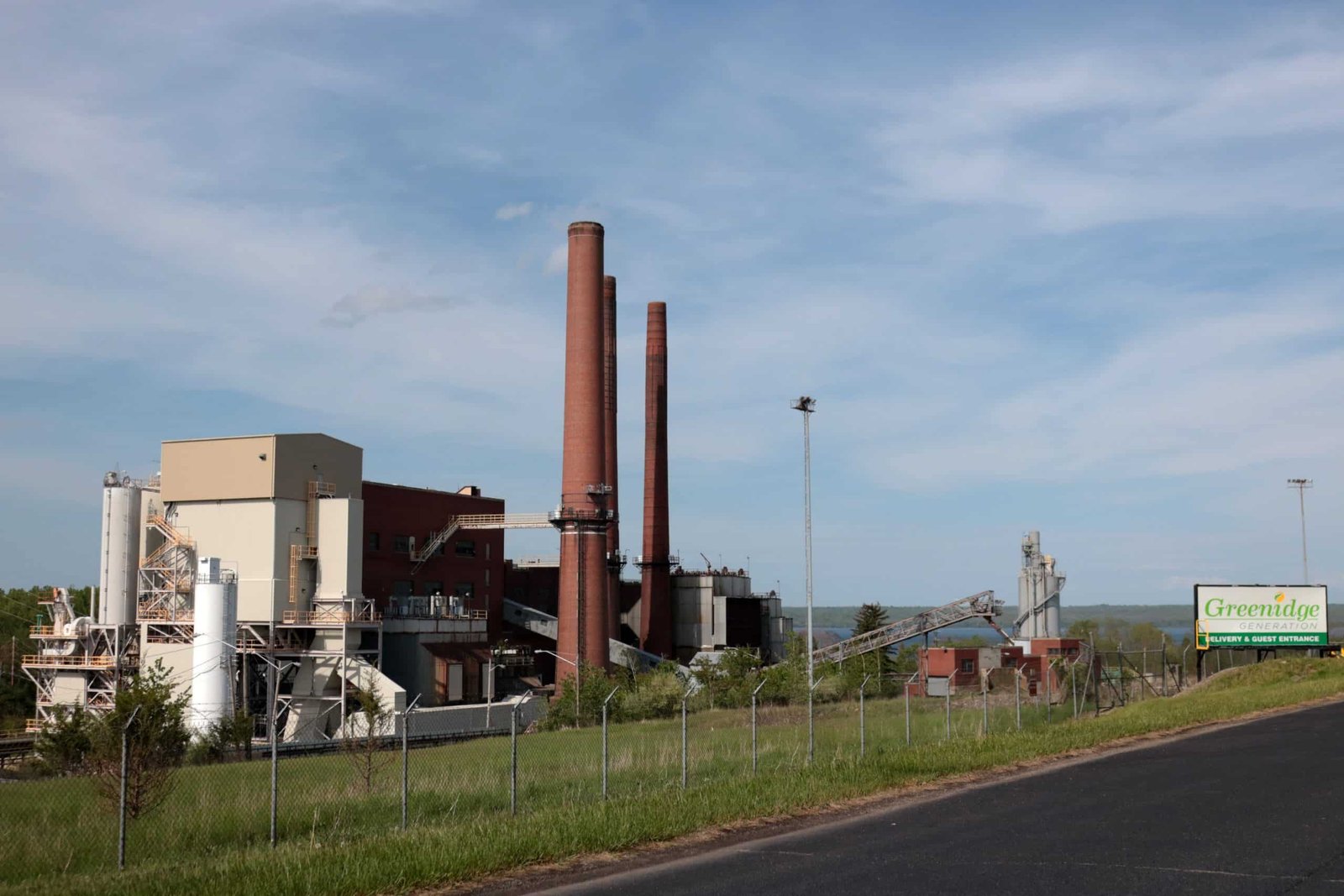
With its Bitcoin mining business stuck in a doom loop, Atlas Holdings is attempting an emergency pivot into the latest investing fad: AI data centers.
To pull it off, the Connecticut private equity group will have to surrender control of Greenidge Generation, the subsidiary that owns the Dresden power plant it bought in 2014 and the Bitcoin mining operation it launched there in 2019.
That’s a tall price for the Greenwich-based high-flyers.
But they figure they need to pay it to enlist new partners in a deal that’s part financial bailout and part ambitious scheme to launch artificial intelligence data centers at one or more of a dozen sites across the U.S. and Canada, including Dresden.
If consummated, the deal would slice Atlas’ ownership share from 66.2% to 17% and knee-cap Greenidge’s common shareholders by aggressively diluting the value of their stock.
And it may be bad news for the state’s electricity ratepayers. Because if all goes according to plan, the Dresden operation would switch from being a net seller of power to the New York electric grid to a net buyer from the grid. And power-hungry new customers tend to drive up rates.

But desperate times call for desperate measures.
On July 20, Greenidge announced that it was changing its name to Vulcan Infrastructure and Power Inc., moving its headquarters to the Rochester suburb of Pittsford and partnering in a proposed $39.4 million recapitalization.
Vulcan is desperate for that new financing because it has no way to repay a $33.1 million high-interest loan due Oct. 31. If the deal fails to close soon — financial analysts note that’s a real risk — the company faces bleak alternatives like bankruptcy or liquidation.
The problem is Bitcoin mining has proven to be a losing bet. After taking on heavy debt to purchase the latest machines used to mine Bitcoin, the company has failed to generate revenue needed to cover its loan repayments.
The situation has gone from lousy to dire.
For the first six months of this year, the company’s cost to mine one Bitcoin soared to 171.5 percent of the value of one mined Bitcoin, compared to 71.4 percent in the same period a year earlier. Company losses have piled up, available cash has continued to shrink and the NASDAQ stock market has renewed its threat to delist its common stock (which now trades under the ticker symbol VIP instead of GREE).
So what do Atlas’ new partners — Machine Investment Group and Conversant Capital — stand to gain by joining forces with such an economic deadbeat?
Coveted access to the New York grid, for one thing.
When it was still named Greenidge, Vulcan requested rights to draw a total of 260 megawatts of power from the grid. One application for 60 MW has been approved, while another seeks grid power for a proposed “Greenidge 200 MW Data Center Project.”
That pending request is in a queue with dozens of other bids from other data center development hopefuls. The state’s power grid, which is managed by the New York Independent System Operator (NYISO), can’t possibly grant them all.
But Atlas may have an edge over others in the line for grid interconnection.

Atlas co-founders and managing partners Andrew Bursky and Tim Fazio have a long track record of winning major concessions from New York politicians and regulators, including New York Gov. Kathy Hochul and her predecessor, Andrew Cuomo. Bursky, in particular, has far-reaching fundraising connections for fueling political campaigns.
Under Cuomo, the state awarded Greenidge a $2 million grant to upgrade the 104-megawatt Dresden station, waived its environmental impact statement and allowed it to restart before it had obtained water intake and water discharge permits.
The company justified its lobbying campaign for lax treatment with the argument that the plant would be supplying the grid with power in times of peak demand (as it still does and would continue to do).
Given that history, there’s a certain irony to Vulcan’s current ambitions, according to James J. Bobreski, a candidate for the New York State Senate.
“For years Dresden has been defended as a power producer. Its future now appears increasingly tied to becoming an enormous power consumer,” Bobreski emphasized in a recent opinion column.“Is Vulcan principally interested in preserving a generating station, or is that (Dresden) station becoming the doorway through which a private AI data center gains access to hundreds of megawatts of New York electrical capacity?”
Amid increasingly widespread public fears that data centers will drive up energy costs, several states have recently taken steps to address the crush of demand for power from would-be data center developers.
In Pennsylvania, for example, Gov. Josh Shapiro signed an executive order Aug. 18 that requires all new data centers to supply their own power rather than draw it off the state grid.
A month earlier, Hochul had issued an executive order establishing a moratorium of up to one year on New York permits for new data centers of 50 megawatts or more — the first such order in the country.
But she has delayed signing a bill passed by the state Legislature that would require all new and existing data centers of 20 MW or more to supply their own power.
While Hochul’s order won her nationwide headlines for decisive early action, critics argue that her stance so far fails to adequately address the potential environmental and energy price consequences of the data center tsunami.
“The Democrats have proven quite adept at appearing to respond to popular demand while ultimately siding with their billionaire backers,” Bill Carini, a member of the Green Party, wrote in a recent opinion column.
Vulcan has noted that Hochul’s moratorium “does not impact existing data centers in New York” — presuming that the failing Bitcoin operation qualifies as one.
In a 31-page promotional pitch to investors released Aug. 17, Vulcan touts the Dresden station as “a 104 MW power plant with existing power revenue streams and 64 MW immediately available for AI/HPC conversion.”
In other words, Vulcan sees no regulatory impediment to immediately converting the Bitcoin mining operation into an artificial intelligence/high performance computing data center.
But Vulcan’s ambitions vastly exceed that one conversion.
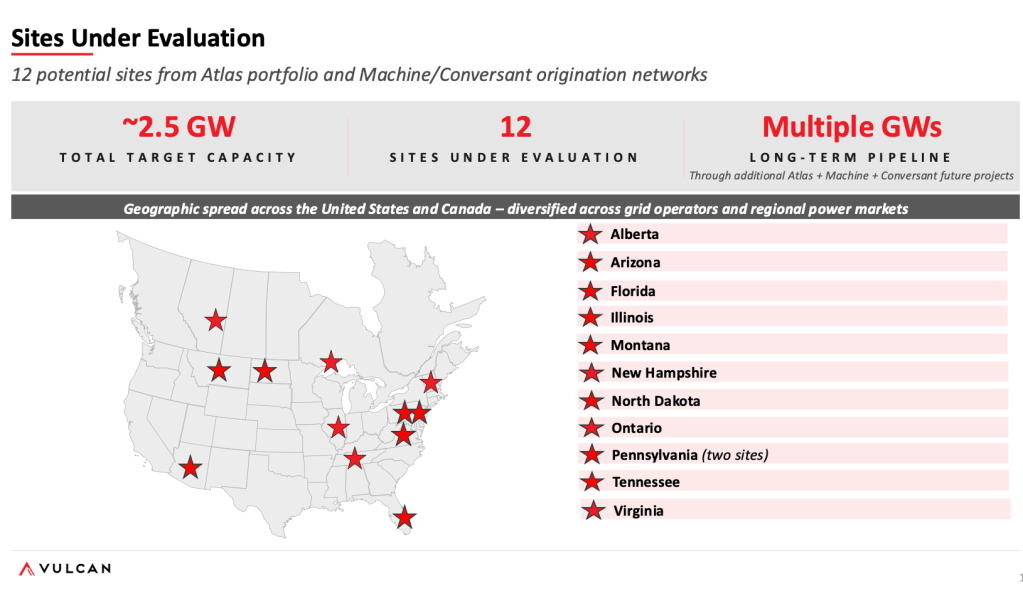
Aside from the prospect of an additional 200MW data center in Dresden, the company says it is evaluating 12 other sites for new data centers powered by at least 500 megawatts of power. Those potential sites, which lie within the Atlas “portfolio” or the “origination networks” of Machine and Conversant, are located in nine states and the Canadian provinces of Alberta and Ontario.
Atlas Holdings has grown spectacularly since its founding in 2002. It owns 30 businesses with 75,000 employees at 300 sites on five continents. It manages $18.1 billion in assets.
Machine Investment Group, founded in New York City in 2020, describes itself as a “real estate investment platform focused on opportunistic, distressed and special situations across the United States.”
Conversant Capital, founded in 2020 in Summit, N.J., has $2.7 billion in assets under management.
The recapitalization plan calls for the issuance of 17.15 million new Vulcan common shares at $1.71 apiece. Machine would invest $15 million for 2.92 million common shares, plus a $10 million loan convertible into common shares. Conversant would invest $5.95 million for about 3.5 million shares, while Atlas would pay $5 million for about 2.9 million shares. Other investors, including several Vulcan executives, would invest $13.37 million for about 7.8 million shares.
After the closing of the $39.4 million transaction — assuming it does close — Machine Investment would control 22.4 percent of Vulcan, Atlas 17.0 percent and Conversant 8.3 percent. Current common shareholders would control 31.9 percent, while company officers and other key investors would hold the remaining 20.2 percent.
Because the transaction would more than double the company’s Class A common shares outstanding, current common shareholders would see their equity slice of the pie cut by more than half.
In a press release that announced the partnership, Fazio, the Atlas co-founder and managing partner, said:
“Atlas has a long history of investing in power generation assets and power-intensive industrial businesses….Like Machine, we look forward to the company building a differentiated platform at the intersection of power generation and digital infrastructure.”
Vulcan CEO Jordan Kovler added: “This transaction is an enormous step forward for our business and a milestone for our stockholders. We are eliminating debt, strengthening our balance sheet, and positioning the company to participate aggressively in the growing market for data center infrastructure.”
Even if Atlas pulls off its recapitalization plan for Vulcan, several environmental issues remain unresolved:
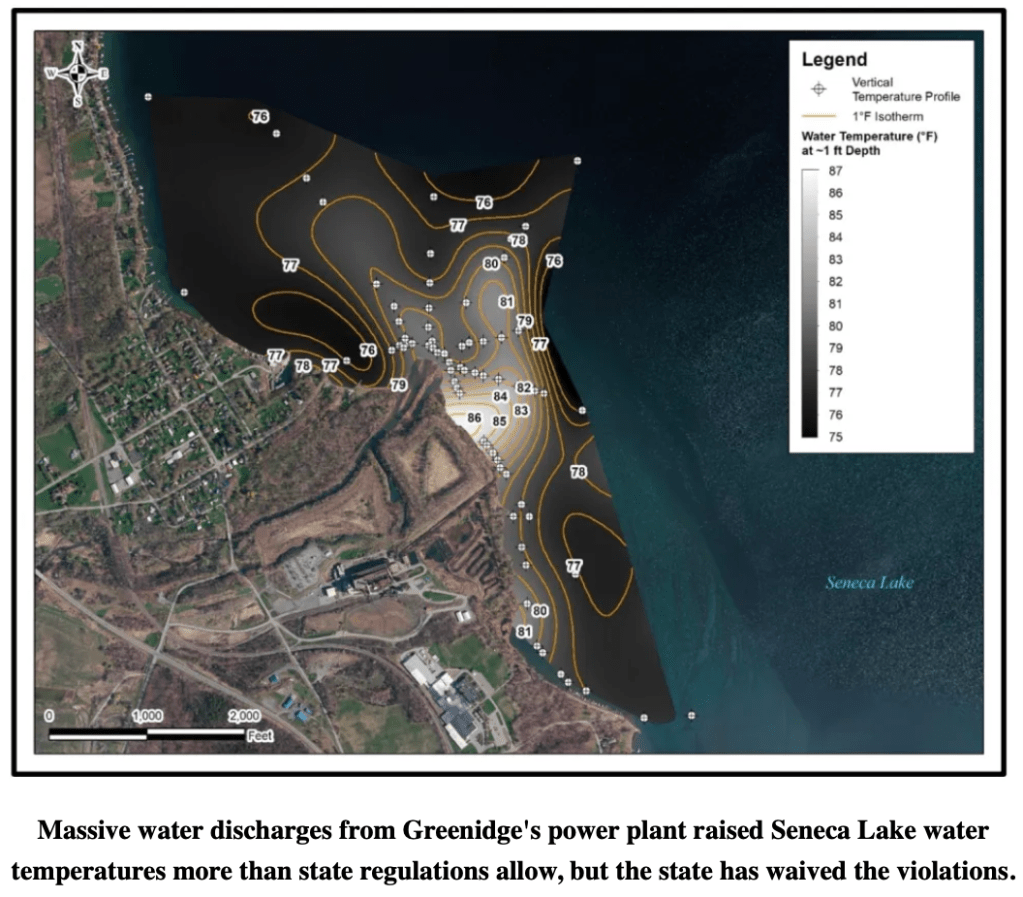
— Water pollution in Seneca Lake. Years ago, New York regulators allowed Atlas to restart the Dresden power plant without requiring it to convert to closed-cycle cooling, the power industry standard, to cool its equipment. Instead, it permitted plant operators to withdraw up to 139 million gallons a day from Seneca Lake and to return water to the lake — unrecycled — at temperatures that exceed state regulations and disturb aquatic life. The state shows no sign of requiring an updated cooling system.
— Unresolved air pollution issues. In 2022, the state denied the company’s bid to renew its Title V air quality permit because the plant failed to comply with the state’s climate law. Last November Hochul announced a stipulation agreement with Greenidge that resolved pending administrative and judicial proceedings — infuriating environmentalists and triggering a 39 percent leap in Greenidge’s stock. But that was only a temporary solution, according Vulcan’s 10Q filing with the Securities and Exchange Commission. “While the stipulation provides a pathway toward resolution of the permit renewal process, there can be no assurance that a final Title V Air Permit will ultimately be issued,” the 10Q, released Aug. 14, stated.
— Mandatory cleanup of its toxic coal ash. The company is required under federal law to remediate a coal ash pond on the Dresden site by November 2028. Meanwhile, it carries a $17.3 million liability on its books until that cleanup is accomplished.
— Eventual cleanup of a landfill that serves as a leachate treatment facility on the Dresden site. The company carries a $13.7 million liability to cover closure costs and expenses if and when the landfill closes.
Those environmental issues could emerge as an issue in the political campaign for the seat that represents Dresden’s state Senate district.
Bobreski, a Democrat, is running against long-time Republican incumbent Tom O’Mara of Big Flats, a past supporter of Atlas’ business plans in the region. Records show O’Mara attended a lobbying meeting at which Fazio and associates lobbied state officials for relaxed regulation.
Bobreski never mentions O’Mara in his Aug. 20 OP-ED, but he concludes:
“While everyone is being invited to look toward the dazzling future of AI, we should keep one eye firmly on the past. Greendge can become Vulcan. Bitcoin can become AI. GREE can become VIP. But changing the corporate name does not make the coal pond disappear.”
Peter is a three-time Pulitzer nominated reporter covering environmental issues through his first-of-its-kind digital publication The Water Front. He’s won an array of Associated Press, UPI, and Society of Professional Journalist awards. His reporting on environmental issues continues to be featured in prominent New York publications and is available on FingerLakes1.com through an exclusive content partnership. Have a question or lead? Send it to peter@fingerlakes1.com.