
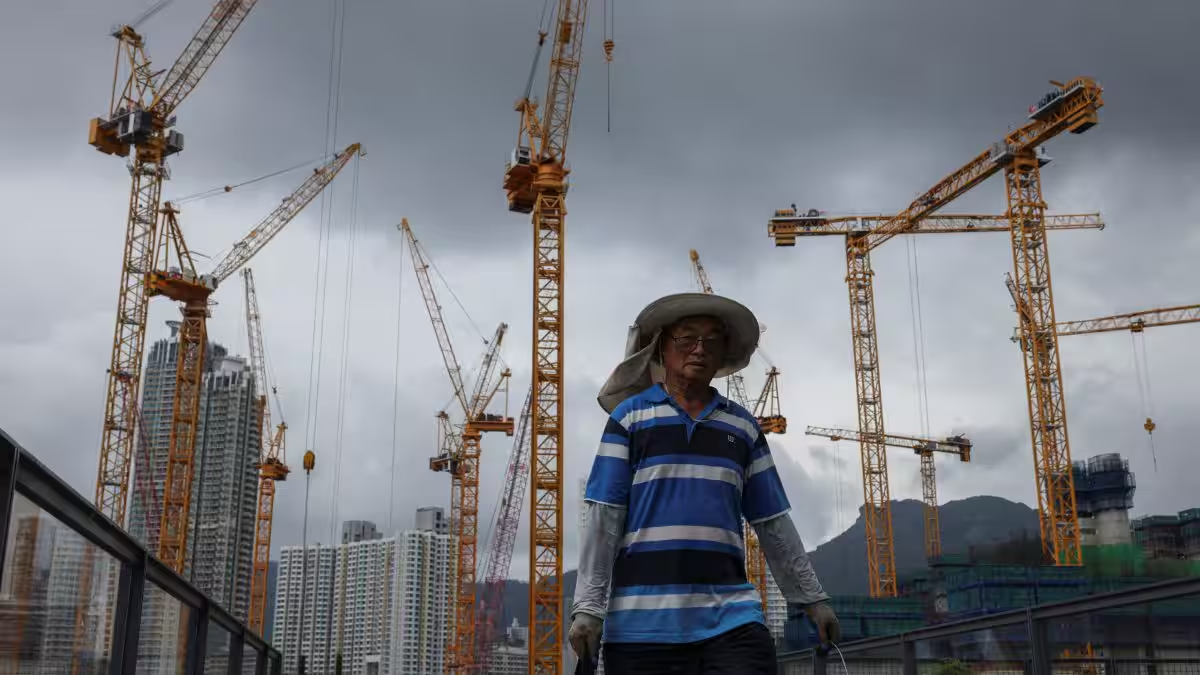
China’s property market faces a growing threat from expiring land leases, with over $148 billion worth of non-residential assets having 20 years or less remaining, putting property values, deals and investor confidence at risk
China’s property market is facing a new problem as thousands of commercial properties approach the end of their land-use leases, creating uncertainty for investors, depressing valuations and making some assets harder to sell.
More than 1 trillion yuan (around $148 billion) worth of non-residential property in China now has 20 years or less remaining on its land leases, according to estimates from Cushman & Wakefield, as reported by Bloomberg News. The issue is becoming increasingly important for developers and investors already struggling with a property downturn that has lasted for more than five years.
The problem stems from China’s system of state ownership of urban land. Property owners do not own the land outright but receive land-use rights for fixed periods.
Under rules established largely in the early 1990s, land-use rights generally run for 40 years for commercial properties such as shopping malls, 50 years for industrial and office properties, and 70 years for residential buildings.
As those leases approach expiry, investors have been left with little clarity over whether they can renew them, how long extensions would last and how much they would have to pay.
That uncertainty is now affecting property transactions.
A growing problem for China’s property market
The issue might appear distant because many leases still have years left to run. But investors, banks and insurers often take the remaining lease period into account when valuing or financing a property.
 More from Business
According to Cushman & Wakefield, banks may be reluctant to extend or refinance loans against properties with less than a decade remaining on their leases.
Insurers and developers, meanwhile, typically prefer properties with more than 20 years remaining before committing to transactions, according to Jones Lang LaSalle.
That creates a problem for owners looking to sell or refinance properties as the remaining lease term gets shorter.
Potential buyers may demand steep discounts to compensate for the uncertainty over future renewal costs. Some investors have effectively priced properties on the assumption that leases may not be renewed on favourable terms, according to people familiar with the matter.
The result is further pressure on already weak commercial property values.
According to the Bloomberg News report, office values in some major Chinese cities have fallen by more than 40 per cent from their peaks. Developers across China’s property sector have also defaulted on roughly $130 billion of debt, adding to the pressure on asset owners.
The lease issue could therefore make it even harder for developers to dispose of properties and raise funds.
Billions of dollars of assets affected
The scale of the problem is expected to grow in the coming years.
By 2030, around 30 million square metres of office and retail space across 18 major Chinese cities could have less than 20 years remaining on their land-use rights, according to an earlier estimate by CBRE.
The figure covers only properties with single owners, suggesting the actual amount of affected commercial real estate could be higher.
Shanghai and Guangzhou move first
Chinese authorities are now beginning to address the issue.
Officials in Shanghai have circulated guidelines in recent weeks setting out proposed terms and costs for extending land leases. The move follows similar steps taken by Guangzhou earlier this year.
The developments could provide some much-needed clarity to a commercial property market that has struggled to find a bottom.
Shanghai and Guangzhou have proposed lease-extension costs of at least 70 per cent of a relevant benchmark. The benchmark is based on land prices before taking into account the additional value created by buildings such as offices and shopping malls.
That means the cost of extending a lease could still represent only a fraction of the total value of a property.
However, investors remain concerned about how the rules will work in practice.
There is still limited clarity over how early property owners can apply for extensions and what conditions they must meet. Some local governments have suggested that applicants may need to demonstrate future investment plans or capacity expansion.
But local authorities retain considerable discretion over how those requirements are interpreted.
Beijing faces pressure to act
China’s central government has so far provided limited details on how commercial and industrial land-use rights will be renewed nationwide.
Earlier this year, Beijing said it would refine laws and regulations governing the renewal of land-use rights for industrial and commercial purposes and advance extensions in a “steady and lawful manner”.
For now, local governments appear to be testing different approaches.
Shanghai and Guangzhou could provide a model for other cities, while areas including Xiamen and parts of Hangzhou have already introduced rules covering some industrial land.
But investors are likely to remain cautious until Beijing establishes a framework that can be applied across the country.
Hong Kong provides one possible comparison. The city has a more standardised approach under which leases can generally be extended for 50 years when they expire, with property owners paying government rent annually.
Mainland China has no similarly clear nationwide framework for commercial and industrial properties.
That uncertainty is becoming increasingly costly.
For a property owner, a shorter lease can mean a lower valuation, fewer potential buyers and greater difficulty obtaining financing. For banks, it can increase the risk of lending against an asset whose underlying land-use rights are approaching expiry.
And for investors, the uncertainty over renewal costs makes it harder to calculate the future value of a property.
China’s authorities are therefore confronting a problem that could become more significant as the country’s property downturn continues: even if the broader market stabilises, a growing number of buildings could remain difficult to sell or finance simply because the land beneath them is running out of time.
The success of Shanghai and Guangzhou’s measures — and whether Beijing eventually establishes a nationwide system — could determine whether expiring leases become a manageable administrative issue or another drag on China’s already troubled property market.
With inputs from agencies.