
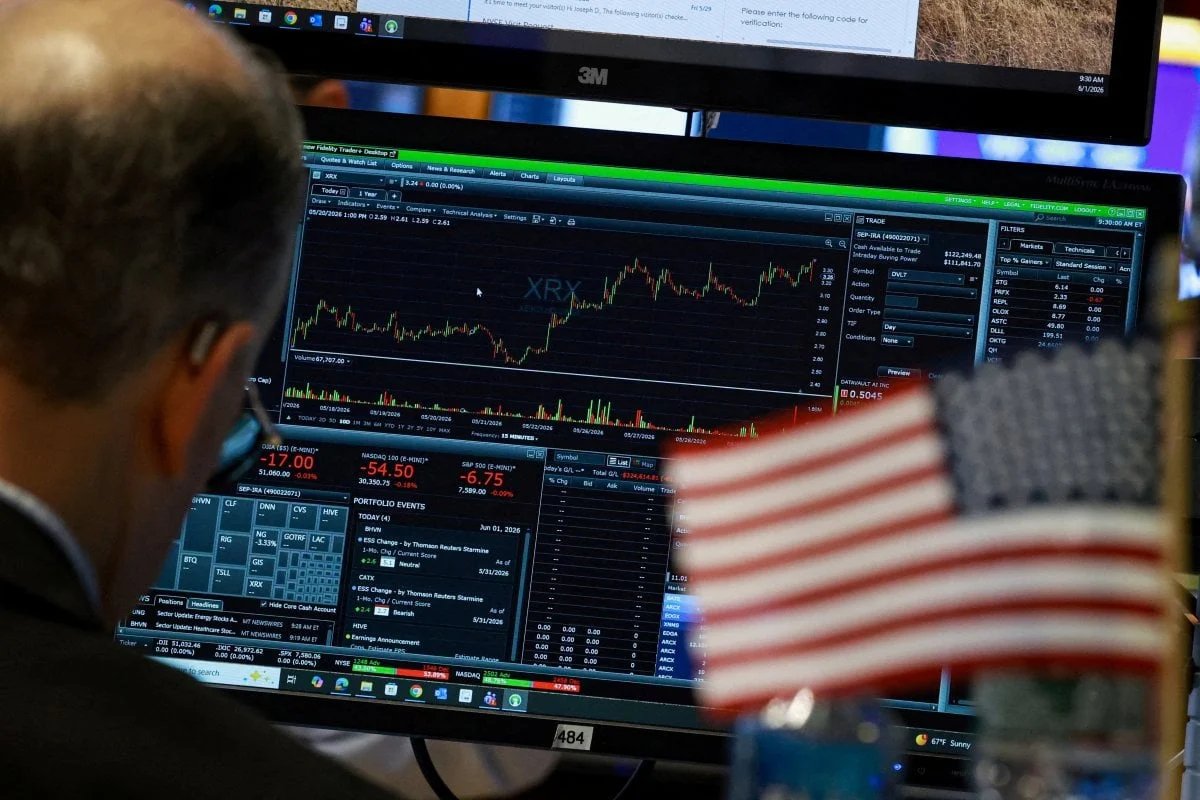
Investing.com — Wall Street on Monday was slightly lower amid small moves after posting its best week since mid-April. Rising oil prices, a slump in the real estate sector, and softness in technology stocks weighed on sentiment.
Stocks are coming off their best week in over three months, helped by a slide in oil, a strong earnings season, and a rebound in semiconductor names. The advance helped the broader market return to record levels for the first time since early June.
Last week’s advance was also boosted by a softer-than-expected July jobs report which prompted traders to pare Federal Reserve rate hike expectations. Attention is now on key inflation data in the days ahead for further cues on monetary policy.
At 14:09 ET (18:09 GMT), the benchmark S&P 500 index was down 0.1% to 7,752.44 points, the tech-heavy slipped 0.4% to 26,585.37 points, and the blue-chip shed 0.3% to 53,896.53 points.
“Wall Street has just had an incredibly strong week, but from here on out, I expect markets to remain volatile,” Yerbol Orynbayev, former World Bank governor of Kazakhstan, told Investing.com.
“The unexpected jobs slump may have lowered the likelihood of a Fed rate increase, but we’ve yet to see July’s inflation data, so uncertainty still hangs over investors. The lack of forward guidance from Warsh doesn’t help matters, either,” he said.
” jumped to their highest since 2007 following the Fed’s last decision, and I expect the consequences of stripped-back communication to hang around over the next few weeks and months,” Orynbayev noted.
“Chip stocks and an oil-price slide drove last week’s solid performance, but with AI bubble risks still present, Middle East tensions continuing to flare, and uncertainty rife, we’re still in for a bumpy ride,” he cautioned. Get premium stock market insights with analyst comments on InvestingPro – now 55% off
Trump demands compensation from Iran amid Hormuz uncertainty
Oil prices rose nearly 5% on Monday after Iran ruled out direct talks with the U.S. and said a full reopening of the Strait of Hormuz would only be possible after Washington met certain conditions. Concerns over regional oil flows were also exacerbated by Iran-backed Houthi attacks on Saudi Arabian energy infrastructure.
, the global oil benchmark, were last up 4.6% to $87.42 a barrel, while gained 4.6% to $81.80 a barrel. Both contracts were coming off steep weekly losses of more than 7%, driven largely by assertions from U.S. officials including President Donald Trump that talks with Iran were ongoing.
But the decline was tempered towards the end of the week amid Tehran’s continuous rejection of Washington’s negotiation claims and reports that the Strait of Hormuz’s management framework would prohibit passage of U.S, Israeli, and other hostile vessels through the vital waterway.
Iran’s state media said a parliamentary commission had approved the framework with the inclusion of the ban on the vessels. Foreign ministry spokesperson Esmaeil Baqaei on Monday said that Iran and Oman had yet to finalize a joint statement on the management of the strait, adding that the plan would include mechanisms to monitor vessel passage, for which compensation should be received.
Iran also ruled out direct talks with the U.S. for now, citing alleged violations of the interim peace agreement reached in June. Tehran reiterated conditions for a full reopening of Hormuz, including an end to the U.S. naval blockade, the removal of sanctions, and compensation for war damage.
Trump on Monday said Iran was asking for compensation for damages since the start of the U.S.-Israeli joint assault on Tehran towards the end of February.
“I am likewise demanding compensation from Iran, for all of the people that they have killed and gravely wounded with their roadside bombs and many conflicts…Additionally, compensation should be paid to the families of the hundreds of thousands of innocent protestors that Iran has killed over the last 50 years, not to mention the 52,000 that have been killed in the last five months,” the president said on his Truth Social service.
“I have instructed my representatives to put this firmly into any, and all, future negotiations,” he added.
Axios on Sunday reported that Trump was prepared to allow economic pressure to build on Iran as opposed to ordering a new military offensive. “We are only semi-negotiating with them. We are just watching Iran with its huge inflation and the fact they have no money,” Axios quoted the U.S. president.
Inflation data steps into the spotlight
Turning away from the Middle East and to the U.S., this week’s economic calendar will be highlighted by the July consumer price index (CPI) and producer price index (PPI) readings on Wednesday and Thursday, respectively. Those will be followed by the July retail sales report on Friday.
The data will come after July nonfarm payrolls on Friday complicated the picture for the Fed. The U.S. economy lost 23k jobs last month, the first negative print since February, primarily due to a fall in local government education jobs. Additionally, payrolls for May and June were collectively revised lower by a 103k.
For the U.S. central bank, on the one hand, despite the negative jobs report, the overall labor market remains solid. On the other hand, inflationary risks are much higher amid ongoing volatility in oil prices due to the Iran war, with some policymakers showing a clear bias towards raising rates at the Fed’s last monetary policy meeting in July.
Traders reacted to the data by paring their expectations for Fed rate hikes in September.
“Friday’s weak jobs report and prior downward revisions give Federal Reserve Chair Warsh the hook he needs to hang his ’no rate hike September’ hat on. This was a classic ’bad news is good news’ reaction as the report was not a recession signal, but it was soft enough that the Fed could not ignore it,” Bob Edwards, chief investment officer at Edwards Asset Management, said.
“My team’s base case is ’steady as she goes.’ The Fed’s dual mandate is maximum employment and price stability. Employment is weakening, while inflation remains above the Fed’s 2% goal, though the central bank has lived with above-target inflation for more than 60 months. Chair Warsh has only had two meetings and I expect a do-nothing Fed for September,” he said.
“Wednesday’s CPI is the next key economic data point that will be more closely watched given Friday’s negative jobs number. Core CPI will likely be 2.5%. The prevailing narrative is that inflation remains damningly high, but 2.5% is not that far from the Fed’s 2% goal. It is not victory, but it is progress. A benign CPI report and no September rate hike would give this market permission to run faster. Investors should enjoy it, but I continue to expect a sawtooth run to the finish,” Edwards added.
cashes in on stock rally, gets a downgrade
Looking at Monday’s notable movers, Intel slipped 3.5% after announcing a proposed $15 billion stock offering. The chipmaker said it would use the proceeds to support in part capital expenditures, adding the customers were continuing to signal a “strong and sustainable demand environment, driven by unprecedented investment” in artificial intelligence compute.
The offering comes at a time when the legacy tech firm’s stock has soared on the back of turnaround efforts to return the company to a major force in the global chip industry. Intel’s shares have nearly tripled in value YTD, outperforming rivals Advanced Micro Devices and Nvidia and the broader Philadelphia Semiconductor Index.
“At the current market cap, a ~$15B stock sale would only be ~3% dilutive (whereas a year ago it would have been nearly 50% dilutive). Since most investors are sanguine on Intel’s fundamental outlook, this stock sale should be absorbed fairly easily by the market,” Vital Knowledge’s Adam Crisafulli said.
“However, the $15B Intel raise is the latest example of how the AI industry, at least at the present time, is demanding capital far above what companies are generating via operating cash flow, requiring markets (via debt and equity) to plug the gap, a dynamic that creates risks for the sustainability of the boom (any pushback from investors would threaten the pace of data center construction),” he added.
Elsewhere, Apple shed 2%. Jefferies earlier downgraded the stock, citing supply-chain checks that suggested the tech titan had canceled its planned all-glass iPhone. The brokerage said the setback undermined the behemoth’s path to higher-priced devices.
Ayushman Ojha and Scott Kanowsky contributed to this article