
AT A GLANCE
• As the ”invoicing” currency of the world, when the U.S. dollar appreciates, other currencies essentially depreciate
• Rising commodity prices can be a boon for emerging economies – including oil exporters Brazil, Mexico and Russia – that rely on them as a critical source of exports and revenues
With 2022 well over halfway through, markets may be feeling like the COVID-19 theme has subsided after the two-year peaks and troughs of the pandemic. But as always, new challenges arise and lead the way for more potential volatility.
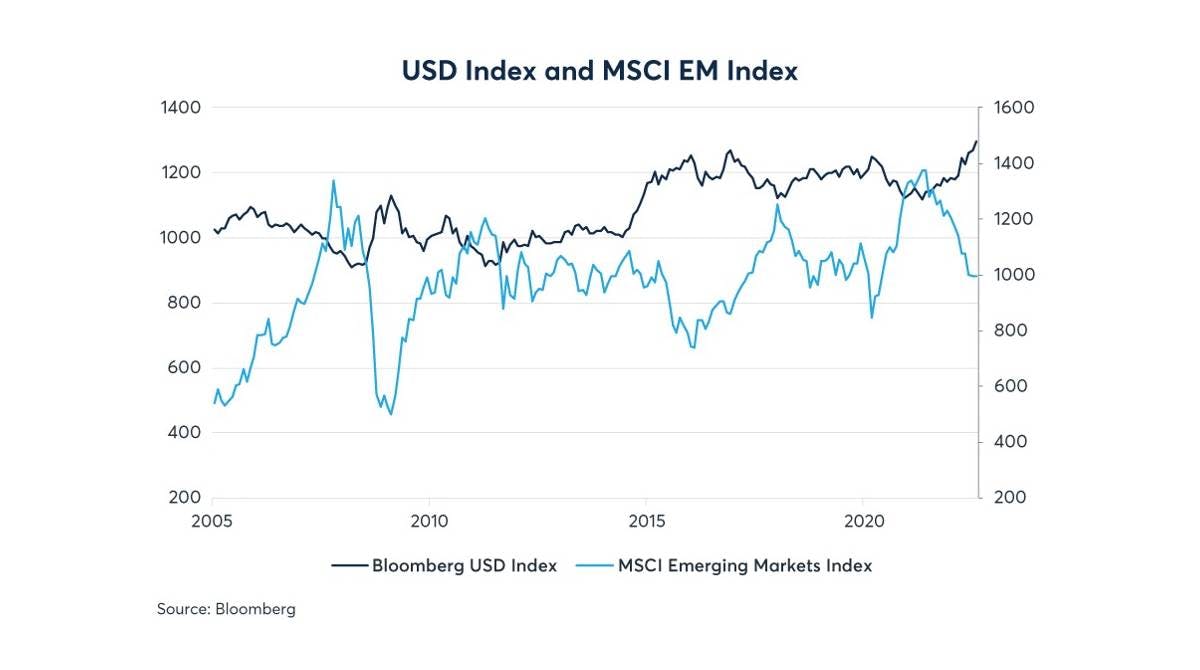
Inflation is the ‘flavor of the year’ as economies swing into the aftermath of the pandemic, with central banks tightening monetary policy to manage dips in their own currencies and curb the rise in inflation. This theme is particularly challenging for emerging market economies. So too is the increasingly stronger U.S. dollar. All previous emerging market fallouts were linked to dollar strength, and as the need to steer off dips in currencies occurs, central banks have turned to tightening their monetary policies. This has led the World Bank to forecast just a 4.6% expansion for emerging economies this year, compared with an earlier 6.3% prediction. Meanwhile, the International Monetary Fund expects inflation to average 9.5% in emerging markets this year, or around 3.6% higher than projected in January.
Why does a stronger dollar lead to a struggle for emerging market economies?
First, a strong dollar often starts to depress global trade growth, as it is the “invoicing” currency of the world and holds the most purchasing power. This means that when the dollar appreciates, other currencies essentially depreciate, making the world poorer and less able to engage in trade. It also makes countries that have dollar-denominated debt less creditworthy, as it makes it harder for them to purchase the U.S. currency to manage their debts. Furthermore, it is likely less favorable for China. This can lead to an obstructive knock-on effect for emerging market countries due to their linked supply chains and commodities demand. Finally, the stronger dollar is also more likely to cause inflationary upward pressures for emerging markets because they typically purchase their raw materials in U.S. dollars.

Commodity appreciation – who reaps the benefits?
The other complication for emerging markets is the simultaneous rise in commodity prices, which are likely to persist for some time given the current economic landscape. Emerging markets are experiencing the lagged effects of higher oil prices, elevated food prices, and higher import prices from currency depreciations. As the demand for products increases, so does demand for the materials used to produce them, which results in higher commodity prices. Commodities are also heavily related to demand and supply dynamics and, compared to other inflation protection assets like TIPS (Treasury Inflation Protected Securities), they tend to offer higher returns.
Rising commodity prices tend to hurt emerging markets, but others stand to benefit. Commodities are a critical source of exports and revenues for many emerging economies, and more than half of the world’s poor resides in commodity exporting countries. The reliance on commodities is particularly high for oil exporters such as Brazil, Mexico and Russia, and on metal and agricultural exporters such as South Africa and Chile.
Commodity prices undergo repeating cycles, and on average, from peak to peak, cycles last almost six years. For industry-intensive commodities, such as copper and aluminum, prices remain in the same phase of the cycle for 80% of the time. According to the World Bank Group’s Flagship Report from January 2022, this synchronization was reflected statistically in a common factor that, on average, accounted for roughly 15-25% of price variability for energy and metals, but only 2-10% of price variability for agricultural commodities and fertilizers.
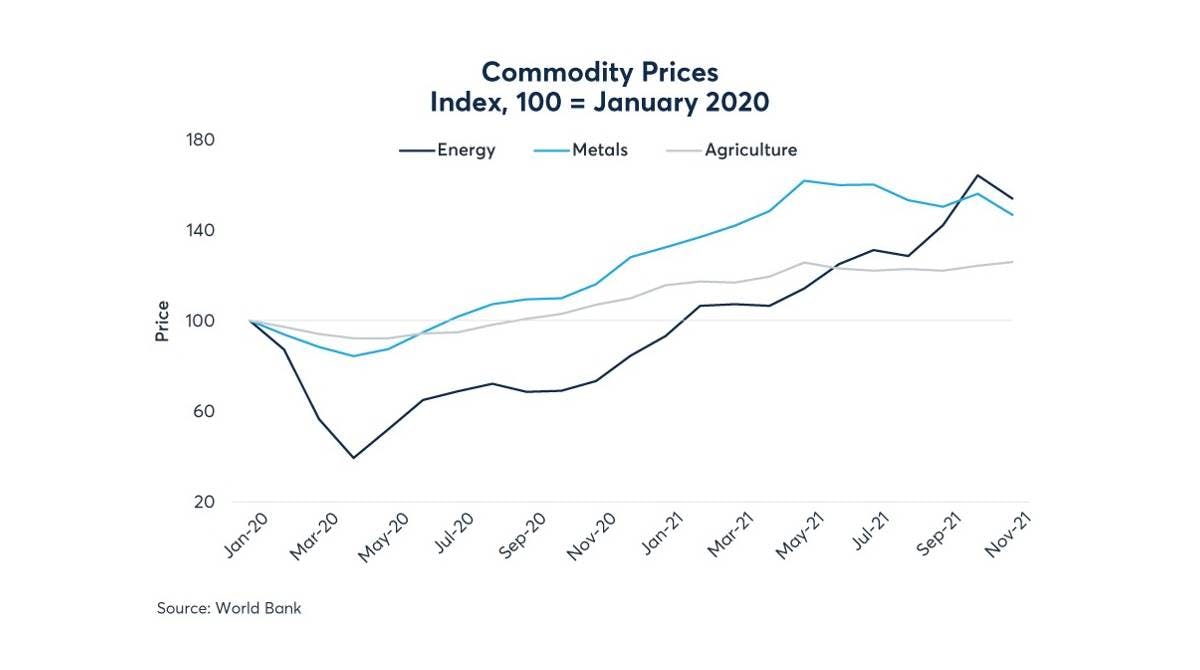
As the chart below highlights, commodity prices bounced in 2021, partly correcting for the sharp decline during the 2020 COVID pandemic, and this rise has continued into 2022.
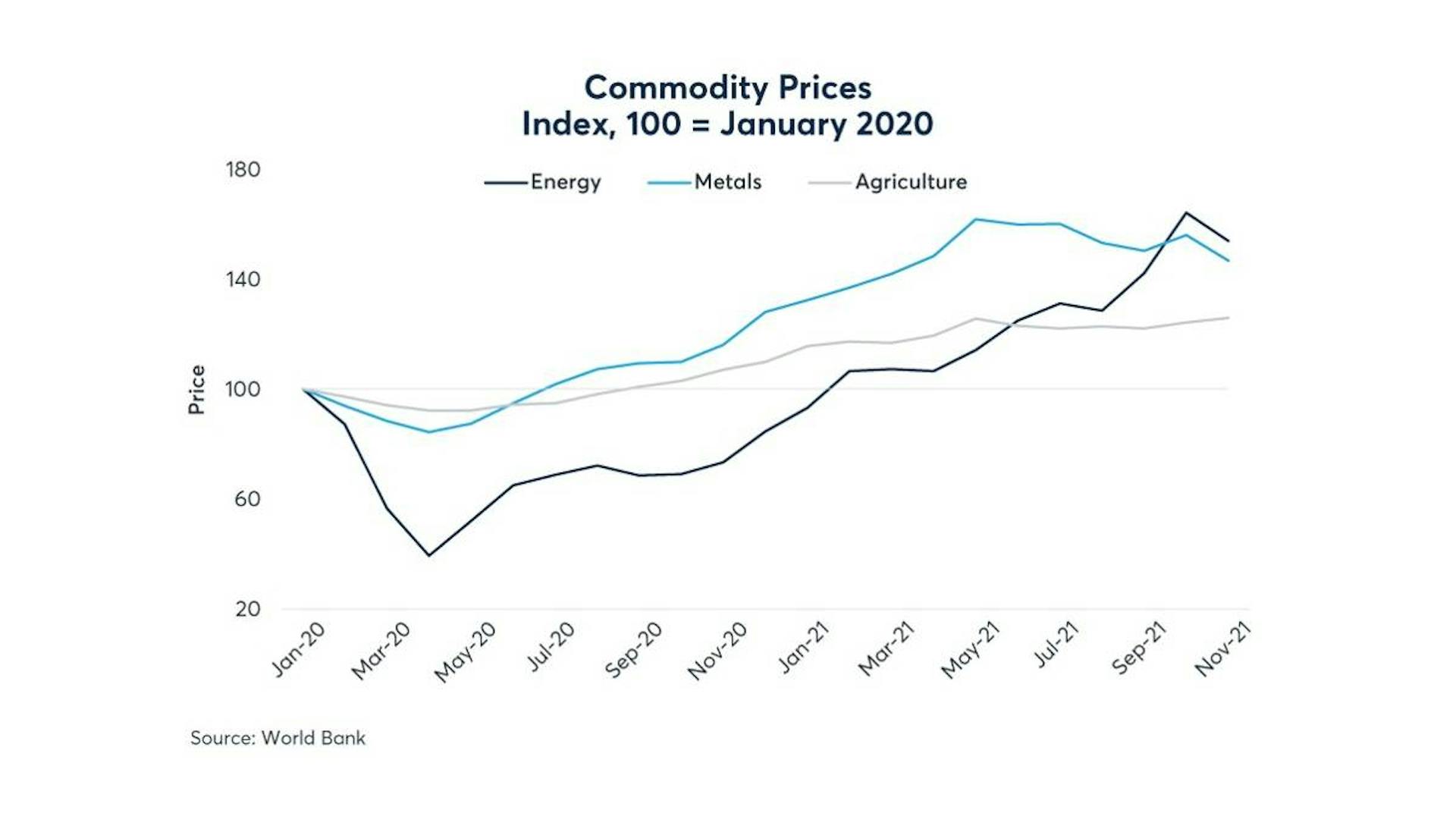
Global trade, supply disruptions and climate-related events are areas that can amplify commodity price movements and their role in economic activity. Therefore, understanding the movement in commodity prices can help manage financial stability and both fiscal and monetary policies.
Taking inflation out of the mix, both commodities and their correlated currencies still need risk management
The changing value of a currency against the dollar can have a substantial effect. Whether a country is the importer or the exporter will dictate either a beneficial or adverse outcome from currency movements.
For example, China is the largest participant in the global copper market; therefore, the exchange rate between the RMB and the USD plays a key role in this trade. China is the largest producer of refined copper, but much of the ore and concentrate is imported. As the copper market trades primarily in dollars, how the value of the Chinese renminbi (RMB) changes versus the U.S. dollar significantly impacts the economics and outcome of the trade. The volatility in the USD/Offshore RMB (CNH) creates variation in the price for USD and CNH-priced copper markets. However, CME Group offers futures contracts on the Chinese renminbi, which can be used to manage this FX exposure via hedging.
The United States is the largest producer and exporter of corn, and Mexico is the largest importer from the United States. Therefore, as the importer, Mexico is more exposed to the exchange rate risk between the U.S. dollar and the Mexican peso (USD/MXN). If the dollar strengthens, Mexican importers are adversely affected as corn becomes more expensive, but vice versa if the dollar weakens. CME Group offers both futures and options contracts on the Mexican peso that can be used to manage this kind of FX exposure, while the CBOT Corn futures contract is the global benchmark for this market.
Similarly, the South African rand is linked to precious metals prices, with South Africa as an exporter. And although their price is often correlated (e.g., higher metals prices can often lead to a stronger rand), there is still the exchange rate risk between the rand and the U.S. dollar, as the metals are primarily priced in dollars. CME Group offers both futures and options contracts on the South African rand that can be used to manage this kind of FX exposure.
Commodity and derivative exchanges around the world enable the trading and risk management of both currencies and commodities. CME Group offers a variety of derivatives contracts to manage these risks together or as separate products.
As demonstrated, the direction of the dollar heavily impacts emerging market currencies and exchange rate risk, particularly for imports and exports. While the dollar stays strong compared to other currencies, it will continue to hold the purchasing power and make it more expensive for emerging economies to engage in trade. High inflation also adds to the struggle for emerging markets, with central banks turning to tighter monetary policy to assist with the rise in prices. Inflation will likely continue to remain in focus.