
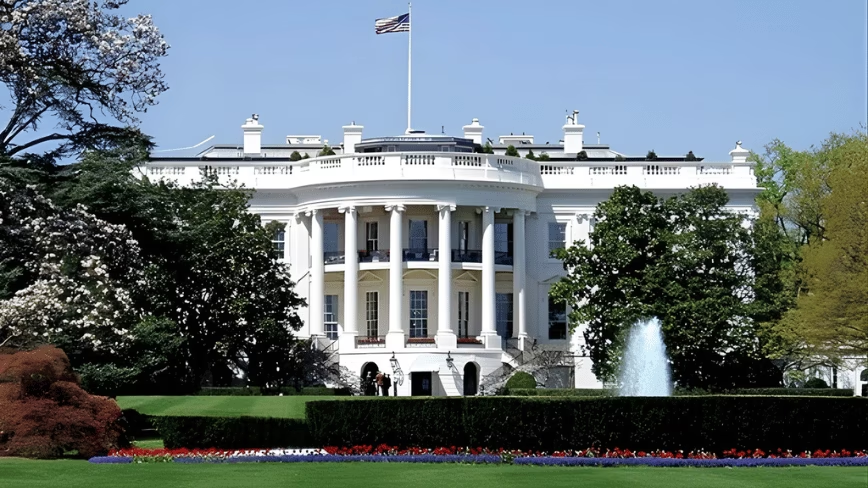
The White House is preparing an event, expected within weeks, at which electric utilities, the companies that build and run data centres for Big Tech, and governors of the states hosting the biggest buildouts will be asked to promise that none of this will end up on household electricity bills.
Three people familiar with the plans described the initiative to Reuters. The guest list is still being finalised, and the mechanism, as before, is a voluntary pledge.
It extends a document the administration already has. In March, Amazon, Google, Meta, Microsoft, OpenAI, Oracle, and xAI signed the Ratepayer Protection Pledge at a White House ceremony, committing to fund the generation and grid upgrades their projects require rather than passing the cost to existing customers, including for capacity they reserve and do not use.
“President Trump’s Ratepayer Protection Pledge has been so impactful that additional stakeholders also want to sign it,” a White House official said, which is one reading of what is happening.
Another is that the original pledge covered the wrong companies. Hyperscalers do not set retail tariffs. Utilities and state regulators do, and if the political objective is to keep bills flat, the signatures that matter are theirs.
Bringing in governors, who appoint or oversee the public utility commissions that approve rate increases, suggests the administration understands exactly where the decision actually sits.
The March pledge asked its signatories to build, bring, or buy the generation their data centres need, to negotiate separate rate structures with utilities and states, to pay for reserved capacity whether or not they use it, and to sell surplus generation back to the grid. Read as an engineering document, it is coherent. Read as a legal one, it is a press release.
The pledge remains voluntary and non-binding, and the White House has no authority over electricity markets. Whatever the utilities sign will be a statement of intent, filed alongside rate cases that will be argued on their own terms, before commissioners who are not bound by anything signed in Washington.
The pressure behind this is not hypothetical. Regulators, consumer advocates, and lawmakers in several states have warned that households are on course to subsidise grid upgrades built for some of the largest companies on earth.
American utilities are planning around $1.4 trillion of capital spending by 2030 to serve AI demand, and residential customers could carry a substantial share of it. Industrial users are already feeling it: Rust Belt manufacturers have watched capacity charges climb steeply as data centres bid for the same megawatts.
Congress has been circling. The House has moved on a bill to push data centre energy costs back onto the companies creating them, which is the same objective as the pledge, pursued with a statute rather than a signing ceremony.
The administration’s position is that America wins the AI race only by building generation and transmission quickly, and that consumers should not pay for the privilege.
Those two commitments are not obviously compatible, which is why the pledge exists: it is the instrument that lets the government promise both at once without choosing. Federal energy regulators have meanwhile been fast-tracking grid connections for data centres, which speeds the buildout the pledge is meant to make painless.
Electricity prices are the rare technology story that reaches voters through their letterbox. An administration that has staked considerable political capital on AI infrastructure is now trying to ensure that the bill arriving each month does not become an argument against it.
No date has been set, and the White House has not said which utilities have agreed to attend. The event, and the length of the guest list, will indicate how many of them think a voluntary promise about future rates is a thing they can safely make.