
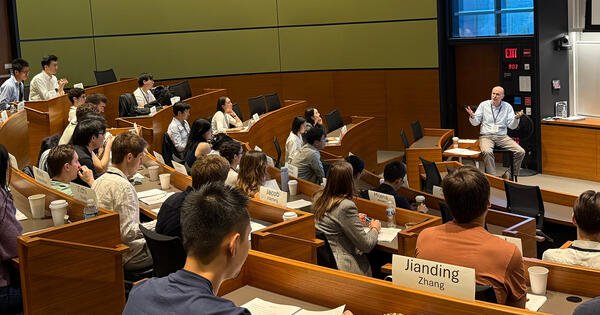
In one session, Shue, the Amman Mineral Professor of Finance, discussed her research using AI photo analysis to study how personality traits are associated with career outcomes. In another, Suproteem Sarkar, assistant professor at the University of Chicago’s Booth School of Business, showed students how AI can be used to translate news articles into mathematical representations, which can help researchers understand how companies are perceived.
For attendee Bam Charoenwong, a finance PhD student at the Wharton School, the summer school offered a unique opportunity to study behavioral finance in a focused setting.
“My own work is in financial intermediation, where traditional rational frameworks are very useful,” she said. “But the summer school helped me think more seriously about settings where behavioral forces such as different preferences and beliefs may help explain what we see in the data.”
Attendee Clara Torslov, a PhD student at Copenhagen Business School who is visiting Harvard University, said the program’s interdisciplinary approach broadened how she thinks about her own field.
“You get to challenge your current knowledge or get inspired to apply the insights in a new way in your own field,” said Torslov, whose research focuses on household finance. “At the end of the day, we are all just humans making decisions.”
Both students noted that the summer school’s structure—which included pre-arranged small-group dinners—helped them build connections with peers. “This was one of my favorite parts of the program,” Charoenwong said. “I left with a much better sense of the broader community, and with several people I hope to stay in touch with.”
For much of its history, the Yale Summer School in Behavioral Finance has been generously supported by the Lynne and Andrew Redleaf Foundation.