
The easiest way to understand crypto used to be to look at Bitcoin.
When the world’s largest cryptocurrency rose, money flooded into startups, venture funds, exchanges and thousands of speculative tokens. When it crashed, businesses disappeared, funding dried up and activity slowed across the industry. Bitcoin wasn’t merely the biggest digital asset. It was the center of gravity for the entire crypto economy.
Now, some of the industry’s fastest-growing businesses are moving according to a different logic.
The coin is down sharply. On Friday, it fell below $60 000, extending a decline that has erased around half its value from last year’s peak. The selloff has been fuelled by money leaving exchange-traded funds, the AI boom competing for retail attention and growing questions about whether the large corporate buyers that helped drive the previous rally can continue accumulating.
Much of the altcoin market is suffering an even deeper downturn that predates Bitcoin’s latest slide. The market value of altcoins, tokens other than Bitcoin, peaked at $431 billion in November of 2021, and is currently languishing around $170 billion, according to TradingView. Entire ecosystems that once promised to reshape finance are shrinking, consolidating or quietly disappearing. Yet at the same time, some of the industry’s most commercially important businesses are growing faster than ever.
Stablecoins are becoming part of the global payments system, adding up to about $390 billion in annual transactions, per McKinsey & Co. and Artemis Analytics. Wall Street firms are racing to tokenize stocks, bonds and money-market funds. Banks that once dismissed blockchain technology are experimenting with it. Payment companies are integrating digital dollars. Prediction markets are attracting mainstream users. The digital infrastructure is spreading even as many of the assets built on top of it struggle.
“The Bitcoin price chart used to be the entire crypto story. It isn’t anymore,” said Eric Jackson, founder and CIO of EMJ Capital, a tech-focused hedge fund. “Price and adoption are not the same metric for crypto, and they shouldn’t be.”
ADVERTISEMENT
CONTINUE READING BELOW
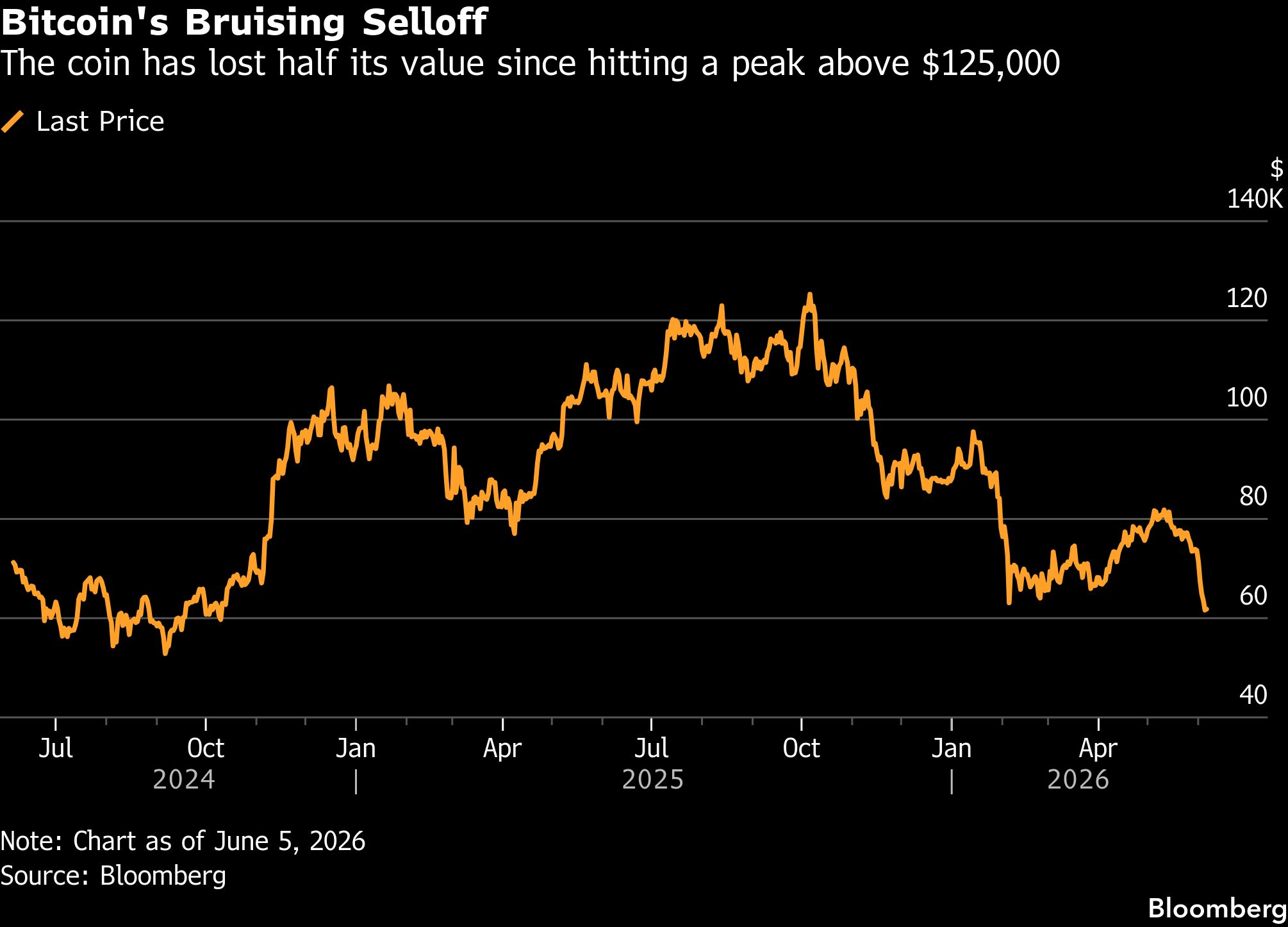
Bitcoin steadied Monday afternoon in New York to trade below $64 000, as Strategy Inc. resumed purchases of the token. The largest digital currency shed around $235 billion of market value during the seven days ended June 7, according to data compiled by Bloomberg.
Today, crypto is becoming harder to summarize with a price chart.
The industry’s original promise was never simply Bitcoin. It was the idea that money, assets and financial activity would eventually move across internet-native networks. The irony is that parts of that vision are beginning to materialize just as investors lose faith in many of the tokens that were supposed to capture its value.
Launched in 2024, BlackRock’s tokenized money-market fund BUIDL has become one of the largest tokenization products, with $2.4 billion in asset value, per tracker RWA.xyz. Among other examples, Nasdaq recently partnered with crypto exchange Kraken to offer tokenized stocks. All in all, more than $30 billion in various assets — from stocks to real estate — has already gotten tokenised, according to RWA.xyz.
Stablecoin adoption is advancing beyond crypto-native firms. Visa and Mastercard have expanded stablecoin settlement capabilities, while a growing number of payments companies are experimenting with digital-dollar infrastructure for cross-border transfers and settlement. Total stablecoin transaction volumes soared 72% to $33 trillion in 2025, according to data compiled by Artemis.
“Although we are a bit surprised by Bitcoin’s weakness as broader risk assets have rallied in recent weeks, the reality is that Bitcoin performance only tells you how investors feel about that particular asset,” said Adam Phillips, managing director and partner at EP Wealth Advisors in Torrance, California. “It doesn’t necessarily tell you how much adoption is occurring beneath the surface.”
Tens of millions of tokens have been created in recent years, yet fewer than 1 700 still generate meaningful trading activity, according to Delphi Digital. Across large parts of the market, capital and attention arrived in short bursts before moving on just as quickly.
ADVERTISEMENT:
CONTINUE READING BELOW
That helps explain one of the defining paradoxes of the current cycle. Some of crypto’s most tangible successes are arriving alongside one of its most brutal shakeouts. The technology is becoming more embedded in the financial system even as much of the asset universe built around it is being abandoned.
In earlier eras, that might have looked like an existential threat. Instead it increasingly resembles something else: maturation.
“The crypto industry is still maturing toward institutional use cases rather than retail speculation,” said Roxanna Islam, head of sector and industry research at ETF shop TMX VettaFi. “Financial institutions are focusing on longer-term utility and infrastructure despite volatile Bitcoin prices.”
New technologies rarely develop in a straight line. Railroads survived the failure of countless railroad companies. The internet survived the collapse of hundreds of dot-com stocks. Financial manias often fund infrastructure whose importance only becomes obvious after the speculation fades.
Crypto may be entering a similar phase. For the first time, the technology is becoming important enough to outgrow the trade that created it. Bitcoin still matters enormously. It just matters less exclusively than it once did.
“The most significant technology is stablecoins — and you don’t need XRP or Bitcoin to store value when you have stablecoins,” said Mike McGlone at Bloomberg Intelligence. “We’re doing a purge and it’s just getting started.”
© 2026 Bloomberg