
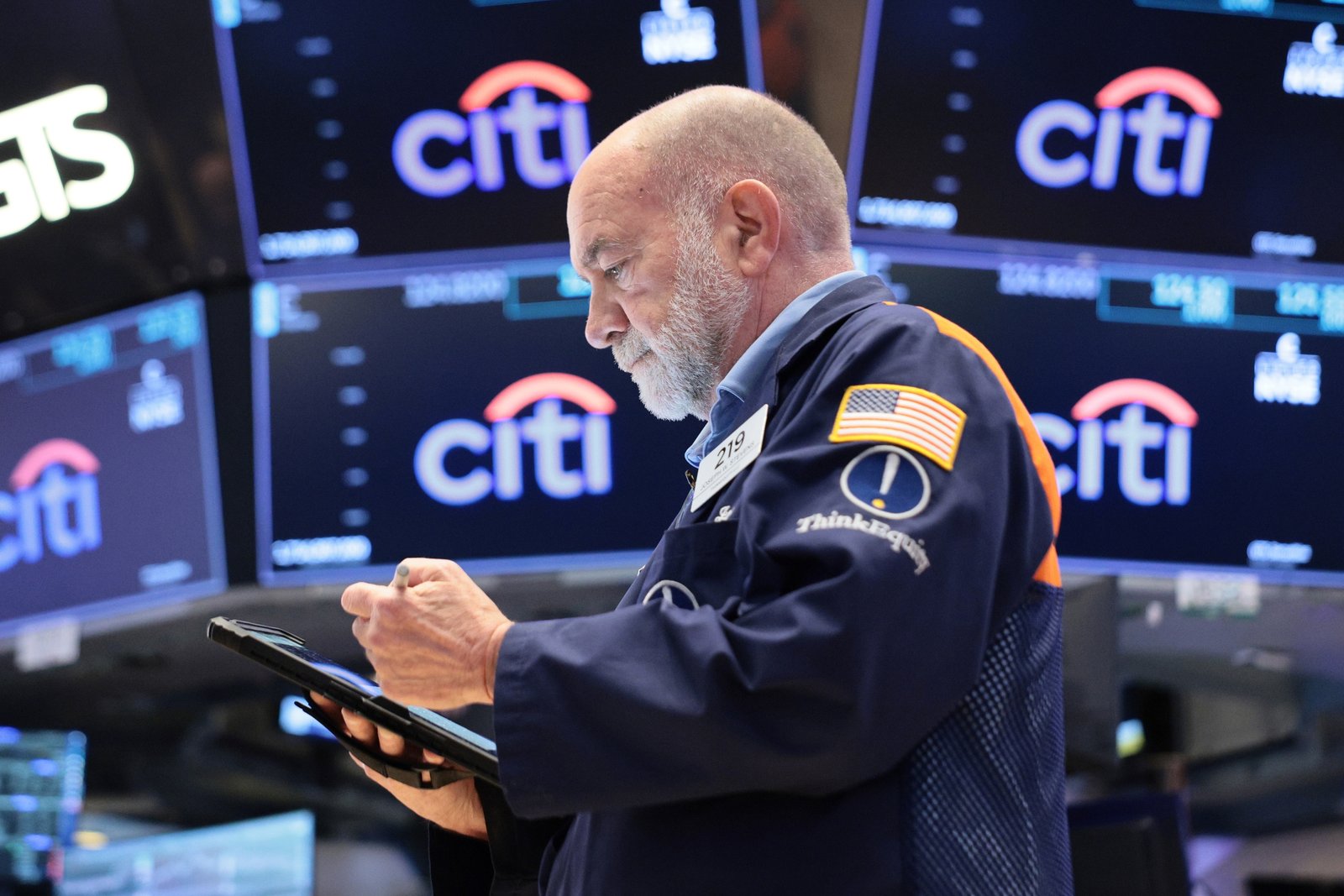
Citigroup’s proprietary Bear Market Checklist has reached its highest reading since the 2008 global financial crisis, with 10 of 18 risk flags triggered globally and 11.5 of 18 in the United States — a level that the bank’s own research warns has historically preceded an acceleration in market stress. The alert landed on Friday, June 5, the same morning a blowout May jobs report more than doubled Wall Street’s expectations and sent the Nasdaq Composite down 4.18% for its worst single-session decline since the tariff turmoil of early 2025, snapping a nine-week S&P 500 winning streak and erasing more than $1.3 trillion in chip-sector market value in a single afternoon.
For the tens of millions of Americans with retirement accounts tied to broad equity indices, the Citi warning quantifies a risk they have been accumulating without necessarily tracking: U.S. stock markets are now more stretched, by this composite measure, than at any point in the fifteen years since the financial crisis. And a scheduled event next week has the potential to amplify that stress further.
Citi Bear Market Checklist at 15-Year High
Citi strategist Beata Manthey outlined the findings in a research note distributed to clients on June 5. The Bear Market Checklist is a composite of 18 distinct indicators — valuation multiples, credit spreads, fund flows, initial public offering activity, and investor sentiment surveys. A flag is triggered when a component moves into territory that has historically preceded market declines.
The current global reading of 10 out of 18 is the highest since the financial crisis, but the U.S. reading of 11.5 out of 18 is more striking. Europe, by contrast, registers only 5 out of 18 flags, suggesting the stress is concentrated in the American market rather than reflecting a synchronized global deterioration. Contributing factors include stretched valuations across several market segments, elevated investor positioning in growth assets, a surge in AI-driven capital expenditure, and a pickup in equity issuance. Credit spreads remain relatively tight, which Manthey characterized as one of the more reassuring signals in the current mix.
Manthey explicitly flagged the acceleration risk. “Once the count reaches double digits,” she wrote, “it has historically tended to rise more rapidly, signaling a potential acceleration in risk.” The checklist registered 17.5 of 18 flags before the dot-com crash in 2000 and 13 of 18 ahead of the 2008 financial crisis. The current reading, while elevated, remains below both historical peaks. Citi maintained a constructive outlook on equities through year-end, but said further increases in the flag count would signal that buying market dips “should not necessarily be” the default strategy.
Nasdaq Selloff 2026: Jobs Shock Collides With Stretched Valuations
Friday’s catalyst was the May nonfarm payrolls report from the Bureau of Labor Statistics, which showed the U.S. economy added 172,000 jobs in May — roughly double the 85,000 consensus estimate and above even the most optimistic pre-report forecasts. Unemployment held steady at 4.3%.
Rather than sparking a rally, the strong labor data triggered what traders call a “good news is bad news” reaction. The 10-year Treasury yield jumped 7 basis points to 4.54%, and by the close the Nasdaq Composite had plunged 4.18% to 25,709 — its steepest single-day loss since April 2025. The S&P 500 shed 2.64% to 7,384, ending nine consecutive weeks of gains. The Philadelphia Semiconductor Index fell 10.3%, its worst day since March 2020.
Nvidia fell 6.2%, Broadcom dropped 7.9%, and Micron Technology slid 13.3%. Meta fell more than 6% in afternoon trading. The only major index to close higher was the Dow Jones Industrial Average, which gained 0.07% as investors rotated into healthcare and consumer staples — a classic defensive flight from high-multiple growth.
AI Stock Valuation Risk: Why Concentration Amplifies Any Correction
The 2008 comparison embedded in Citi’s checklist is instructive, but the structural parallel differs from what it might first suggest. In the lead-up to the financial crisis, concentration risk was a financial-sector story: banks had grown to represent an outsized share of global indices, meaning stress in one sector could cascade into a systemic event.
In 2026, the cast of characters has changed. AI-adjacent semiconductors and hyperscale cloud providers — Nvidia, Microsoft, Meta, and Alphabet — now account for more than 30% of S&P 500 market capitalization. The top seven firms in the index represent a historically unusual share of total weighting. When rate policy tightens and compresses the premium investors pay for long-duration growth assets, that concentration amplifies any downside: a rotation away from one sector is simultaneously a rotation away from the index.
The S&P 500’s Shiller CAPE ratio stands at approximately 40, a level exceeded only during the dot-com peak of 1999 and the post-pandemic surge of late 2021. The U.S. market-cap-to-GDP ratio — commonly called the Buffett Indicator — stands at record highs above 235%. The central debate among strategists is whether these multiples reflect a genuine structural shift in corporate profitability driven by AI, or the latest iteration of new-paradigm thinking that proves fragile when the cost of capital rises.
Will the Fed Raise Interest Rates in 2026?
The jobs report forced a decisive repricing of monetary policy expectations. According to CME FedWatch data, rate futures now price in a 68.4% chance of Fed tightening by the December policy meeting — up from 52% the day before.
Wall Street’s major banks parted ways on what this means. Goldman Sachs economists said that “the strong jobs numbers and stable unemployment rate increase the risk of a longer Fed pause, though we still view rate hikes as unlikely,” citing tepid wage growth as a mitigating factor. BNP Paribas economists took a sharply different view, arguing that the Fed’s three rate cuts of 2025 were modeled on its 1998 response to the Long-Term Capital Management crisis — and that, with the U.S. economy now proving stronger than anticipated, the central bank would follow its 1999 playbook of three successive hikes. They expect the first move in December, with an earlier start possible if Iran-war-driven inflation continues to build.
The Fed is scheduled to meet June 16-17, with markets expecting it to hold rates steady at that meeting. The July FOMC meeting and May CPI and PCE data will sharpen the picture considerably.
SpaceX IPO Adds Index Pressure to an Already Stretched Market
Friday’s selloff arrived days before SpaceX is scheduled to begin trading on June 12 in what analysts anticipate will be the largest initial public offering in history, with an expected valuation of approximately $1.75 trillion. The listing carries a structural complication for existing index investors: S&P Global confirmed on June 5 that SpaceX will not receive fast-track S&P 500 inclusion, reaffirming its profitability rules. However, Nasdaq’s revised methodology — effective May 1 — allows immediate fast-track entry into the Nasdaq-100 after just 15 trading days for companies ranked in the top 40 by market cap, meaning Nasdaq-tracking funds will be forced to absorb SpaceX shares on a compressed timeline regardless.
Some analysts noted before the selloff that institutional investors may have been rebalancing ahead of the listing, freeing up capacity for what will be a significant forced purchase for passive funds. Gold fell 3.27% on Friday to settle near $4,340. Bitcoin fell below $60,000 for the first time since late 2024, touching an intraday low near $59,100. The dollar strengthened broadly.
Signposts Investors Should Track Before the July FOMC Meeting
For investors trying to calibrate their exposure, the critical signposts in the weeks ahead are: Fed communications ahead of the June 16-17 FOMC meeting, particularly any language that signals a shift toward an explicit hike bias; the May CPI and PCE data, which will clarify whether the strong jobs print reflects genuine re-acceleration in price pressure; SpaceX’s IPO pricing and early trading on June 12, which will act as both a sentiment test and a potential trigger for sector rotation in Nasdaq-tracking funds; and subsequent updates to Citi’s Bear Market Checklist, given Manthey’s own warning that the count tends to accelerate once in double-digit territory.
Citi’s note is a reminder that valuations, sentiment, and monetary policy rarely stay out of sync indefinitely. The current combination of AI-optimism multiples and renewed rate-hike risk is historically unusual: prior cycles of multiple expansion have generally coincided with accommodative or at least neutral monetary policy. What the Bear Market Checklist does not determine — what no composite of 18 indicators can determine — is the precise point at which that tension resolves. It measures the pressure that has accumulated. It does not set the timer.
Frequently Asked Questions
What is Citi’s Bear Market Checklist, and should investors be worried?
Citi’s Bear Market Checklist is a composite of 18 market indicators — including valuation multiples, credit spreads, fund flows, IPO activity, and investor sentiment surveys — designed to track how stretched market conditions have become relative to levels that historically preceded corrections. A reading of 10 global flags and 11.5 U.S. flags is the highest since 2008, but remains below the 17.5 flags seen before the dot-com crash and 13 before the 2008 financial crisis. Citi maintained its constructive year-end equity outlook while warning that further increases in the flag count would change its guidance on buying market dips.
What caused the Nasdaq to drop 4% on June 5, 2026?
A stronger-than-expected May jobs report — 172,000 new payrolls against a consensus of roughly 85,000 — forced a rapid repricing of Federal Reserve rate expectations, pushing the 10-year Treasury yield to 4.54% and triggering a “good news is bad news” selloff concentrated in high-valuation AI and semiconductor stocks. The Philadelphia Semiconductor Index fell 10.3%, its worst day since March 2020, erasing roughly $1.3 trillion in chip-sector market value in a single session.
Will the Fed raise interest rates before the end of 2026?
CME FedWatch data places a 68.4% probability on a Fed rate hike by December 2026. Goldman Sachs economists say hikes remain unlikely despite the strong jobs print; BNP Paribas economists argue the Fed will execute three successive hikes starting as early as December, echoing its 1999 policy reversal after emergency 1998 cuts proved premature. The July FOMC meeting and May inflation data will be the next major data points.
Is the stock market overvalued in 2026?
By several traditional measures, yes. The S&P 500’s Shiller CAPE ratio stands at approximately 40, exceeded only during the 1999 dot-com peak and the late-2021 post-pandemic surge. The U.S. market-cap-to-GDP ratio is at record highs above 235%. Whether these valuations are sustainable depends on whether AI-driven earnings growth can justify them — a question Citi’s 11.5 of 18 U.S. risk flags suggests the market is increasingly pricing in a negative answer to.