
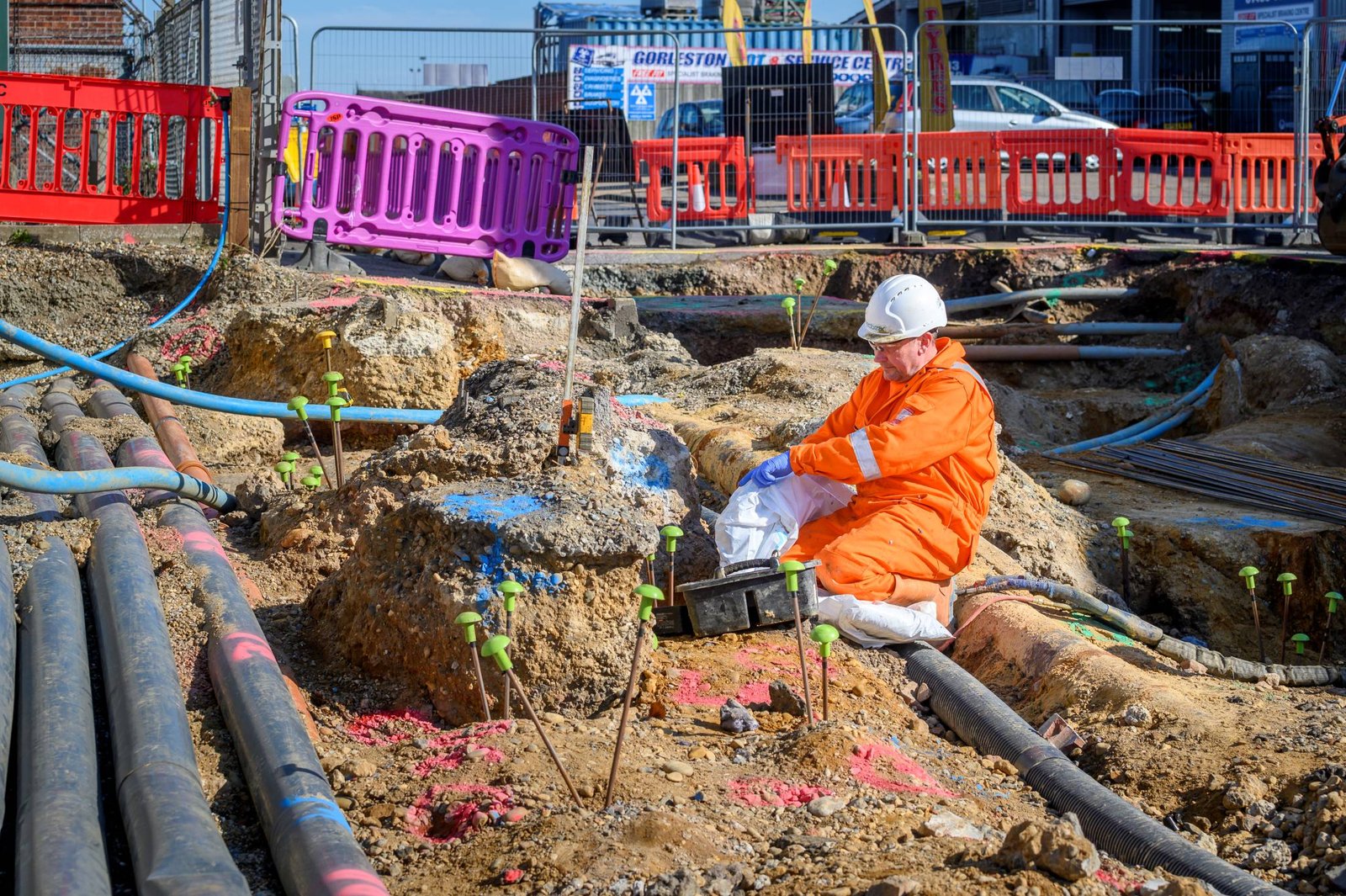
Every day, millions rely on a vast network of unseen infrastructure to power their homes, deliver clean water, and keep essential services running. Yet beneath our feet, shifting ground threatens to disrupt these critical networks, often without warning. Here, Karl Sivori-O’Neill, design and estimating manager at ground engineering specialist Geobear, explores how a proactive approach to maintenance can improve visibility across utility networks while reducing disruption, lowering costs, and improving service reliability.
With the UK’s water supply network spanning over 300,000 miles and the wastewater system covering another 220,000 miles, the scale and complexity of maintaining our infrastructure is vital. As demand for reliable, sustainable services increases, utility companies face unprecedented challenges in ensuring operational resilience and future-proofing critical networks.
The impact of settlement on utilities infrastructure
Settlement — a downward movement of the ground due to soil compression or subsurface changes — poses a significant threat to these utilities. Settlement is a natural but disruptive process where the ground beneath pipelines shifts, placing stress on pipe joints and leading to blockages, backups, leaks, and flooding.
If left unaddressed, settlement can lead to large-scale disruptions. Burst pipes have the potential to cut off mains water supply to entire communities, causing extensive road closures and even forcing residents to relocate.
It is critical to address settlement proactively, in order to prevent such large-scale disruptions. Early warning signs, such as ground depressions, must be monitored, particularly in vulnerable areas with soft soil or a history of flooding.
Traditional methods for repairing damaged pipelines rely on excavation, which is time-consuming, disruptive, and carbon intensive. The works often require extensive road closures, heavy machinery, and prolonged service interruptions for local communities.
A modern solution to ground settlement
An alternative solution is geopolymer resin injection, which involves drilling small holes to inject the material below ground. The material follows the path of least resistance, filling voids, compacting, and stabilising the soil. This process helps level and lift the ground, as well as stabilising the surrounding pipework.
This method has several advantages: it produces lower carbon emissions, requires only lightweight equipment, and minimises material use for reduced overall environmental impact. Additionally, it is significantly faster than excavation, which allows for rapid stabilisation with minimal disruptions to communities and infrastructure and potential cost savings.
Enjoying this article? Sign up for our FREE newsletter!
Proven lower environmental impact
Alongside eradicating the need for heavy machinery and reducing waste production, geopolymers also offer lower environmental impact. A sustainability analysis by consultant KLH Sustainability identified a 46 per cent reduction in the carbon footprint of geopolymers compared with conventional techniques, offering contractors a method that supports net-zero pledges.
Pollution risks with geopolymers were also identified as lower in an environmental impact assessment conducted by ESI/Stantec. Leachability testing showed that groundwater would be able to flow through the resin without any hazardous substances or non-hazardous pollutants leaking into waterways.
A success story
A notable example of this approach’s effectiveness took place in Great Yarmouth, Norfolk, UK. A road and its surrounding sewer system experienced significant settlement, which had been caused initially by flash flooding. Located in a busy town centre, severe ground settlement resulted in sections of road and sewer pipes dropping by 100 to 200 mm, compromising their structural integrity.
The flash flooding, combined with the area’s very loose ground conditions, washed out unconsolidated soil around the pipe. As the surrounding soil weakened, sewer joints began to bow and fail, leading to further erosion and a cycle of leakage and ground loss. Traditional excavation was unfeasible due to the extensive disruptions it would cause, including the need for temporary works and prolonged road closures.
To restore stability, technicians injected geopolymer resin at depths down to 7.5 meters, reinforcing the soil and realigning the pipeline. The treatment’s effectiveness was confirmed through post-injection standard penetration tests (SPT), which showed a significant increase in soil density from 0–1 (very loose) pre-treatment, to 5–15 (medium) post-treatment. This threefold improvement ensured long-term stability and reduced the risk of future settlement.
A new approach to safeguarding utilities
The future of safeguarding utilities lies in proactive servicing. Periodic surveys can assess ground movement and pipeline stability, allowing for intervention before major issues arise. In areas with a history of settlement, particularly those with unconsolidated ground or high clay content, targeted treatment can be carried out in a matter of days, preventing months of disruption.
The ability of a utility company to respond effectively to settlement is a direct reflection of its visibility and reliability. Companies that prioritise proactive intervention, reduce disruption, and invest in modern solutions like geopolymer injection will be better positioned to maintain service continuity and public trust.
To learn how geopolymer technology is being used to safeguard utility infrastructure, visit Geobear’s case studies page