
China is cracking down on negative commentary about the financial market and other sectors as the authorities seek to boost public confidence despite challenging economic headwinds.
This month the Weibo account Weibo Finance, which has more than 1.5 million followers, issued an instruction against posting any comments “that bad-mouth the economy”. The post appears to have since been deleted. Bloomberg reported that several other finance influencers had been told by Weibo to “avoid crossing red lines” and to post less about the economy. Weibo did not reply to a request for comment.
China’s ministry of state security published an article on 12 December saying there was a need to “sing the bright theory of China’s economy”.
In a separate WeChat post, the ministry said: “Various cliches intended to denigrate China’s economy continue to appear. Their essence is to use false narratives to construct a ‘discourse trap’ and ‘cognitive trap’ of China’s decline, in order to cast doubt on the system and path of socialism with Chinese characteristics.”
Alicia García-Herrero, the chief economist for Asia Pacific at Natixis, an investment bank, said: “Economic topics used to be widely discussed but there is an increasing number of topics that are becoming problematic.”
Topics that are considered increasingly sensitive in China’s economy include record high youth unemployment figures (the government stopped publishing this data in August), deflation, the struggling property sector and capital flight.
The restrictions have been building for some time. In June, three finance commentators, one of whom had 4.7 million Weibo followers, were blocked by the platform as a punishment for “hyping up the unemployment rate, spreading negative information … [and] smearing the development of the securities market”.
Dan Wang, the chief economist at Hang Seng Bank, said “the number one sensitive issue now” was foreign investment, because of its links to cross-border capital flows.
“There is a difference between the actual capital flows and the official attitude when it comes to whether they welcome foreign investors or not. Openly, [the government] welcomes foreign investors, but the current situation is not the best for foreigners to stay. There’s a gap between what the government says and what is actually going on in the market,” Wang said.
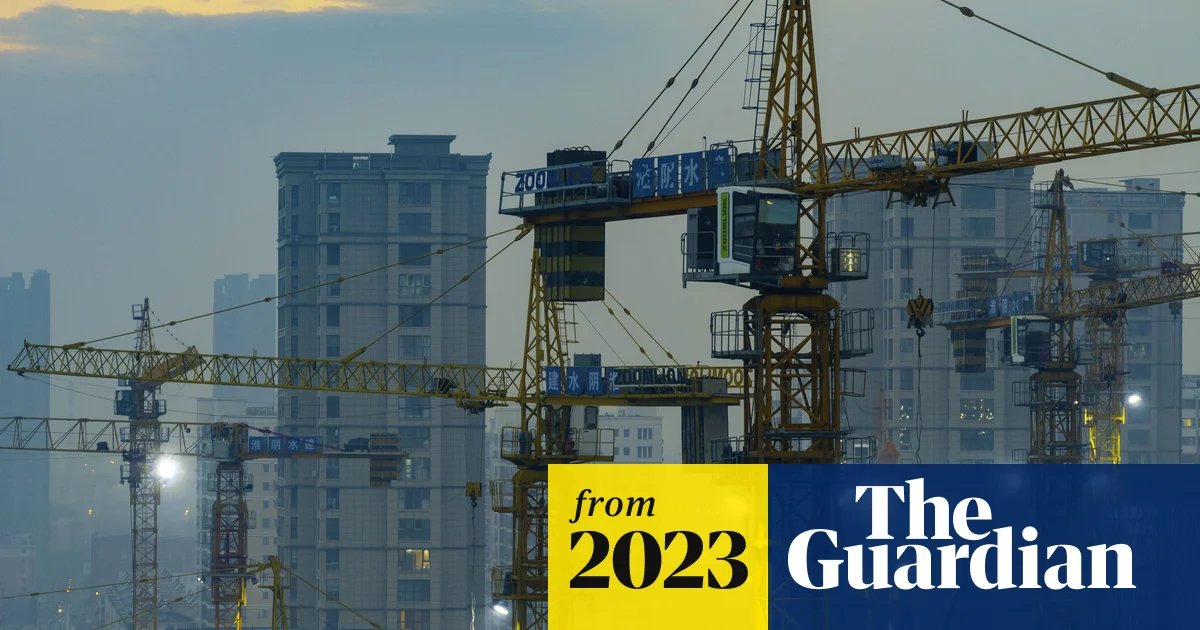
Property is another sensitive topic. The real estate sector, which typically accounts for between a quarter and a third of GDP, has struggled to recover from a regulatory whirlwind known as the “three red lines” policy, which limited developers’ ability to take on debt, meaning that construction on hundreds of residential developments stalled.
Evergrande, once China’s biggest developer, is in the midst of a painful debt restructuring process, while Country Garden, its main rival, defaulted in October.
New home prices fell in November, and property investment in the first 11 months of the year fell by 9.4% year on year, according to the National Bureau of Statistics. Analysts have said there is now a growing gulf between official statistics and private market data as Beijing tries to control the spread of pessimism in the sector.
There is also pressure on economists in Hong Kong to be optimistic about the mainland economy, although analysts say this is a long-term trend and one that comes from a general atmosphere of deference to Beijing rather than specific instructions.
“This was even more obvious following the three red lines policy that instigated the popping of China’s property bubble in 2020,” said Andrew Collier, a managing director at Orient Capital Research, a financial research firm. “While there were structural reasons for the decline, the three red lines policy set it off. Economists and property analysts kept calling a floor to the decline and also insisted that Beijing would support the property market. But it didn’t.”
Wang said: “We need to conform to the official party line. We need to focus on the positive side of the economy, [but] it’s harder to find those bright spots.”
Some analysts argue that confidence will be just as important, if not more, as government stimulus in rescuing China’s economy, although the two are linked. Collier said: “Statements about a turnaround in China property won’t do the trick.”
Wang said: “People need to understand what the policies are for, but there’s a lack of discussion in the public space. The government has to be more willing to openly discuss why they do certain things or not do certain things.”