
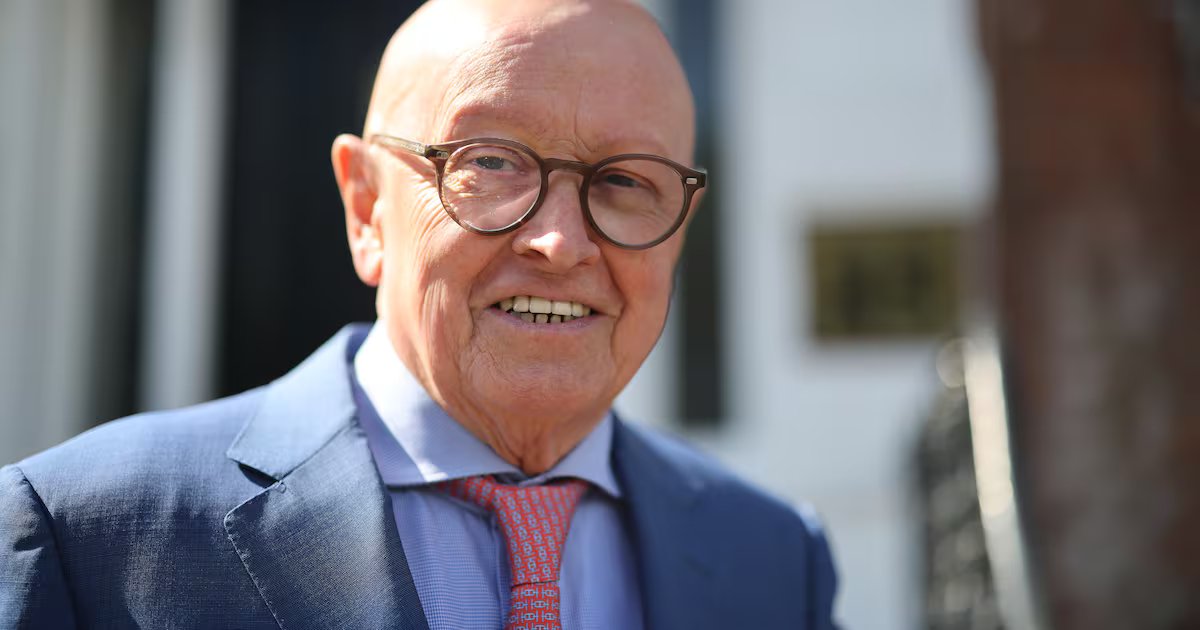
Billy Kane first sensed in late January 2020 that a planned flotation of Finance Ireland might not unfold as hoped when, in a meeting with fund managers in New York, he saw their attention drift from his pitch to a television on the wall.
“They were talking about this coronavirus on TV,” recalls the founder and chief executive of the non-bank lender.
The first US case had been confirmed on January 21st in Washington state, from a patient who had returned from Wuhan, the outbreak’s ground zero. Within days, the World Health Organisation (WHO) had declared Covid-19 an international public health emergency.
By the time Kane and his team made it to Edinburgh, the last stop of the early-look roadshow for the initial public offering (IPO), in early March, it was already game over as equity markets faltered.
“We had a very lucky escape,” says Kane in an interview in Finance Ireland’s boardroom in Ballsbridge in Dublin. “Had we done the IPO and gone into that period of uncertainty in the market [as a listed company], it would have been quite painful.”
The years since Kane, a former head of PTSB predecessor Irish Permanent, founded Finance Ireland in 2002 have seen the company deal with its share of run-ins with vagaries of the markets – including having to stop writing new business during the financial crisis. And a fair share of narrow escapes.
The UK banking group that would help it restart lending honoured a deal struck just as Ireland was sliding towards an international bailout.
Persistence has paid off. Finance Ireland paid a maiden dividend to shareholders – amounting to €75 million –last September, releasing some of the surplus capital it had built up, according to newly-filed accounts for its parent company, FICS Group Holding.
Net profit soared almost 25 per cent to €22.7 million last year. And the size of its loan book jumped 15 per cent to a record €1.38 billion, even as it exited the residential mortgages business.
The business has also been the subject in the past 18 months of two takeover attempts – from PTSB and Austria’s Bawag – that went nowhere.
Kane now thinks Finance Ireland, which is majority owned by US investment giant Pimco, should switch roles and become a hunter.
“We believe there has to be consolidation in the non-bank lending market – and as the biggest player in it, we think we should be playing a part in driving that,” says Kane. “If you’re the biggest in town, you acquire.”
Loan growth
The business appears to be in good shape. New lending in its motor finance division, the group’s largest business, rose 12 per cent, while its loan portfolio rose 26 per cent to a record €653.2 million, according to the latest financial statement from the lender’s parent company, FICS Group Holdings.
Chief financial officer Jim Hickey, who sat in on the interview, put this down to the unit’s strong relationships with forecourt dealers and a “very slick” digital platform, where all documents and authentication checks can be done online. This has helped the lender take market share from banks and finance units of vehicle manufacturers, even as new car sales only crept up 3 per cent last year.
Some 70 per cent of Finance Ireland’s motor business is carried out electronically, up six-fold in five years, Kane estimates.
The commercial real estate unit’s portfolio – including loans against multi-family apartment blocks, warehouses, hotels, regional retail centres and mixed developments – grew for the first time in recent years, by 9 per cent to €526.4 million. Losses in this book have been “de minimis” in the decade or so that Finance Ireland has been active in this area, according to Hickey.
The SME leasing division’s loan book grew 12 per cent to €101.8 million, fuelled by a pick-up in businesses taking on fresh credit and green-energy lending, where it provides consumer-financing arrangements to the likes of solar panel suppliers.
Finance Ireland’s final unit, agri finance, saw new lending slide last year as Irish dairy farmers held off investing amid concerns about whether the EU would extend a derogation allowing them to spread higher levels of fertiliser on their land. This portfolio contracted 12.5 per cent to €115.9 million. However, Kane says that there has been a surge in new loans so far this year, after Brussels decided to extend the exemption for another three years.
Career start
A native of Bray, Co Wicklow, Kane started his career 50 years ago as a financial analyst with British Leyland in England after studying commerce in University College Dublin (UCD), just after the once-proud carmaker was effectively nationalised.
On returning to Ireland two years later, he took a role as a sales representative with Rank Xerox. He then moved to office equipment supplier Sharptext, where he caught the eye of Craig McKinney of specialist lender Woodchester Finance.
In 1984, Kane joined Woodchester as sales director, initially focusing on leasing office equipment before expanding into car finance. Its growth was turbocharged as McKinney – a larger-than-life character with a penchant for fast cars and polo ponies, who passed away six years ago – acquired a lot of businesses from UK finance houses leaving the market. They included Mercantile Credit, Bowmaker Bank, and Trinity Bank.
McKinney sent Kane to the UK in 1988 to run Woodchester Investments (UK), but the commute took its toll on family life, he says. It came to a head in the early 1990s when Kane realised there was little prospect of him returning to Ireland within the company.
After leaving in 1992, he approached Irish Permanent, then a building society, about setting up a car finance venture. Already a millionaire by the time he was 30, thanks to vested share options in Woodchester, he would sell his 10 per cent stake in Irish Permanent’s motor finance business to the parent for €4.4 million in 1995 and became general manager of the lender’s retail banking operation.
Kane became CEO of Irish Permanent in 1999 following its merger with Irish Life and used the lending arm’s subsequent tie-up with TSB Bank two years later as an opportunity to exit.
TSB brought badly-needed banking systems to the party, says Kane, who recalls an inauspicious foray by Irish Permanent into current accounts years earlier. “I remember us giving chequebooks to directors at the time and two of them used them to pay for their yacht club membership – only for the cheques to bounce because of an admin error,” he says.
Kane didn’t enjoy the merger with Irish Life, a former semi-state body that “had a very different culture”.
In 2002, he set up Shared Home Investment Plan (Ship) offering an equity-release product for seniors. Ship secured a stock market quotation four years later by reversing into publicly-quoted Ardent and renaming the group Finance Ireland. The company set up a subprime mortgage joint venture with Investec, called Nua Mortgages, in April 2007, just after Irish house prices hit their Celtic Tiger-era peak.
Luckily for Kane, Investec was forced to buy out its partner later that year as it took on another subprime business.
Finance Ireland had lined up Lehman Brothers by mid-2008 to refinance a chunk of its €80 million of equity release loans at the time – only to be ghosted by the Wall Street firm as it teetered towards bankruptcy.
Having delisted and stopped writing new business during the financial crisis, Finance Ireland secured a new funding partner, UK merchant bank Close Brothers, in 2010 to back its entry into the car finance market.
The deal ended up being struck – and ultimately honoured – just as officials from the International Monetary Fund (IMF) and European Union were landing in Dublin to hammer out an international bailout of the State.
The planned IPO of Finance Ireland in 2020 was aimed at raising money for Finance Ireland to take car lending onto its own balance sheet, after almost a decade of being funded by Close Brothers.
Shareholder overhaul
The company would undergo a major refinancing two years later, with London-based M&G, then the funding partner for its mortgage portfolio, joining forces with Pimco to commit €50 million of fresh capital and acquire 33 per cent stake held by the Ireland Strategic Investment Fund (ISIF).
The deal also saw Pimco and M&G buy out 130 legacy investors from its stock market days, and Kane and other managers and staff take some money off the table. Pimco now owns 51 per cent of the business, with about 40 per cent in the hands of M&G.
Kane confirmed for the first time in the interview that PTSB made an approach in late 2024 to buy Finance Ireland – which would have boosted the bank’s business lending and provided the latter with cheap deposits funding. The talks had fizzled out by early last summer. Bawag, meanwhile, started courting Kane and Hickey in September 2025, a month before PTSB itself was put up for sale.
“We never put the business up for sale,” insists Kane. “But, of course, we’re always up for sale, because that’s the nature of the business.”
While Kane describes Bawag as “a great company”, he confirms that the talks ended in February. “We broke off the discussions,” he says. It is understood that Finance Ireland’s shareholders decided the execution risks were too high, given that Bawag was widely seen as a strong contender for PTSB, a far larger acquisition that would demand considerable focus to integrate.
PTSB, which is 57.5 per cent State owned, agreed last week to be bought by Bawag for almost €1.62 billion.
“I think it’s a great deal for both parties,” says Kane. “PTSB needs major investment in systems and platforms. While [CEO] Eamonn Crowley has done a great job and they could have continued independently, they were a very poor third horse in the race. I don’t mean that in any derogatory sense. But they were just too small. Bawag is going to give them a whole new lease of life.”
Would Finance Ireland be open to having conversations with the combined group in time? “We’ll have a conversation with anybody, but I suspect they’ll be busy and have indigestion with that particular transaction,” he says.
Special dividend
Pimco and M&G remain supportive shareholders, says Kane, even if M&G, in particular, now seems an unnatural investor after Finance Ireland quit the mortgage business as it struggled to compete with deposit-funded banks. M&G, which funded the mortgage book, also last year sold its economic interest in the more than €1 billion of outstanding home loans to Goldman Sachs.
The special dividend last year follows moves by the group to improve its capital efficiency in recent years by refinancing car and commercial real estate loans with bond investors through so-called securitisation deals and adding mezzanine finance – a hybrid form of capital that combines elements of equity and debt – to the property book.
Hickey estimates that Finance Ireland would have needed to lend about €5 billion to use up the surplus equity it had on the balance sheet before the payout. “We still have more than enough excess capital to grow the business over the next few years – and are continuing to generate capital through profits,” he says.
Kane says the prospect of more sizeable dividends in the coming years depends on whether Finance Ireland can find something to acquire.
First Citizen Finance, a motor-to-property lender led by Chris Hanlon, Kane’s friend and former colleague at Woodchester and Irish Permanent, had long been seen as a natural tie-up candidate. However, it was snapped up by European private credit and property investment group Arrow Global last year.
“It’s a small market. We’ve looked at a few opportunities but they weren’t right for us,” he says, declining to give names. “But we feel there still needs to be consolidation.”
Meanwhile, Kane, who turned 71 in January, says he remains as excited by the job as ever.
“I love it,” he says, “and plan to be around for as long as I enjoy it – and as long as the lads put up with me.”
CV
Name: Billy Kane.
Job: Chief executive of Finance Ireland, the State’s largest non-bank retail lender.
Age: 71.
Lives: Rathfarnham in south Dublin.
Family: Married to Maud. He has three children from a previous marriage.
Something you might expect: “I’ve always been entrepreneurial, but for me success is as much about the people as the product – working with teams who enjoy what they do and who they do it with.”
Something that might surprise: “I’m a complete petrolhead and enjoy nothing more than searching for my next dream car online or talking to our network of car dealers about what’s selling or – even better – what’s coming down the line.”