
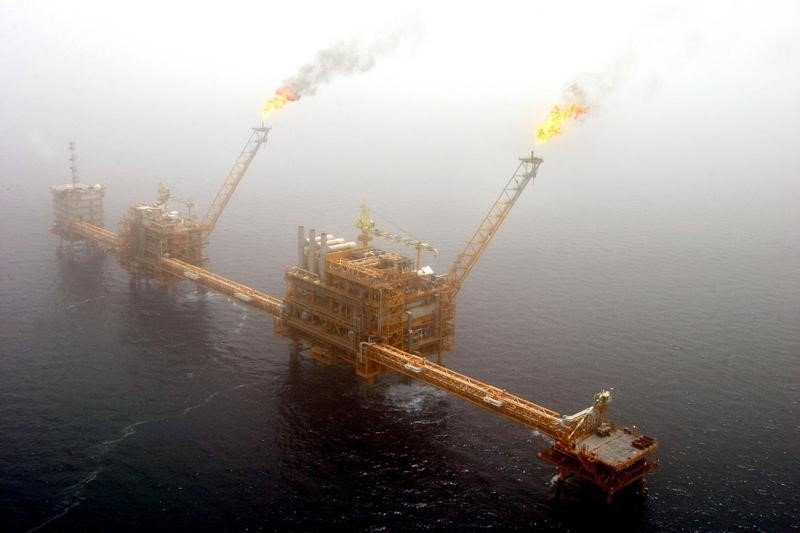
Investing.com — Oil prices were higher on Wednesday, with global benchmark Brent surging past $110 a barrel after an attack to the largest natural gas field in the world shared by Iran and Qatar.
Market participants also digested a Federal Reserve that expressed great uncertainty over how surging oil prices due to the Middle East conflict would affect inflation and the U.S. economy.
At 16:49 ET (20:49 GMT), advanced 7.5% to $111.16 a barrel, while climbed 3.8% to $99.17 a barrel.
Track oil prices with InvestingPro – now 55% off
Qatar condemns attack on Iran’s South Pars field
Iran’s semi-official Tasnim News Agency on Wednesday said the Islamic Revolutionary Guard Corps (IRGC) had listed oil and gas targets in Saudi Arabia, the United Arab Emirates, and Qatar and had warned citizens to keep clear of those locations.
The IRGC’s move came after media reports said facilities in Iran’s South Pars field – the largest natural gas field in the world – had been targeted by the Israeli Air Force. Qatar condemned the attack.
“The Israeli targeting of facilities linked to Iran’s South Pars field, an extension of Qatar’s North Field, is a dangerous & irresponsible step amid the current military escalation in the region,” Qatar’s Ministry of Foreign Affairs said.
“We reiterate, as we have repeatedly emphasized, the necessity of avoiding the targeting of vital facilities,” the Ministry added.
Oil prices surged to session highs after the South Pars news, but then pared gains later after a report that Iran’s foreign minister Seyed Abbas Araghchi had spoken with the European Union’s Foreign Affairs chief Kaja Kallas.
U.S. temporarily waives Jones Act
The attack on the South Pars field comes at a time when the critical Strait of Hormuz, which accounts for roughly a fifth of the world’s oil flows, remains effectively shuttered by Tehran.
Earlier in the day, Iraqi and Kurdish authorities agreed to resume oil exports through Turkey’s Ceyhan port, offering some relief to markets. But the Middle East conflict showed few signs of easing, and the ongoing closure of the Strait of Hormuz continued to boost oil prices.
The spike in oil and gas prices due to the conflict has already hit U.S. consumers. Prices at the gasoline-pump have hit their highest levels since October 2023. Along with being a major factor for American voters in November’s midterm elections, such an increase will also likely play into overall inflation.
Trump on Wednesday issued a decision to waive the Jones Act for 60 days in order to offset disruptions to the oil market. The Jones Act is a more than century-old legislation governing domestic shipping.
“This action will allow vital resources like oil, natural gas, fertilizer, and coal to flow freely to U.S. ports for sixty days, and the Administration remains committed to continuing to strengthen our critical supply chains,” White House Press Secretary Karoline Leavitt said.
Fed says ’we just don’t know’ on oil shock effects
“The implications of events in the Middle East for the U.S. economy are uncertain. In the near term, higher energy prices will push up overall inflation, but it is too soon to know the scope and duration of the potential effects on the economy,” Fed Chair Jerome Powell told reporters on Wednesday.
Powell’s comments came after the Federal Open Market Committee (FOMC) earlier held its key policy rate steady as widely expected. Separately, the FOMC’s updated Summary of Economic Projections (SEP), or dot plot, showed a higher forecast for core PCE inflation this year, reflecting spiking oil prices and low progress on tariffs. The Fed maintained its projection for one rate cut this year and one next year.
Powell said that policymakers “will have to wait and see what happens” in the Middle East and see how “long the current situation lasts.”
“I wouldn’t speculate in any way,” the Fed chief added.
Ambar Warrick and Scott Kanowsky contributed to this article