
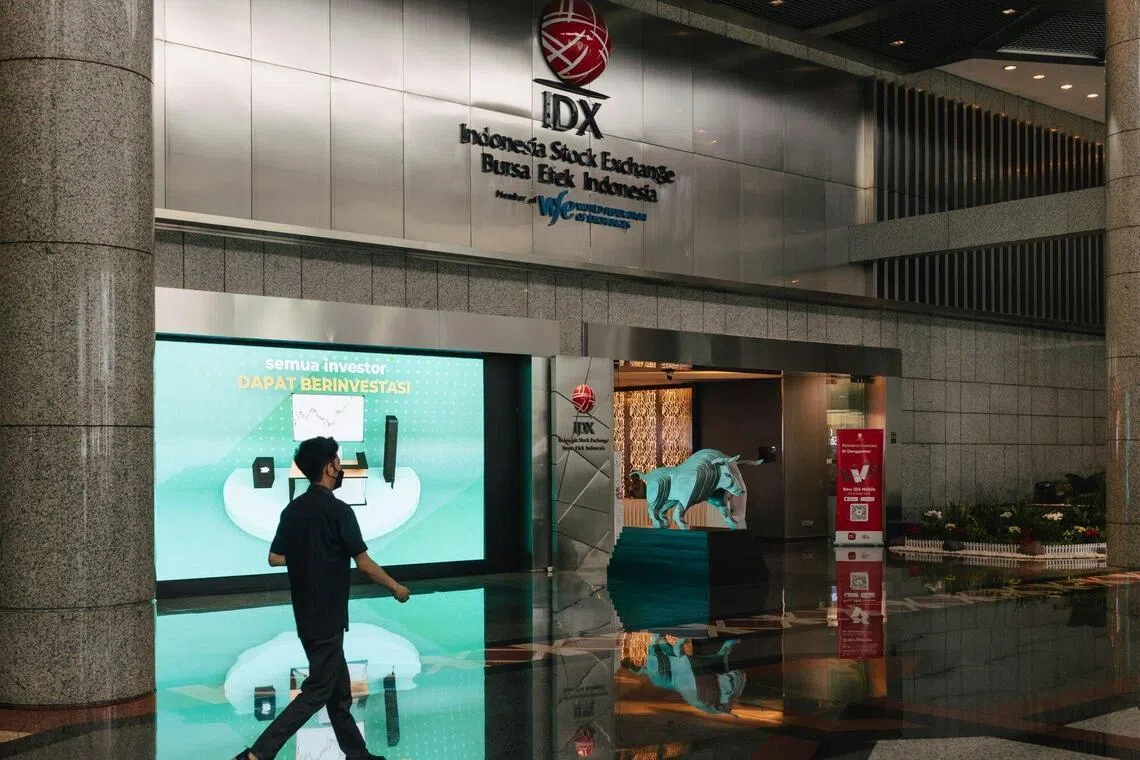
JAKARTA – Indonesia’s stock market is drawing global brokerages eager to tap a fast-growing army of young retail investors. But this rapid expansion is also exposing manipulation and transparency gaps, prompting regulators to launch an aggressive clean-up of South-east Asia’s largest equity market.
Among the prominent foreign names that are making, or have made, moves to expand their footprint to Indonesia’s capital markets over the last two years are major US online brokerage Robinhood Markets, South Korea’s Hanwha Investment & Securities and Singapore-headquartered Doo Financial.
This comes as the number of retail investors in Indonesia jumped from just 3.9 million in 2020 over the past five years to more than 20 million currently. Indonesia has the largest number of such investors in ASEAN, with over half of them under 30.
For global brokerages, the benefits to be reaped from rapid investor growth far outweigh having to navigate a stock market that has witnessed occasional price manipulation and is now undergoing intense regulatory turbulence.
Indonesia’s stock market is currently in the midst of a sweeping overhaul following a US$80 billion (S$102 billion) market rout in late January 2026.
This crisis was triggered by MSCI, which flagged severe transparency issues, including opaque ownership and “coordinated trading behaviour”. The global investment research firm had raised concerns about the investability of Indonesian stocks and warned of a potential downgrade of the country to “frontier market” status. Financial markets were assuaged only after the authorities pledged its commitment to reforms.
Robinhood is now awaiting the green light to commence operations in Indonesia, which would be the firm’s first market for brokerage services in South-east Asia.
In December 2025, the US financial services firm announced it would acquire Jakarta-based stockbroker Buana Capital and local crypto trader Pedagang Aset Kripto in efforts to expand into the world’s largest archipelago.
“We remain enthusiastic about our planned investments in Indonesia,” a spokesperson for Robinhood told The Straits Times on March 2.
These acquisitions are expected to close in the first half of 2026, pending approval from Indonesia’s Financial Services Authority (OJK).
“Indonesia represents a fast-growing market for trading, with more than 19 million capital market investors and 17 million crypto investors,” the spokesperson said, referring to Indonesia’s investor numbers as at late 2025.
Robinhood’s initial plan after acquiring Buana Capital is to continue providing local Indonesian financial products to existing customers. In time, it plans to launch an app to offer Indonesian users access to US equities, global cryptocurrencies and other international instruments. A full roll-out of its local stock and crypto trading app is targeted for early 2027.
Robinhood, which has established a presence in Singapore’s crypto sector, also told ST that it is pursuing a brokerage licence in the Republic and remains “excited” about expanding into the city-state, but did not provide further details.
Meanwhile, South Korea’s Hanwha Investment & Securities has been cementing its foothold in Indonesia since finalising its acquisition in October 2024 of an 80 per cent stake in Ciptadana, – which handles stock brokerage and wealth management – from the Lippo Group. This move will allow Hanwha to directly tap Indonesia’s growing financial market.
Ahead of the acquisition, Hanwha had said its aim was to strengthen its coverage in South-east Asia, where the digital economy is growing fast, the Korea Economic Daily reported then. Hanwha’s entry into Indonesia – the region’s largest economy with a population of around 280 million – follows its expansion into Vietnam in 2019.
“Indonesia has the fourth-largest population in the world and we decided to enter the market due to its high growth potential, with an average (investor) age of 30,” The Korea Economic Daily reported on June 15, 2023, quoting Mr Han Doo-hee, then CEO of Hanwha Investment & Securities.
Doo Financial made its initial foray into Indonesia in November 2024 by acquiring a local, licensed broker, eyeing the country’s growing crypto market. Currently, it does not provide access to the Indonesia Stock Exchange or any stock markets elsewhere, but it does offer global market access through derivatives and futures products.
Doo Financial has not responded to ST’s request for comment on its plans in Indonesia.
Still, observers say its recent trajectory suggests some intent to broaden its local services.
For the influx of foreign capital to Indonesia and vigorous retail participation levels to remain sustainable, the market requires a transparent and fair playing field.
In recent weeks, Indonesia’s financial regulatory and supervisory authority has launched an aggressive crackdown to weed out market manipulators who exploit novice investors.
“Our objective is not to pursue personal vendettas against specific individuals, but rather to target deceptive market activities,” OJK chairwoman Friderica Widyasari Dewi told reporters on March 3.
“An example is the manipulative behaviour of a social media influencer who actively encouraged his audience to buy a specific stock, while at some point he was secretly liquidating his own shares in that same company to gain a profit,” she noted.
Ms Friderica was referring to popular social media influencer Belvin Tannadi. In February 2026, the OJK handed the “finfluencer” or financial influencer a 5.35 billion rupiah (S$407,000) fine over stock market manipulation related to breaches committed in 2021 and 2022. Mr Belvin did not respond to ST’s request for comment.
Another notable case involves two individuals and a corporate entity working together to commit stock cornering – a market manipulation strategy where an individual or group acquires enough of a particular stock to control its supply and effectively dictate its market price.
Using 29 securities trading accounts, the syndicate bought and sold shares of listed roofing material maker Impack Pratama Industri to create a false impression of high demand. It aggressively hyped up a volatile and fundamentally weak stock to artificially inflate its trading price – thus benefiting by unloading its holdings at a premium as retail investors rushed in to buy.
For this, the OJK ordered the syndicate to pay a combined 5.7 billion rupiah fine.
The regulatory sweep has also reached institutional players. On March 4, OJK and the police raided the Jakarta office of local investment bank Mirae Asset Sekuritas Indonesia.
The bank was under investigation for alleged share price manipulation and insider trading related to the initial public offering of building material manufacturer Berkah Beton Sadaya – seven companies were implicated in stock cornering from 2020 to 2022, Mr Daniel Bolly Hyronimus Tifaona, an executive director of investigation at OJK, told reporters on March 4.
“The case involved purchases of shares based on insider information and share price manipulation,” Mr Daniel said.
Some market observers say the recent enforcement actions may be only the first step.
Several large-capitalisation companies have seen their share prices rise by more than 100 – and in some cases more than 1,000 – per cent within a short period. Such anomalies have drawn intense scrutiny not just from analysts, but also from global index providers and institutional investors wary of stock cornering.
Such companies are often linked to wealthy entrepreneurs or prominent business groups, which can complicate investigations, observers say.
“We are seeing that OJK has so far been only targeting the smaller fish, whose cases date back some years ago,” a stock market analyst told ST on condition of anonymity. “There have been more recent cases involving alleged stock cornering by the big fish, but they don’t seem to be given priority.”
Corporate lawyers say such cases are rarely straightforward.
Giovanni Mofsol Muhammad and Cindy Rahmatya Hadianti from Jakarta-based law firm Dentons HPRP noted that sharp share price increases alone do not automatically indicate market manipulation.
Regulators must examine trading patterns, transaction concentration among investors, and whether misleading information was spread to influence prices.
“Only if the price surge can be linked to coordinated transactions or the spread of misleading information can it be categorised as market manipulation or insider trading,” the lawyers said in a written reply to ST.
Such cases can carry criminal penalties including jail terms.
But in practice, enforcement often stops at administrative sanctions such as fines or licence revocations, they added.
For Indonesia, the challenge is ensuring that a fast-growing retail market develops on a foundation of trust.
With millions of new investors entering Indonesia’s stock market, and international brokerages moving in, analysts say stronger enforcement may ultimately prove necessary to sustain the market’s long-term growth.