
Key Points
-
The Dow Jones Industrial Average, S&P 500, and Nasdaq Composite have all soared due to a confluence of factors.
-
President Trump’s nomination of Kevin Warsh comes with an assortment of potential unintended consequences.
-
Additionally, a historic division has taken hold of the Federal Open Market Committee (FOMC) at the tail end of Jerome Powell’s term as Fed chair.
For much of the last 17 years, the stock market has been virtually unstoppable. With the exception of the five-week COVID-19 crash in February-March 2020 and the nine-month bear market in 2022, the Dow Jones Industrial Average (DJINDICES: ^DJI), S&P 500 (SNPINDEX: ^GSPC), and Nasdaq Composite (NASDAQINDEX: ^IXIC) have spent roughly 16 of the last 17 years trekking higher.
Investors have enjoyed no shortage of catalysts, including the rise of artificial intelligence, the advent of quantum computing, record S&P 500 share buybacks, and the Federal Reserve’s rate-easing cycle, which have instilled optimism.
Will AI create the world’s first trillionaire? Our team just released a report on the one little-known company, called an “Indispensable Monopoly” providing the critical technology Nvidia and Intel both need. Continue »
However, in just two months, one of Wall Street’s premier catalysts — the Federal Reserve — has the potential to serve as a tipping point for a historically expensive stock market.

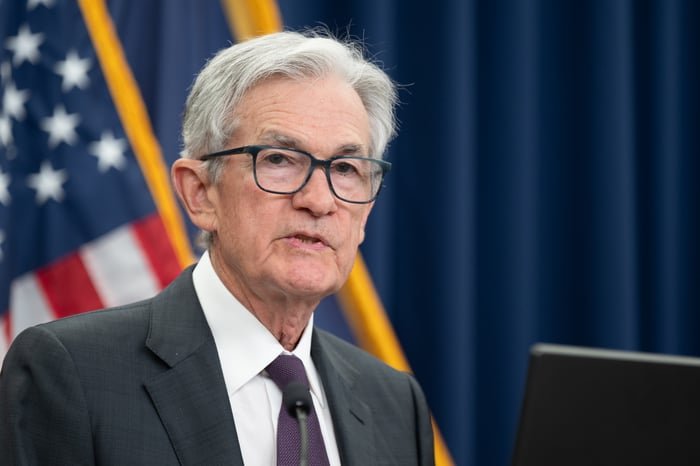
Jerome Powell fielding questions following a Federal Open Market Committee meeting.
Jerome Powell’s term as Fed chair ends on May 15. Image source: Official Federal Reserve Photo.
President Trump’s Fed chair nominee may come with unintended consequences
If there’s one thing investors dislike, it’s change. The more transparent the outlook for stocks and the U.S. economy, the happier investors tend to be.
But change is inevitable — especially at America’s foremost financial institution. Jerome Powell’s term as Fed chair is set to end on May 15. With President Donald Trump vocally critiquing Powell’s monetary policy approach concerning interest rates since his second, non-consecutive term began in January 2025, it was a foregone conclusion that Powell’s latest four-year term as Fed chair would be his last.
On Jan. 30, the president nominated former Fed Governor and voting member of the Federal Open Market Committee (FOMC) Kevin Warsh to succeed Powell. The FOMC is the 12-person body, including the Fed chair, responsible for setting the nation’s monetary policy.
On the surface, Warsh’s tenure as a prior voting member of the FOMC during the financial crisis lends credibility to his nomination. But there are nuances to Warsh’s voting record and his critiques of Fed policy that can lead to unintended consequences for the U.S. economy and/or stock market.
For instance, Kevin Warsh has often been labeled as “hawkish” — and with good reason. A hawk is an individual who favors higher interest rates and typically prioritizes price stability/curbing inflation over lowering unemployment. Before, during, and after the height of the financial crisis, Warsh’s commentary focused on inflationary concerns, even as the unemployment rate soared. This indicates he may not be inclined to aggressively lower interest rates, which is something President Trump has pushed for.
Perhaps more importantly, Warsh has been critical of the Fed’s balance sheet in the wake of the Great Recession. The Fed chair nominee views America’s foremost financial institution as a casual observer and not an active market participant. As a result, he’d like to see the nation’s central bank meaningfully reduce its $6.6 trillion balance sheet, comprised primarily of U.S. Treasury bonds and mortgage-backed securities (MBS).
Herein lies the problem: Bond prices and yields are inversely related. If there’s a meaningful deleveraging of the Fed’s balance sheet, it would be expected to drive down prices and pump up yields, thereby increasing long-term borrowing costs and mortgage rates. In other words, Warsh’s actions could stymie the economy and stock market.

The facade of a Federal Reserve building.
Image source: Getty Images.
Warsh may exacerbate a historic level of division within the FOMC
However, the previous voting record and vocal critiques of President Trump’s Fed chair nominee aren’t the only catalysts that can upend Wall Street. The double whammy for the stock market relates to the historic level of division within the FOMC that Warsh would inherit, assuming he earns the requisite votes from the Senate Banking Committee and U.S. Senate to succeed Powell.
Although the Federal Reserve has two straightforward goals — maximize employment and stabilize prices — there’s no one-size-fits-all blueprint for achieving them. The 12 voting members of the FOMC rely on extensive economic data to guide their policy decisions.
Since this data is backward-looking, FOMC decisions are often perceived as reactive rather than proactive. In short, policymakers are typically behind the curve when adjusting the federal funds target rate (the overnight lending rate between financial institutions) or when conducting open-market operations.
Wall Street and investors willingly give the FOMC ample leeway, as long as one condition is met: unanimity. If all 12 members vote in unison, investors tend to be happy. Maintaining consensus is paramount to the Fed’s credibility in the eyes of investors.

Target Federal Funds Rate Upper Limit Chart
Target Federal Funds Rate Upper Limit data by YCharts.
But in each of the last five FOMC meetings, dating back to the midpoint of 2025, there’s been at least one dissent. Moreover, the October and December FOMC meetings featured dissents in opposite directions — i.e., at least one member favored no rate cut, while another pushed for a more aggressive 50-basis-point reduction in the federal funds target rate.
To put into perspective how incredibly rare opposite dissents are, there have only been three documented opposite dissents since 1990, two of which have occurred since late October. It’s a dubious bit of history for a storied financial institution that’s often viewed as the bedrock of Wall Street.
Given Warsh’s track record, it’s not clear that his appointment would end this historic level of division within the FOMC. But if consensus isn’t reached soon, Fed credibility could be damaged, which would almost certainly be bad news for the aforementioned historically pricey stock market.
Should you buy stock in S&P 500 Index right now?
Before you buy stock in S&P 500 Index, consider this:
The Motley Fool Stock Advisor analyst team just identified what they believe are the 10 best stocks for investors to buy now… and S&P 500 Index wasn’t one of them. The 10 stocks that made the cut could produce monster returns in the coming years.
Consider when Netflix made this list on December 17, 2004… if you invested $1,000 at the time of our recommendation, you’d have $534,817!* Or when Nvidia made this list on April 15, 2005… if you invested $1,000 at the time of our recommendation, you’d have $1,123,912!*
Now, it’s worth noting Stock Advisor’s total average return is 964% — a market-crushing outperformance compared to 192% for the S&P 500. Don’t miss the latest top 10 list, available with Stock Advisor, and join an investing community built by individual investors for individual investors.
*Stock Advisor returns as of March 7, 2026.
Sean Williams has no position in any of the stocks mentioned. The Motley Fool has no position in any of the stocks mentioned. The Motley Fool has a disclosure policy.