

At Bitcoin Conference 2026, BrainSprout enters the art gallery as a cultural participant. Founded by Bruce Barone and his son, BrainSprout focuses on cultivating creative literacy and narrative intelligence in younger generations — a mission that intersects in unexpected ways with Bitcoin’s emphasis on sovereignty, responsibility, and long-term thinking.
In an era when algorithmic feeds shape what young people see, believe, and value, BrainSprout’s work poses a question that resonates deeply within Bitcoin culture: How do you teach someone to think for themselves? This conversation explores creativity, symbolic language, youth education, and why the Bitcoin Conference art gallery — a space already dedicated to the intersection of value, narrative, and visual culture — provides fertile ground for BrainSprout’s vision of intellectual development.
Creative literacy has become something of a buzzword in education circles, but BrainSprout seems to be operating with a more specific definition. What is BrainSprout at its core, and what does it mean to cultivate “creative confidence” in a generation that has more access to information than any before it—and arguably less capacity to interpret it?
Bruce: BrainSprout is about cultivating creative confidence and critical thinking in young people. We focus on helping students engage with big ideas—narrative, symbolism, ethics, technology—through art and storytelling. It’s less about prescribing belief systems and more about helping people develop intellectual resilience and imagination.
The Bitcoin Conference art gallery has hosted artists exploring how memes and digital culture accumulate symbolic meaning at internet speed, writers and historians situating Bitcoin within broader cultural and intellectual traditions, and everything in between. It’s a space where ideas about value, time, and meaning collide in public. What made this particular venue interesting for BrainSprout to show up?
Bruce: Bitcoin is more than a financial protocol—it’s a cultural moment. It represents self-custody, responsibility, long-term thinking in the face of an immediate, fast-food information culture. Those are ideas we care deeply about in education. The art gallery in particular felt like a space where symbolic thinking and value intersect publicly. You’re not pitching people on a product. You’re inviting them into a conversation about what matters.
In the digital age, icons, symbols, and cultural references accumulate meaning almost instantly — a kind of visual literacy happening organically online, but without anyone teaching the underlying mechanics. Education hasn’t caught up to this faster-paced media consumption. Artists like Nardo, who has exhibited at multiple Bitcoin Conference galleries, make work that engages adult audiences already fluent in that symbolic language. How does BrainSprout think about decoding imagery as a learned ability, and how does that approach differ for younger audiences who don’t yet have that context?
Bruce: We’re living in an era where symbols move at internet speed. Memes, icons, cultural references—they accumulate meaning almost instantly. But education hasn’t caught up. Most curricula still treat visual literacy as optional, an elective rather than a core skill. We try to slow that process down and teach people how to decode imagery, how to understand the structures beneath the surface. For young people especially, the challenge is different than it is for adults. Adults consuming Nardo’s work can appreciate the irony of a hand-painted meme. A twelve-year-old needs to first understand why something is funny, or persuasive, or manipulative—before they can begin to create on those terms themselves.
Bitcoin culture often talks about sovereignty—self-custody of your keys, verification over trust, personal responsibility for your financial future. But sovereignty isn’t just a financial concept. Alternative education models are gaining traction, from Austin’s Alpha School to the broader homeschooling movement, all rooted in a similar instinct: the idea that individuals and families should have more control over how knowledge is transmitted. Do you see a parallel between financial sovereignty and creative sovereignty?
Bruce: Absolutely. Creative literacy is a form of sovereignty. When you can interpret narratives, construct your own frameworks, and think independently, you’re less vulnerable to manipulation. That applies financially and culturally. There’s a reason library checkout data used to be monitored—what people read, what they choose to learn, is a form of power. We’re trying to give young people the tools to be literate not just in text, but in image, narrative, and financial systems. Those literacies reinforce each other.
The questions BrainSprout seems to be pointing to in its content — meaning, purpose, truth, how to live well — are the same questions that religious traditions, philosophy, and literature have grappled with for millennia. How do you navigate that territory, and how do you think about BrainSprout’s relationship to those traditions without being confined by any single one?
Bruce: We’re interested in the universal human questions—meaning, purpose, responsibility, truth. Those questions have been explored through religious traditions, philosophy, literature, and art for thousands of years. We draw from that broad heritage, but our focus is on cultivating thoughtful, grounded individuals who can navigate complexity—and also dream big. We’re not prescribing answers. We’re trying to build the kind of person who can sit with hard questions and not collapse into the first easy narrative that comes along.
Art historian and Bitcoin Magazine contributor Steven Reiss has argued that Bitcoin is the cultural consequence of ideas rehearsed for over a century — from Dada’s attack on institutional authority to the cypherpunks’ insistence on building systems beyond centralized control. There’s a through-line about resisting what you might call corporate flattening — algorithmic systems optimizing everything for speed and engagement at the expense of depth. Young people today are fully immersed in those systems. What role does creativity play in that environment?
Bruce: Creativity is a stabilizing force. When everything around you is optimized for speed and engagement, deep thinking becomes rare—and valuable. We’re trying to give students tools to step back, analyze the systems they’re embedded in, and build their own structures of meaning rather than passively consuming someone else’s. That’s not anti-technology. It’s about having the intellectual foundation to use technology intentionally rather than being used by it.
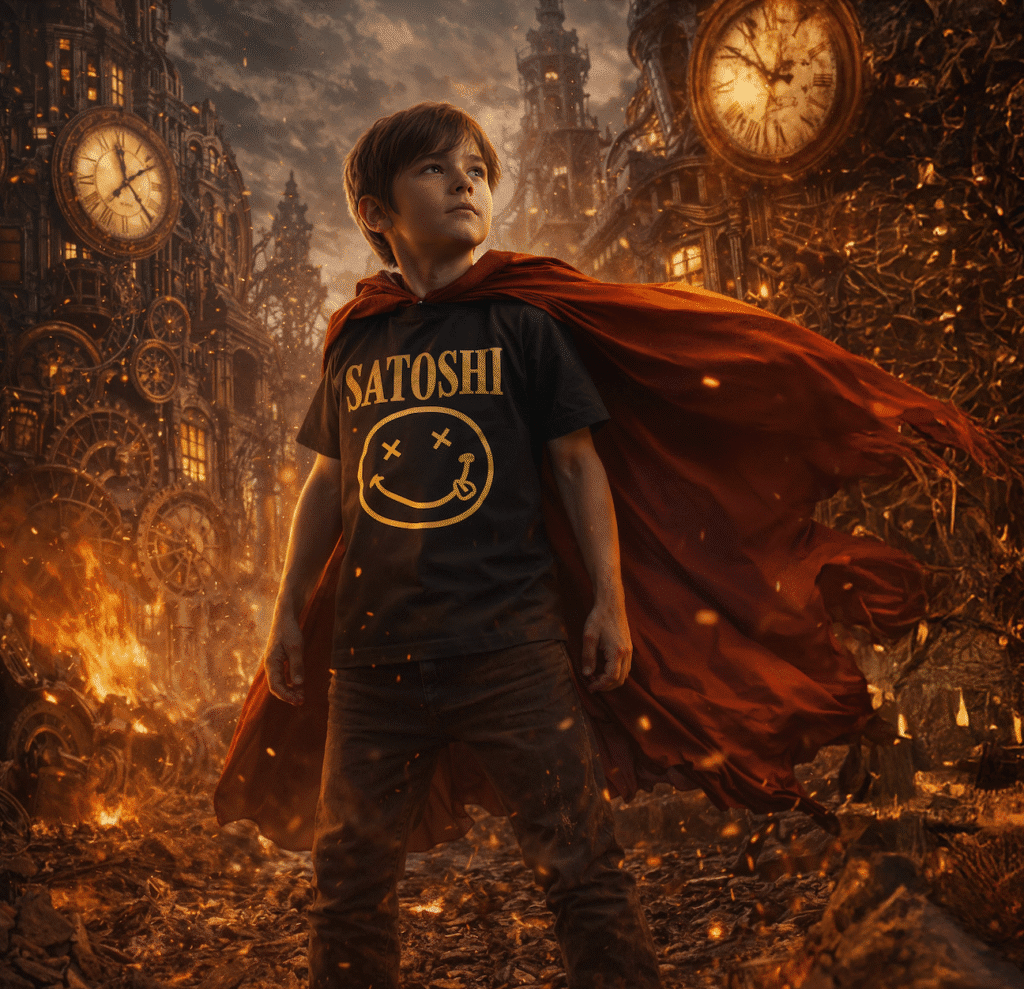
Much of BrainSprout’s visual content is produced by Bruce’s son Brucie Jr., who uses AI-assisted tools to build the imagery that accompanies the project’s educational mission — a detail that quietly underscores the whole premise. The next generation isn’t waiting to be taught how to create. They’re already building. Explore more of BrainSprout’s work at brainsproutkids.com and on their YouTube channel.