
Bitcoin has shed nearly a quarter of its value over the past four weeks – its worst monthly performance since June 2022.
The world’s largest cryptocurrency has fallen 5.5 per cent in the past five days, 22 per cent over the month, and is now down 7.5 per cent for the year, currently trading at A$135,424.
The steep slide comes just weeks after Bitcoin hit an all-time high of A$190,538 as money surged into Bitcoin exchange-traded funds (ETFs).
But sentiment flipped rapidly when US President Donald Trump threatened to impose an additional 100 per cent tariff on Chinese imports, a move that triggered the largest cryptocurrency sell-off in history.
Deutsche Bank said Bitcoin’s slump is being driven by a combination of global and crypto-specific pressures.
Analysts pointed to a broader ‘risk-off’ shift in markets, the US Federal Reserve‘s more hawkish stance on interest rates, and delays to the CLARITY Act, legislation designed to give the crypto industry greater regulatory certainty.
At the same time, major institutional investors have slowed their buying, while many long-term Bitcoin holders have begun selling to lock in profits after last month’s record highs.

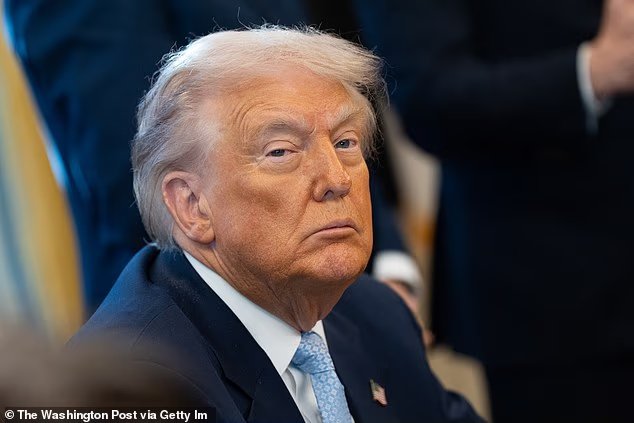
Bitcoin sentiment soured after US President Donald Trump (pictured) threatened to a 100 per cent tariff on Chinese imports, triggering the largest liquidation event in crypto history

BTC Markets crypto analyst Rachael Lucas (pictured) said November was the ‘worst monthly vibe’ for Bitcoin since 2022 with $1trillion wiped from its value
Together, these forces have created sustained downward pressure on the price, the bank warns.
‘Whether Bitcoin stabilises after this correction remains uncertain,’ the bank’s analysts wrote.
‘Unlike prior crashes, driven primarily by retail speculation, this year’s downturn has occurred amid substantial institutional participation, policy developments, and global macro trends.
‘Further uncertainty around the Fed’s interest rate trajectory may continue to spur further declines in Bitcoin’s performance.’
Compare the Market economic director David ‘Kochie’ Koch said the latest turmoil shows Bitcoin is far more tied to the broader economy than many previously believed, and that he would never invest in it.
‘Cryptocurrencies are unregulated, unpredictable, and many of the big players are unaccountable,’ he said.
‘Proponents once lauded crypto as a decentralised currency immune to the influence of governments and banks. As the current crash shows, that’s clearly not the case.’
Independent economist and Bitcoin critic Saul Eslake told the ABC that because the cryptocurrency doesn’t return income, pay interest or dividends, it has no intrinsic value.

Economist Saul Eslake (pictured) says because the crytocurrency doesn’t return income, pay interest or dividends it has no intrinsic value

Deutsche Bank said investor belief is crucial for continued gains with Bitcoin and right now the faithful are wavering
‘If you don’t believe it’s going to keep going up, why hold it,’ he said.
‘I suspect that what’s behind it is a growing perception on the part of people who’ve previously bought Bitcoin that it has run way ahead of any plausible interpretation of its potential value.
‘There’ve been ebbs and flows into and out of bitcoin-related and crypto-related ETFs over the course of this year, but it would now seem that those outflows are increasing in size and that’s why the price has fallen so much over the last few weeks.’
But BTC Markets crypto analyst and Bitcoin enthusiast Rachael Lucas said that historically, when Bitcoin sinks to multi-month lows like this, it is often followed by a recovery.
‘When Bitcoin gets this low the next chapters have often included choppy basing, then recovery, not always immediately, and not in a straight line,’ she said.
‘History says big flushes set the stage for the next leg if demand comes back.’
Ms Lucas said one reason people like Bitcoin is because its supply is fixed, there will only ever be 21 million of them.
Almost all of that supply has already been created, with about 95 per cent of all Bitcoin now in circulation.
Every four years, the amount of new Bitcoin that miners can create is cut in half, which slows down how quickly new coins enter the market.
Because of this, the final tiny fraction of Bitcoin won’t be mined until around 2140.
‘So supply is steady, but price? That’s driven by demand, and demand is anything but steady,’ she said.