

On Friday, September 5th, the market soared to all-time highs based on a . But my question has always been: Why does the market usually make such profound moves based on their knee-jerk reaction to a bogus (or at least premature) job count?
Fed Chair Powell always chimes in with his mantra that the are “data dependent,” but what if that data is nearly worthless – even according to the government’s own job-counting agency?
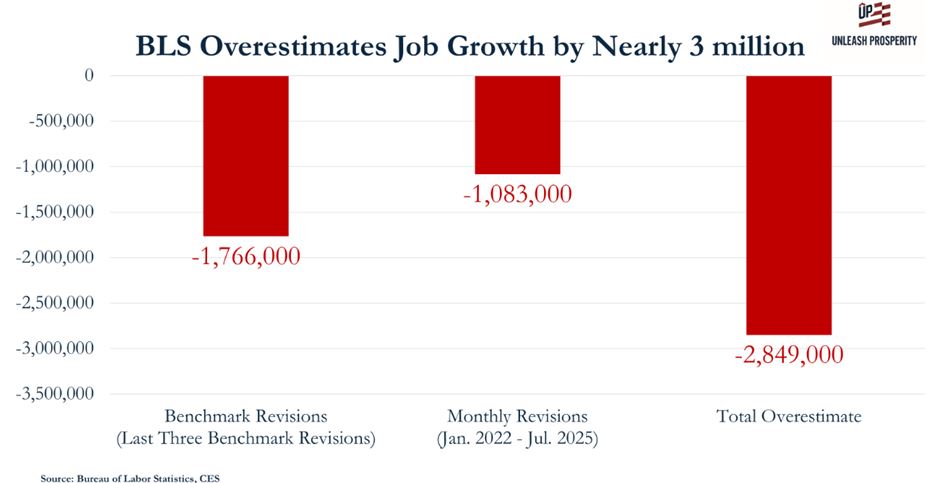
On Tuesday, September 9, the Bureau of Labor Statistics (BLS) published the result of its latest annual audit of their reported job totals each month, and the 12-month miss was staggering this time. It turns out that there were 911,000 fewer jobs created than reported for the year April 2024 to March 2025 (which is composed of 80% Biden’s watch and 20% Trump’s). The original estimates averaged +146,000 per month, and the audited totals are over 50% lower, at 70,000 per month, or 76,000 fewer jobs per month.
Tallying their longer-term inaccuracy, since 2022, we find nearly three million bogus jobs counted, nearly all in the Biden years. Combining its last three annual benchmark audits with monthly misses, the BLS counted 2.85 million non-existent jobs since January 2022, mostly in the reputedly booming Biden era.
Why such monstrous misses? The main culprit is the low rate of responses to the BLS’ monthly survey. Out of 33 million U.S. businesses – large and small – the BLS contacts an average of 650,000 businesses per month (a 2% sample), but their response rate is now down to just 43%, since only 280,000 of the 650,000 businesses respond. That’s a self-selected response rate from under 1% of all U.S. businesses. And, when they get no response, the BLS says they “intuit” an answer. That sounds more like a séance than science.
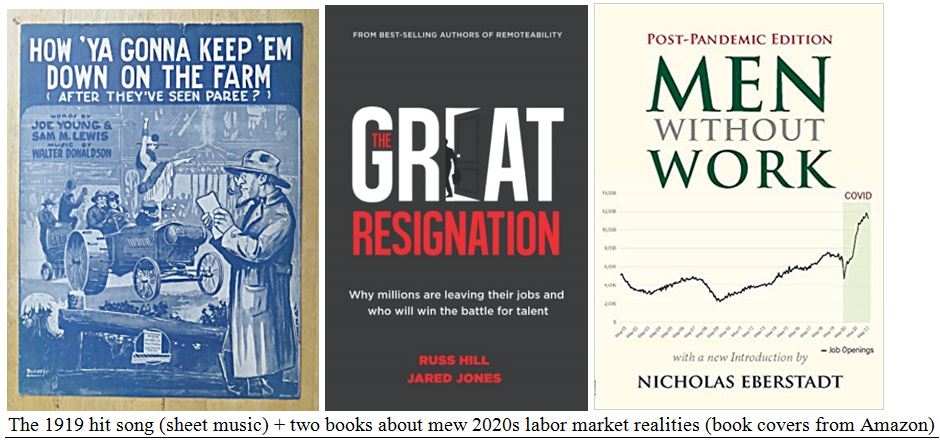
We also need to question the veracity and value of the business survey, when it’s so hard to define a “job” in this era of the gig economy, off-the-books moonlighting, plus a young male labor strike out on strike.
Even before COVID, we saw a new relationship between work and life in America. More workers were “playing the system,” opting for early retirement at generous pension levels through government or union contracts, or gaming the disability system. With far safer workplaces than the coal-mining era of 70 years (and 16 tons) ago, far more workers discovered bad backs or designer diseases that kept them out of work (while quadriplegic Charles Krauthammer was able to finish medical school and work at the top level of several careers without use of 90% of his body below his chest. I guess some people are wired to work.)
Since 2020, many have worked from home, at first by force of law, then by choice. Homework cuts down on myriad costs – commuting time and gasoline, wardrobe costs, childcare expense, office rent and more – and it could be the “green” solution many ecologists yearn for – without the mandate of electric cars.
Some employers are now demanding workers return to the office, but many either resist the draft, or quit, as the 1919 song lamented: “How’ya gonna keep ‘em down on the farm, after they’ve seen Paree?”
From the 1850s to the 1950s, men aged 25 to 54 felt they had to work, so about 87% of prime working-age men were either at work or looking for work (that is, in the Labor Force). That number is now 67%.
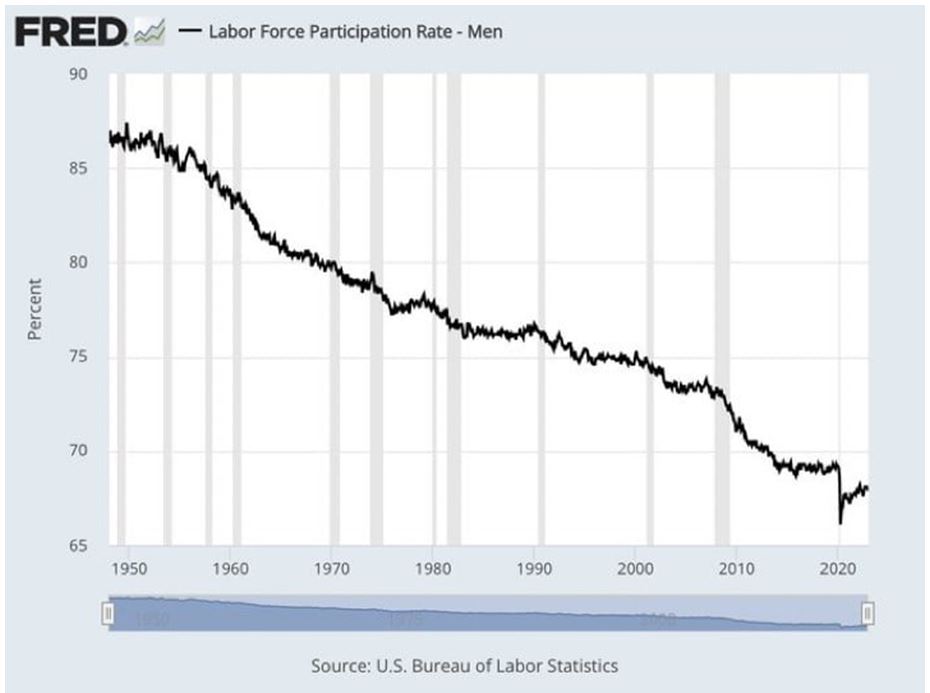
Before the pandemic, the three major reasons for lower male labor rates were: (1) skyrocketing disability claims and drug addiction; (2) lower incentives for work and higher rewards for not working; and (3) viable off-the-grid options. In a 2017 paper (“Where Have All the Workers Gone? An inquiry Into the Decline of the U.S. Labor Force Participation Rate”), Princeton economist Alan Krueger found that nearly half of all prime working age males not in the labor force (PWAM-NILFs) “take pain medication on a daily basis, and in nearly two-thirds of these cases they take prescription pain medication.” With limited immigrant labor now, America’s men need to put their big-boy pants on and get back to work.
The “Roaring-20s” Began Near This Date – In 1920, 2020… and 1620
The Roaring-20s was the nickname for the market surge and technological gains of the 1920s, including the mass marketing of automobiles, radio, aircraft technology and communications. But that decade began with a dismal depression, a 47% crash in the Dow, a “Red Scare,” a crippling influenza plague and that big bomb on September 16, 1920, on Wall Street, killing 38 and injuring hundreds.
The Dow fell 45% from 119.62 on November 13, 1919, to 66.75 on December 21, 1920, before reviving:

Source: Stock Trader’s Almanac
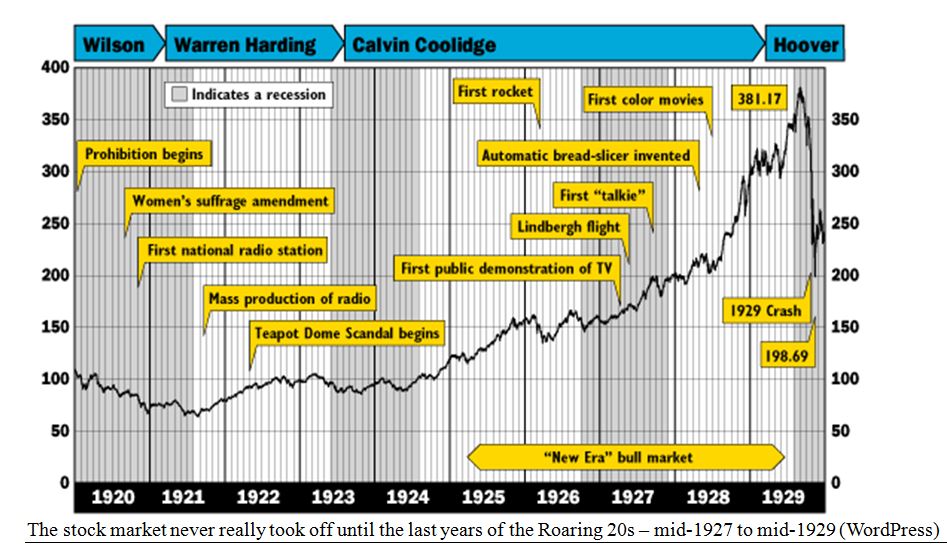
Could we see the same kinds of market gains in the late 2020s that we saw in the late 1920s? Well, the same sort of scary shock launched the current not-yet-roaring ‘20s, with a deadly COVID epidemic and enforced national lockdown. However, the market and economy recovered rapidly in both the 1920s and 2020s. In September 2020, the Dow returned to 29,000, its pre-COVID panic high level, and the economy also soared back in the second half of 2020, due in large part to an avalanche of federal relief checks.
Looking back, we’ve seen other dramatic events at the start of previous Roaring 20s, like:
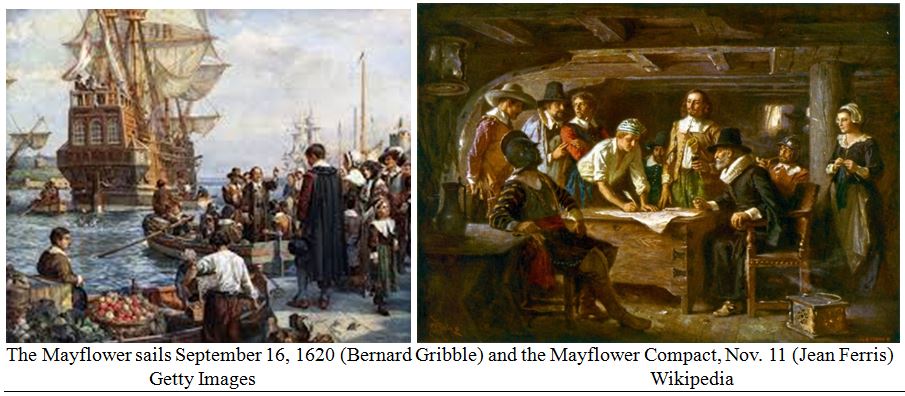
On September 16, 1620, a determined band of 35 religious dissenters, plus 67 non-Puritan separatists and a crew of 25, set sail from Plymouth, England, in the Mayflower. After 57 days at sea, 41 family heads met off Cape Cod and drafted the Mayflower Compact, which established a democratic Bay colony to operate under “just and equal laws.” Then, after nearly starving that winter, they instituted a Thanksgiving banquet in late 1621. They weren’t “corn sufficient” until 1625, but the Puritans soon arrived in 1630.
The Roaring 1920s gave us new technologies: Radios grew from a high-technology hobby to a common family companion. The same with cars, starting with hundreds of brands and ending with the Big 3. Silent movies flourished, and then they began to talk. Jazz music was born, and the glorious Frigidaire replaced the icebox.
What’s next? Will future historians tell us that “AI” launched the roaring 2020s of 2024 to 2029? Maybe.