

Growth in the US is ebbing, and it is likely only the AI boom that is keeping us from recording a small recession. is still rising, although slowly, and credit delinquencies are rising. Because the services sector and the goods sector are still asynchronous – a holdover from the COVID period – we haven’t seen an aggregate contraction, but it will happen eventually. That doesn’t concern me.
Recessions happen. It is only worrisome because equity markets are so ‘fully valued’ that an adjustment to a recession could be rough. On the other hand, all signs point to the Federal Reserve starting to ease, and this may support stocks. I would go so far as to say that investors are counting on that.
That is a rather ordinary problem. The bigger problem has not yet been realized by equity markets, but as we look at long maturities on the yield curve we see that yields are near the highs of the year even with the Fed expected to ease. That is not normal. When the eases the curve tends to steepen, because however long the period of lower short rates, it will be a larger proportion of a shorter-maturity instrument. But long rates still decline in that case, normally.
You can insert your favorite story here, about how foreign investors hate Trump, or people are worried about inflation, or the credit profile of the United States. My preferred explanation (see “The Twin Deficits – One Out of Two IS Bad”) is that if you reduce the trade deficit sharply but do not reduce the budget deficit equally sharply, then the balance must be made up by domestic savers and that implies a higher rate of interest.
There’s also some reason to be wary of the turn higher in , even though that was entirely foreseen (see “Ep. 145: Beware the Coming Inflation Bounce”) and a good part due to base effects. There are, though, some signs of underlying secular rather than cyclical pressures on prices.
For example, thanks partly to AI electricity prices started accelerating higher in 2021 but unlike other parts of the CPI have continued to rise. The for Electricity stands 35% above the level of year-end 2020, and well beyond the long-term trend. Beef prices are 41% higher and still rising.
Of course, there are always prices that are rising but there are two reasons I am more concerned about this now. The first is that the money supply has returned to a positive and rising growth rate and is at a level inconsistent with long-term price stability even before the Fed renews its easing campaign.
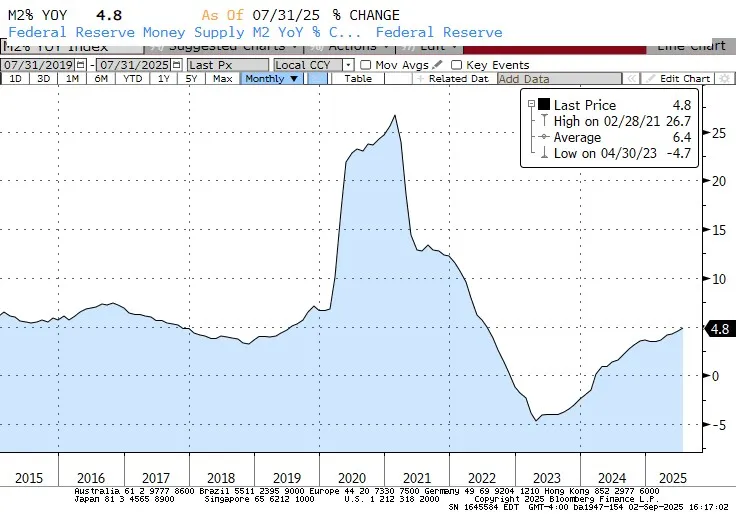
Five percent was once a nice level for M2 growth, when demographics and globalization were following winds. Now they are headwinds and we need to be lower. Still, I wouldn’t get panicky about 5%. Get to 8% and I’ll be more concerned. But the reason that might happen concerns changes happening at the central bank.
What gets the headlines is the continual pressure that the Trump Administration is putting on Fed Chairman Powell and others on the Federal Reserve Board, several of whom are jockeying to be dovish enough to be selected as the next Fed Chair. But the much more important development was the 5-year review of the Fed’s operating framework, which Powell discussed at his Jackson Hole speech.
The significance of this was seeming lost on most investors, although breakevens have gradually risen and are up at 2.42%, and other than in the post-COVID surge they’ve not been much higher than that since 2012 or so.
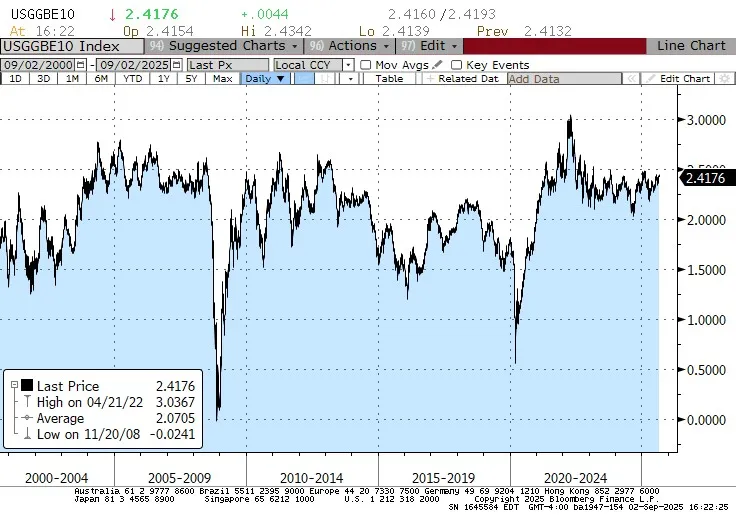
These are 10-year breakevens, so this isn’t a tariff effect. What’s going on here? Not much, yet, but…there is the change in the Fed’s framework, which I think is important.
Five years ago, the Fed abandoned a specific inflation target in favor of “Flexible Average Inflation Targeting”, or FAIT, which basically said “we are targeting 2% inflation, but only over time. So when inflation is too low for a while, then it’s okay to let it run hot for a while later.”
At the time, this was a clear sign that monetarists – who don’t necessarily believe there is a tradeoff between inflation and growth like the Keynesians do – were losing the battle. More flexibility to respond to inflation ‘tactically’ is not something that we needed, and it wasn’t clear how that would be a helpful change anyway.
But the current 5-year framework adjustment is worse. It basically abandoned the good part of FAIT, which was any kind of soft commitment to be hawkish in the future if necessary. In Powell’s words – and I’m not making this up – “…we returned to a framework of flexible inflation targeting and eliminated the ‘makeup’ strategy.”
Yep, that’s what he said.
There is a lot more in Powell’s explanation, but most of it all leans in the same direction. For all my historical criticism of former Chairman Greenspan, he deserves credit for this: he used to say that achieving low and stable inflation was key to achieving maximum stable employment over time. Thus, inflation was primary, not secondary, in achieving the dual mandate.
Now, the Fed ostensibly wants to target a low level of inflation…because that’s what central banks are supposed to do…but recognizes that sometimes they’ll want to emphasize lower rates to help Employment – and the important part is that as I just noted, they won’t ‘make up’ for running too much liquidity now by running less liquidity later.
Does anyone want to take the other side of the bet that the Fed will have an easier time lowering rates and keeping them low, than raising them and keeping them high? Accordingly, the long-term inflation outlook just got worse. I don’t think we are returning to the 1970s, but we aren’t returning to 2% any time soon – and the Fed is okay with that!
FAIT was never a very good idea, and I didn’t think it would survive the first time inflation ran too high and dictated an extended period of very tight money. It didn’t. I didn’t think they’d actively make it worse, and maybe the joke’s on me. They always make it worse.