

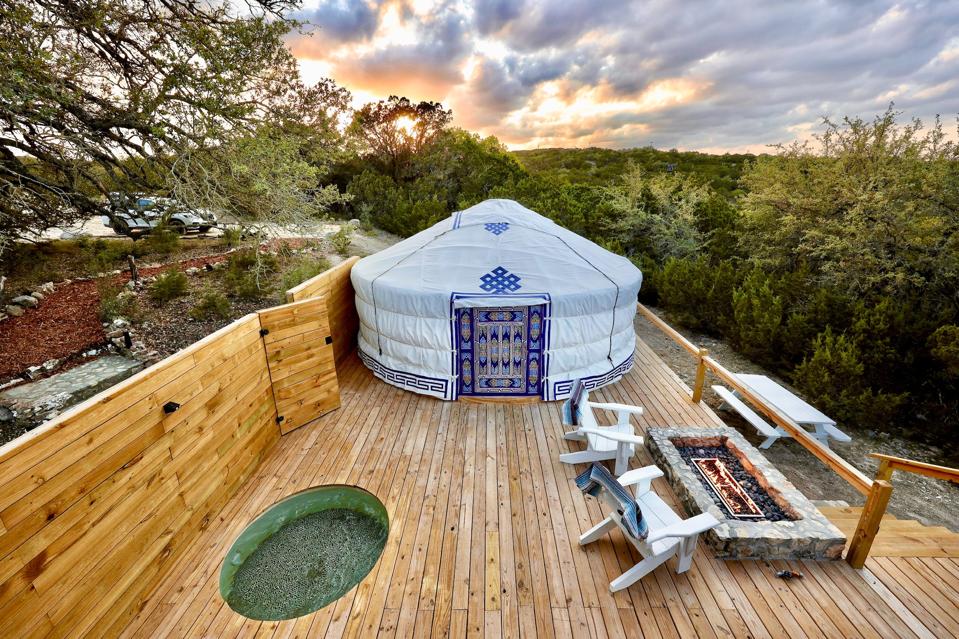
A glamping resort in Dripping Springs, Texas is being raffled for $10 tickets.
Amanda Spencer
When Ann-Tyler and Brian Konradi decided to raffle off their $7 million Yurtopian Hill Resort instead of selling it the traditional way, they weren’t just trying to avoid real estate commissions.
They were tapping into something much deeper about how consumers think about value, accessibility, and trust—similar to how brands are beginning to explore various contest-oriented initiatives, such as Olipop’s 2024 “Dream Job” contest.
The resort, complete with 10 luxury Mongolian yurts and 46 acres in the Texas Hill Country, is being offered through UK-based platform Raffall for $10 tickets. It’s reportedly the first U.S. real estate transaction of its kind, but the marketing psychology behind it extends far beyond property sales.
“After hearing about an Irish woman who raffled off her farmhouse through a platform called Raffall, it struck us as a creative, people-first way to transfer property—opening the door for someone who might never otherwise afford it,” the Konradis explained. “Traditional real estate is efficient, but it rarely sparks dreams. This model adds excitement and accessibility.”
That shift from exclusivity to accessibility represents something retailers have been grappling with for years. How do you make premium experiences feel attainable?
The raffle model transforms a $7 million purchase—out of reach for most consumers—into a $10 dream that anyone can participate in. The same psychology drives everything from limited-edition sneaker drops to subscription boxes filled with luxury samples.
The skepticism was immediate, of course. People don’t typically associate legitimate business transactions with raffle tickets. But the Konradis addressed this head-on with radical transparency about their motivations and mechanics.
“We overcame it by being transparent: showing the property, detailing the process, and partnering with a trusted platform so people know it’s legitimate,” they said. They even disclosed their business structure—explaining that they’ve set minimum ticket sales thresholds that ensure profitability whether the property transfers or not.
Shopify’s Head of Community Grace Clarke sees this transparency trend accelerating across industries. “Consumers increasingly expect to understand not just what they’re buying, but why companies are selling in particular ways,” she said.
The platform selection reveals another shift in consumer confidence. Rather than creating their own raffle system, the Konradis chose the Raffall platform for its track record with similar transactions.
“That international track record gave us credibility from day one and reassured both U.S. and global participants that this is a legitimate and secure opportunity,” they said.
It’s a pattern retail marketers are seeing everywhere: consumers look to third-party validators before trusting new brands or experiences. Amazon’s review system, Apple’s App Store curation, and even TikTok’s algorithm serve similar credibility functions.
The campaign’s content strategy offers another insight into changing consumer attention patterns. Instead of a traditional sales approach, the Konradis are “treating the campaign as a rolling story, rather than a static listing,” releasing new content weekly (such as behind-the-scenes videos, special ticket bundles, and live Q&As) to maintain engagement over months.
“Every week, we release new content to keep it fresh,” the Konradis explained. This approach recognizes how consumer attention works now: not as a single moment of decision, but as sustained engagement over time.
The September 30 winner announcement at the Glamping Show Americas in Colorado adds another layer. “Live events create a ripple effect—you get the in-person energy, the media coverage, and the social sharing all at once,” they noted.
The financial structure, with guaranteed payouts regardless of participation levels, reveals sophisticated risk management thinking from both business and consumer perspectives. Participants accept small losses for potential significant gains, while organizers ensure positive outcomes, no matter how many tickets sell.
“This isn’t just a giveaway—it’s a carefully structured transaction,” the Konradis emphasized. “We set a minimum ticket sales threshold that covers the full value of the property, plus Raffall’s fees.
If the threshold is met, the winner receives the property, and we walk away with the money—perhaps with more than we might have received through a traditional sale.”
It’s a risk distribution model that could inform everything from flash sales to crowdfunded product launches. It shows how brands can design promotions that ensure favorable outcomes while still creating genuine excitement for consumers.
What makes this campaign particularly instructive for retail marketers isn’t just the novelty—it’s how it addresses fundamental shifts in consumer behavior: the desire for accessible luxury, expectations for transparency, comfort with digital platforms, and appetite for alternatives to traditional purchasing models.
As the Konradis put it: “We wanted to define the conversation and set the tone before any competition arises. That’s a rare advantage.” Whether that advantage translates to a successful campaign will be clear on September 30, but the marketing lessons are already worth studying.
The question for retail marketers isn’t whether they should start raffling products, but what these underlying consumer psychology shifts mean for how they design experiences, build trust, and create sustained engagement in increasingly crowded markets.